



Organizations that move quickly rarely rely on vague objectives. Many modern teams now use FAST goals, a goal-setting approach introduced by Donald Sull and Charles Sull in their book Simple Rules: How to Thrive in a Complex World.
What Are FAST Goals?
FAST goals are a goal-setting framework designed to help teams maintain focus, accountability and alignment while executing complex work. The acronym stands for Frequently discussed, Ambitious, Specific and Transparent, meaning goals should be reviewed regularly, stretch team performance, define clear outcomes and remain visible across the organization. The main purpose of a FAST goal is to keep priorities active in day-to-day operations so teams continuously track progress, coordinate work and adjust execution when project conditions change.
Related: 15 Free Goal-Setting and Tracking Templates for Excel and Word
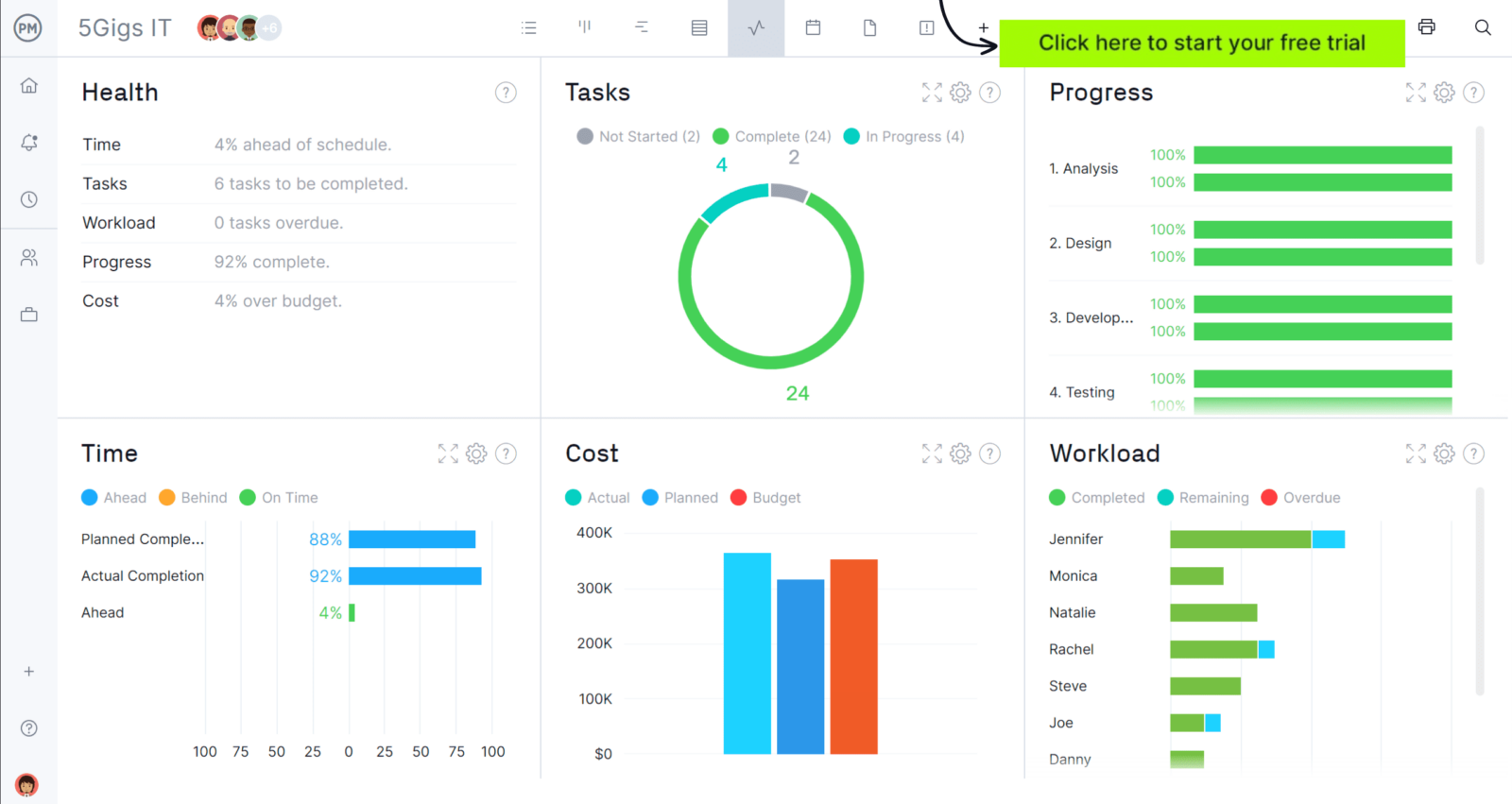
Once goals are defined, teams need tools to plan the work and track progress. ProjectManager is an award-winning project management software that helps turn a big hairy audacious goal into an executable project plan by organizing tasks, building project timelines and monitoring progress in real time. Teams can track milestones, manage resources and visualize progress through dashboards and Gantt charts, ensuring their goals stay aligned with schedules, budgets and priorities. Get started for free today.
Who Should Set FAST Goals?
Modern organizations operate through teams, not isolated individuals. That’s why FAST goals are designed to guide groups that collaborate, track progress and deliver results together. Whether a team manages projects, develops products or executes strategic initiatives, this framework helps maintain alignment, visibility and measurable progress across shared objectives.
- Product development teams: Teams building software, hardware or digital products benefit from FAST goals because frequent progress discussions and transparent metrics help coordinate feature development, sprint planning and product release timelines.
- Project management teams: Groups responsible for planning and executing projects use FAST goals to maintain alignment around project objectives, track milestones and ensure progress stays visible across stakeholders.
- Executive leadership teams: Senior leaders can apply FAST goals to translate strategic priorities into visible, organization-wide objectives that remain ambitious while staying specific enough for teams to execute.
- Operations and process improvement teams: Continuous improvement initiatives rely on measurable performance targets, and FAST goals help operational teams monitor progress while keeping improvement efforts transparent across departments.
- Sales and revenue teams: Sales organizations benefit from ambitious but specific targets that are discussed frequently during pipeline reviews, helping managers track revenue progress and adjust strategy quickly.
- Cross-functional initiative teams: When multiple departments collaborate on large initiatives, FAST goals create shared visibility and accountability, ensuring every team understands the objectives and how their work contributes to overall outcomes.
Get your free
Fast Goals Template
Use this free Fast Goals Template for Word to manage your projects better.
What Are the Benefits of FAST Goals?
When teams treat goals as living priorities instead of static statements, execution becomes far more coordinated. A fast goal helps organizations keep objectives visible, measurable and actively discussed throughout the project lifecycle. By tying goal-setting to regular conversations, clear outcomes and shared transparency, FAST goals strengthen alignment, improve accountability and help teams maintain steady progress toward meaningful results.
- Stronger team alignment: FAST goals create a shared understanding of what success looks like. Because goals are transparent and discussed frequently, every team member understands how their work connects to broader project objectives and organizational priorities.
- Better accountability across teams: Visibility is a core element of FAST goals. When objectives and progress metrics are openly shared, individuals and teams naturally take greater ownership of deliverables, deadlines and performance outcomes.
- Faster decision-making: Regular conversations around FAST goals allow teams to quickly identify obstacles and adjust priorities. Instead of waiting for quarterly reviews, leaders and project managers can make timely decisions that keep initiatives moving forward.
- Clearer performance tracking: Because FAST goals are specific, they define measurable outcomes that teams can monitor over time. This clarity makes it easier to track progress against milestones, project timelines and strategic targets.
- Greater transparency across the organization: A fast goal encourages open visibility of priorities, progress and results. Teams gain a clearer view of how different departments contribute to shared initiatives, reducing silos and improving collaboration.
- More ambitious organizational targets: This goal-setting strategy encourages teams to set ambitious goals that push performance beyond incremental improvements. Stretch objectives can inspire innovation while still remaining grounded in specific and measurable outcomes.
- Continuous progress through regular discussion: Frequent goal discussions keep priorities active in daily work rather than buried in planning documents. As teams revisit FAST goals during meetings and project reviews, they stay focused on execution and long-term strategic outcomes.
How to Write FAST Goals
Turning priorities into consistent action requires more than writing a goal statement. FAST goals work when teams actively manage them throughout the project lifecycle. By keeping project goals visible, measurable and discussed regularly, organizations ensure objectives guide daily work. The framework focuses on four characteristics—frequently discussed, ambitious, specific and transparent—that keep teams aligned and focused on execution.
1. Make Your Goal Frequently Discussed
Within the FAST goals framework, goals should remain part of regular conversations rather than sitting in static planning documents. Teams review progress frequently in meetings, project updates and performance discussions. This consistent dialogue keeps priorities visible, allows managers to identify obstacles early and ensures that everyone remains focused on the outcomes that matter most.
Consider a product development team responsible for launching a new feature. Instead of setting a goal and revisiting it months later, the team reviews the FAST goals during weekly sprint planning and project status meetings. By keeping the objective visible in dashboards and discussions, the team continuously tracks progress and adjusts tasks when development milestones start slipping.
2. Make Your Goal Ambitious
A central idea behind FAST goals is that objectives should challenge teams to stretch their performance. Donald Sull and Charles Sull emphasize setting ambitious goals that push organizations beyond incremental improvement while still remaining achievable. Ambitious goals encourage innovation, motivate teams to pursue meaningful outcomes and help organizations focus effort on strategic initiatives that truly move the business forward.
Imagine the same product development team deciding that releasing a minor update is not enough. Instead, their FAST goals aim to launch a feature capable of reducing customer onboarding time by 40 percent. Because the target is ambitious, engineers, designers and project managers must collaborate closely to redesign workflows and accelerate delivery.
3. Make Your Goal Specific
FAST goals require clear and precise outcomes so teams understand exactly what success looks like. Specificity ensures goals are measurable and actionable rather than vague aspirations. When objectives define concrete metrics, milestones or deliverables, teams can track progress over time and evaluate whether project execution is moving in the right direction.
Returning to the product development example, the team refines its FAST goals by defining a measurable result: reduce customer onboarding time from ten minutes to six minutes before the next product release. With a specific target and a defined timeline, the team can monitor user testing data, measure improvements and adjust development priorities until the outcome is achieved.
4. Make Your Goal Transparent
Transparency is a defining characteristic of FAST goals in the framework introduced by Donald Sull and Charles Sull. Instead of hiding objectives inside department plans or leadership documents, a FAST goal is visible across the organization. When goals and progress metrics are shared openly, teams understand priorities, track results collectively and coordinate work more effectively across multiple projects.
Continuing the earlier example, the product development team publishes its FAST goals and progress metrics in a shared dashboard visible to leadership, marketing, customer success and engineering teams. Everyone can see the target of reducing onboarding time from ten minutes to six minutes and monitor progress as updates are delivered throughout the product development cycle.
FAST Goals Template
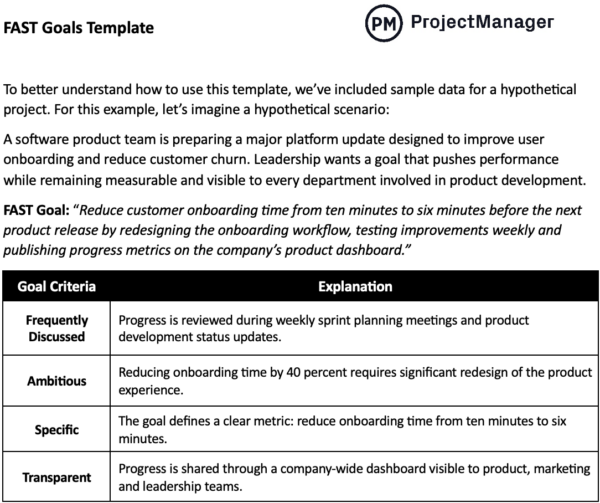
This FAST goals template helps teams evaluate whether an objective follows the FAST framework by organizing goals according to four criteria: frequently discussed, ambitious, specific and transparent. It allows teams to clearly define objectives, explain their purpose and verify that progress can be tracked and shared across the organization. We’ve also created other goal-setting templates you can use to establish personal, project and organizational goals.
3 FAST Goals Examples
Understanding the FAST framework becomes easier when you see how organizations apply it in real scenarios. The following FAST goals examples illustrate how teams can define ambitious objectives, track progress through regular discussions and maintain transparency across departments while executing complex initiatives.
1. FAST Goal Example #1
A software product team is preparing a major platform update designed to improve user onboarding and reduce customer churn. Leadership wants a goal that pushes performance while remaining measurable and visible to every department involved in product development.
Reduce customer onboarding time from ten minutes to six minutes before the next product release by redesigning the onboarding workflow, testing improvements weekly and publishing progress metrics on the company’s product dashboard.
| FAST Criteria | Explanation |
| Frequently Discussed | Progress is reviewed during weekly sprint planning meetings and product development status updates. |
| Ambitious | Reducing onboarding time by 40 percent requires significant redesign of the product experience. |
| Specific | The goal defines a clear metric: reduce onboarding time from ten minutes to six minutes. |
| Transparent | Progress is shared through a company-wide dashboard visible to product, marketing and leadership teams. |
2. FAST Goal Example #2
A manufacturing company is expanding production capacity to meet growing demand for its products. Operations leaders want a goal that encourages innovation while ensuring the entire organization understands how the production expansion will be tracked and measured.
Increase monthly production output by 30 percent within twelve months by upgrading manufacturing equipment, optimizing production workflows and reviewing performance metrics during weekly operations planning meetings.
| FAST Criteria | Explanation |
| Frequently Discussed | Production targets and progress metrics are reviewed during weekly operations management meetings. |
| Ambitious | Increasing production capacity by 30 percent requires operational improvements and capital investment. |
| Specific | The objective clearly defines the target output increase and a twelve-month timeline. |
| Transparent | Production metrics are published in internal dashboards accessible to leadership and plant managers. |
3. FAST Goal Example #3
A marketing team is launching a new digital campaign to expand brand visibility and attract qualified leads. Leadership wants a clear performance target that keeps campaign progress visible while encouraging teams to experiment with new marketing strategies.
Generate 50,000 qualified leads through digital marketing campaigns within nine months by optimizing advertising channels, tracking campaign performance weekly and sharing results across marketing and sales teams.
| FAST Criteria | Explanation |
| Frequently Discussed | Campaign performance and lead generation metrics are reviewed during weekly marketing meetings. |
| Ambitious | Generating 50,000 qualified leads requires coordinated campaign strategy and optimization. |
| Specific | The goal defines a precise lead generation target and a nine-month timeframe. |
| Transparent | Campaign performance metrics are shared with both marketing and sales teams through reporting dashboards. |
ProjectManager Is an Award-Winning Project Management Software
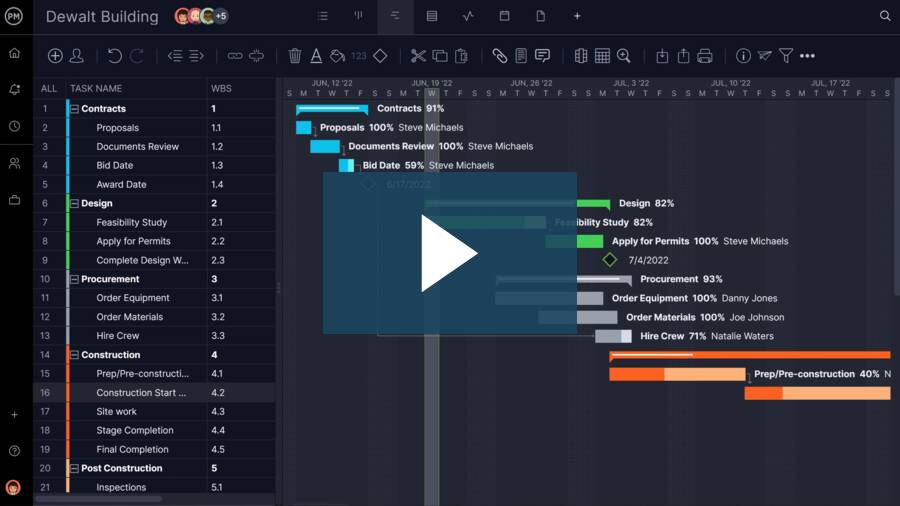
ProjectManager offers robust project management features that are ideal for planning, scheduling and tracking the work required to achieve the FAST goals defined by an organization, such as Gantt charts, task lists, workload management charts, timesheets and real-time dashboards and reports. In addition to that, it’s also equipped with AI project insights, online team collaboration features and unlimited file storage that further help project managers ensure nothing falls through the cracks. Watch the video to learn more!
Related Content
- 15 Goal-Setting Strategies for Individuals and Teams
- 15 Free Goal-Setting and Tracking Templates for Excel and Word
- How to Write SMART Goals: SMART Goal Examples
- How to Set CLEAR Goals: CLEAR Goal Examples
- How to Set a Big Hairy Audacious Goal (BHAG)
- SMART Goals Template
If you need a tool to help you manage projects from start to finish, then signup for our software now at ProjectManager. Our online software can help project managers plan, track and oversee projects as they unfold. Sign up for a free 30-day trial today!
