



When a build feels chaotic, it’s usually because the team can’t agree on what “on track” even looks like. That’s where construction milestones come in—they give everyone a shared set of moments to aim for, check against and communicate around. In this article, you’ll see how they fit into a milestone schedule example and how they help reduce surprises as work moves from one phase to the next.
What Is a Construction Milestone?
A construction milestone is a significant, measurable point in a project timeline that marks the completion or approval of a major activity, phase or deliverable. Milestones do not represent duration; they represent an outcome, such as finishing foundations, receiving a permit or achieving substantial completion. They are used to track progress, align stakeholders and confirm readiness to proceed to subsequent work.
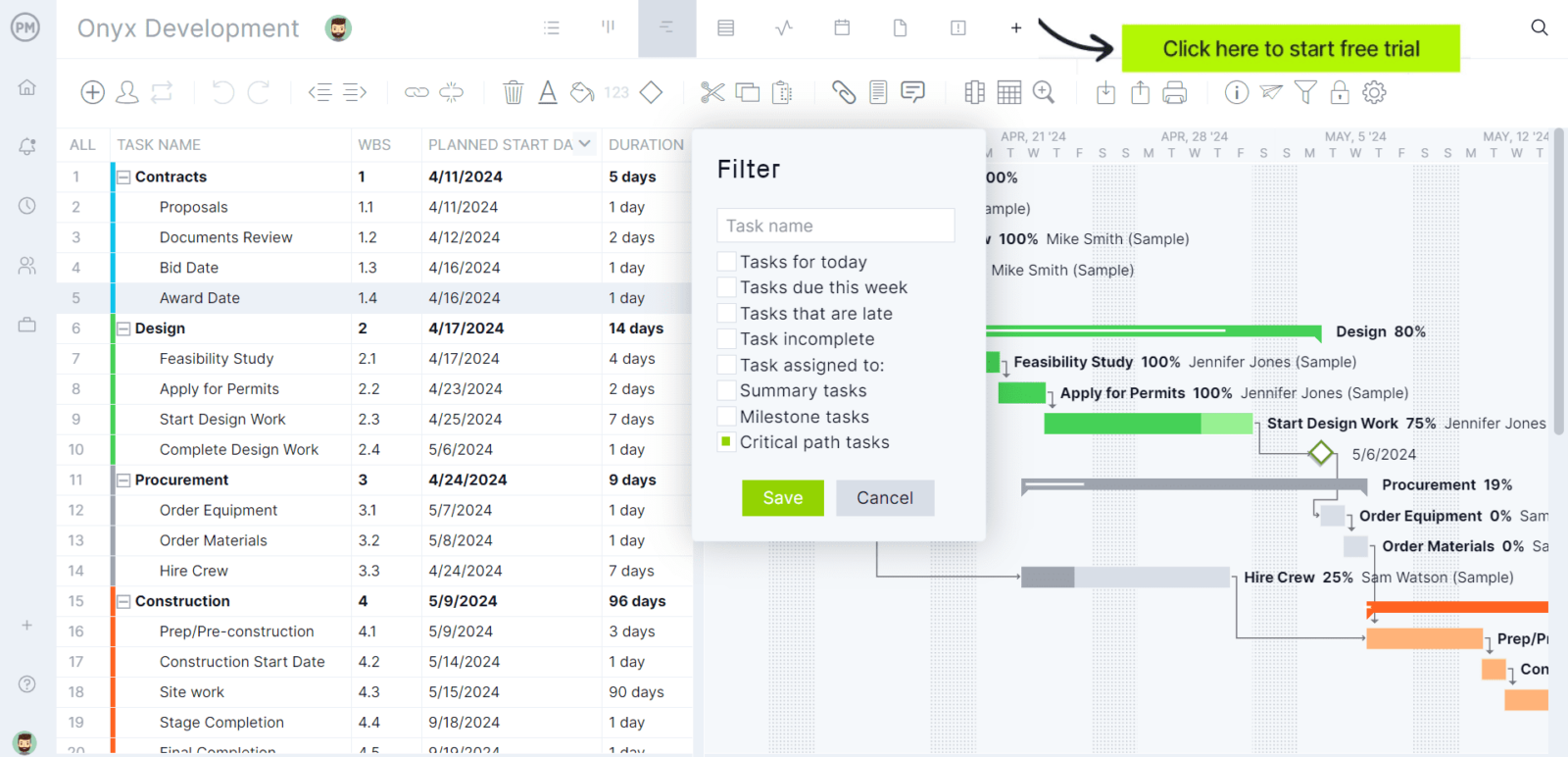
ProjectManager is an award-winning construction project management software equipped with powerful project planning, scheduling and monitoring features including Gantt charts, timesheets, workload management charts and real-time dashboards. ProjectManager’s Gantt chart is ideal for construction scheduling as it allows project managers to visualize project tasks, WBS levels, dependencies, critical path activities and construction milestones. On top of that, it can also be used to allocate resources, establish project baselines and compare planned vs. actual project performance. Get started for free today.
What Is the Purpose of Construction Milestones?
Unlike day-to-day tasks, milestones act as high-visibility checkpoints that keep construction planning realistic and scheduling accountable. They translate a long, complex construction plan into a sequence of decision-ready moments—when a crew can start, an inspection must pass or a trade handoff becomes possible. Used well, they also sharpen monitoring by making slippage obvious early, so adjustments happen before delays compound into missed dates.
Using construction milestones can help:
- Clarify phase handoffs so trades mobilize with fewer clashes and idle time.
- Create clear inspection and approval gates that prevent rework and schedule churn.
- Improve stakeholder communication with simple, outcome-based progress reporting.
- Expose schedule risk earlier by highlighting late critical events, not just tasks.
- Support payment and contract administration tied to verifiable completion points.
Beyond planning and tracking progress, construction milestones also lend themselves naturally to visual construction scheduling. When plotted together, these key events form a milestone chart that highlights sequencing, dependencies and timing at a glance, making it easier to communicate expectations, review progress and align teams around critical dates throughout the construction lifecycle.
What Is a Construction Milestone Schedule?
A construction milestone schedule is a high-level project schedule that displays key milestone dates rather than individual task durations. It organizes major approvals, phase completions and decision points along a timeline, allowing teams to track progress against planned outcomes. The schedule emphasizes timing, sequence and accountability without detailing daily activities or resource assignments across the entire construction lifecycle and delivery.
Related: 10 Free Construction Scheduling Templates for Excel, Word & Google Sheets
Typically prepared by the general contractor or construction manager, the construction milestone schedule is developed early using contract requirements and client expectations. It is shared with owners, lenders, designers and inspectors to set visibility around critical dates.
Internally, project teams use it to align sequencing and monitor commitments, while externally it supports reporting, coordination meetings and high-level reviews where detailed task schedules would be unnecessary or distracting for executive decision-making, approvals, funding releases and strategic oversight across project phases and milestones.
When to Make a Construction Milestone Schedule
A construction milestone schedule is created once the project scope is defined, permits are underway, and major phases can be logically sequenced. It is especially useful during early planning and preconstruction, when stakeholders need high-level visibility into progress without managing task-level detail.
Milestone schedules help align contractors, owners, and inspectors by highlighting critical approval points, major work completions, and handoff moments throughout the construction lifecycle.
Construction Milestone Schedule Example
This construction milestone schedule example illustrates how a typical building project progresses from regulatory approvals through final closeout. The table highlights major checkpoints rather than task-level detail, showing when key phases are expected to be completed and verified. It provides stakeholders with a high-level view of project flow, helping align expectations, track progress and communicate schedule status without managing a full, detailed construction schedule during planning and early project coordination.
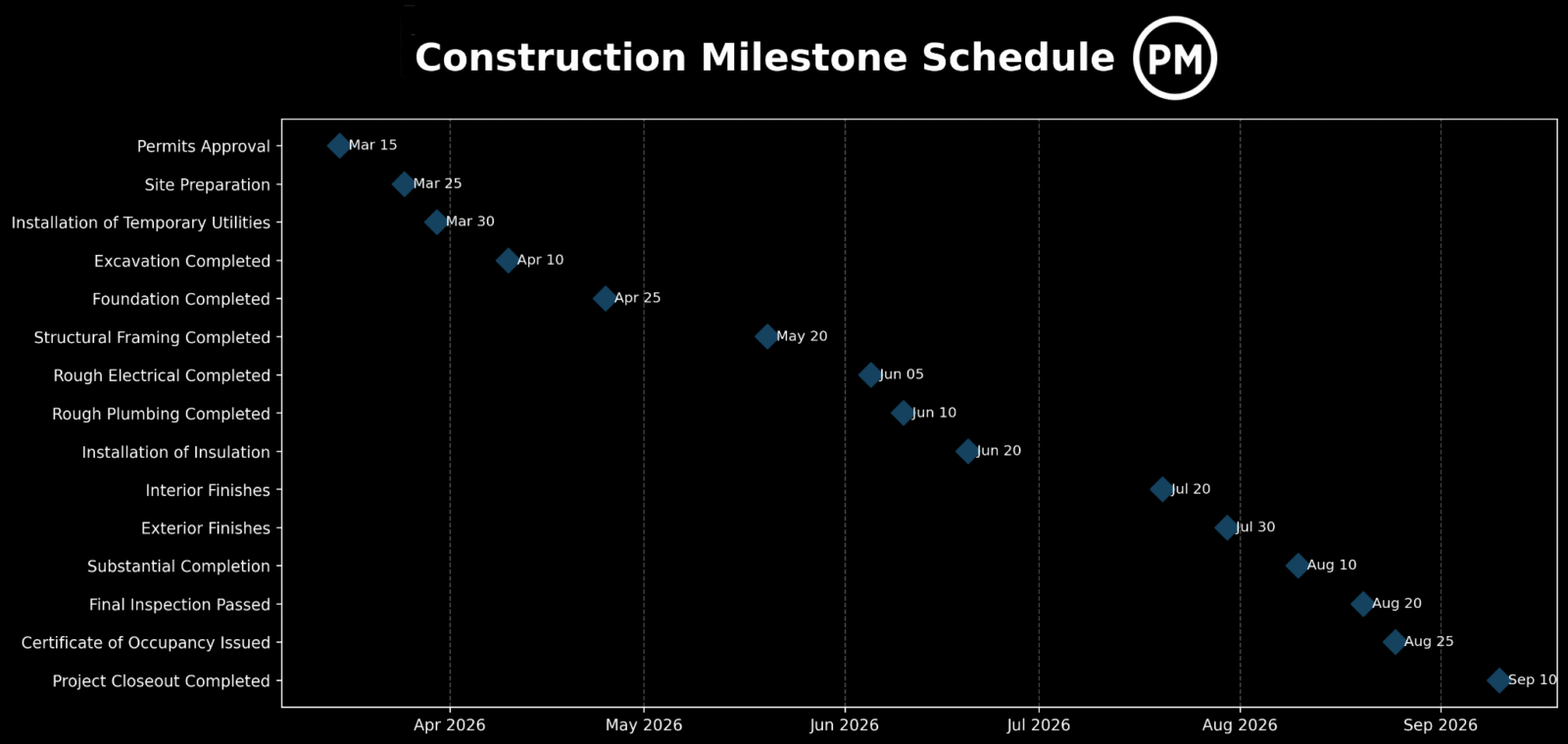
Imagine a general contractor hired to build a three-story commercial office building for a local professional services firm. The project includes surface parking, utility connections, and standard interior finishes. To coordinate approvals, inspections, and major construction phases, the project team develops a construction milestone schedule like the example below, outlining key completion points from permits and site preparation through occupancy and final closeout.
| Milestone name | Milestone description | Estimated milestone completion date |
| Permits Approval | Required regulatory permits approved by authorities | March 15 |
| Site Preparation | Site cleared, graded, and prepared for construction | March 25 |
| Installation of Temporary Utilities | Temporary power, water, and site services installed | March 30 |
| Excavation Completed | Earthwork completed to required depths | April 10 |
| Foundation Completed | Foundations placed, cured, and approved | April 25 |
| Structural Framing Completed | Primary structural system fully erected | May 20 |
| Rough Electrical Completed | Electrical rough-in installed and inspected | June 5 |
| Rough Plumbing Completed | Plumbing rough-in installed and tested | June 10 |
| Installation of Insulation | Thermal and acoustic insulation installed | June 20 |
| Interior Finishes | Interior architectural finishes completed | July 20 |
| Exterior Finishes | Exterior cladding and finishes completed | July 30 |
| Substantial Completion | Building ready for intended use | August 10 |
| Final Inspection Passed | Final inspections approved by authorities | August 20 |
| Certificate of Occupancy Issued | Legal authorization to occupy issued | August 25 |
| Project Closeout Completed | Final documentation and handover completed | September 10 |
Free Construction Milestone Tracking Templates
We’ve created dozens of free construction project management templates for Excel, Word and Google Sheets. Here are some that can help keep track of construction milestones.
Milestones Template
This free milestones template allows you to document the milestones of a construction project and details such as the tasks required to complete them, priority level, start and end dates and status.
Project Milestone Template
This project milestone template allows you to try ProjectManager’s Gantt chart and use it’s powerful project scheduling features to create a construction schedule with milestones, task dependencies, estimated costs, allocated resources and much more.
Now that we’ve learned how construction milestones are used for and how they can be visualized with a milestone schedule, let’s go over the most common construction milestones that occur in most projects.
Common Construction Milestone Examples
Construction milestones vary by project type, but certain examples appear on most construction sites and schedules, marking regulatory approvals, readiness to build, and completion of critical early-stage work phases consistently.
1. Permits Approval
This milestone is achieved after required construction permits are identified, applications prepared, documents submitted and agency reviews completed. It includes responding to comments, revising drawings, coordinating with designers and securing formal approvals that legally authorize site work, inspections and subsequent construction activities to proceed without regulatory delays, penalties or stoppages.
2. Site Preparation
Completion of site preparation confirms the location is physically ready for construction to begin. Work typically includes clearing vegetation, demolishing existing structures, grading, erosion controls, temporary access roads and layout surveying, ensuring the site meets safety, environmental and logistical requirements before crews and equipment mobilize on schedule, without constraints remaining.
3. Installation of Temporary Utilities
This milestone is reached once temporary services are installed to support construction operations. Activities include coordinating with utility providers, installing temporary power, water and lighting, setting up site communications and testing connections, allowing crews to work safely, efficiently and in compliance with local regulations throughout active construction phases onsite conditions.
4. Excavation Completed
Excavation is considered complete when required earthworks reach specified depths, lines and grades. This milestone covers bulk excavation, trenching, soil removal, dewatering and verification through surveys or inspections, confirming the site is ready for foundations, underground utilities and subsequent structural construction activities to commence without rework, delays, redesigns or disputes.
5. Foundation Completed
Reaching this milestone means all foundation work has been executed and approved. It includes installing formwork, placing reinforcement, pouring concrete, curing to required strength and completing inspections. Once achieved, the structure has a stable base capable of supporting vertical loads and allowing framing activities to begin without structural risk.
6. Structural Framing Completed
Structural framing is complete when the primary load-bearing system is fully erected. This covers columns, beams, slabs, walls or structural steel installation, along with connections and bracing. Inspections and engineering sign-offs confirm the building’s shape, stability and alignment before enclosure, mechanical rough-ins and interior systems can progress.
7. Rough Electrical Completed
This milestone is achieved after all electrical infrastructure is installed within walls, ceilings and floors. Work includes running conduits, pulling wiring, installing boxes, panels and grounding systems. Completion is typically verified through inspections, confirming readiness for insulation and drywall without needing future access or destructive rework.
8. Rough Plumbing Completed
Rough plumbing is completed once supply lines, drainage, venting and pipe penetrations are installed and tested. Activities involve pressure testing, securing piping and coordinating with structural elements. Approval at this stage confirms systems are correctly placed before walls are closed and fixtures are installed later in the project.
9. Installation of Insulation
Insulation installation marks the transition toward enclosure and energy efficiency. This milestone includes placing thermal and acoustic insulation in walls, ceilings and floors according to specifications. Inspections verify coverage, thickness and compliance, ensuring comfort, performance and code requirements are met before interior finishes conceal assemblies.
10. Interior Finishes
Interior finishes are considered complete when visible surfaces are installed and detailed. This milestone typically includes drywall finishing, painting, flooring, ceiling systems, millwork and fixture installation. Final adjustments, quality checks and punch-list corrections confirm interior spaces meet design intent and are ready for functional use.
11. Exterior Finishes
Exterior finishes are complete once the building envelope is fully installed and weather-tight. This milestone includes cladding, roofing, exterior doors and windows, sealants and surface treatments. Coordination between trades, quality inspections and punch corrections ensure durability, appearance and protection from environmental exposure before final site works conclude.
12. Substantial Completion
Substantial completion is reached when the project is fit for its intended use. Remaining work is minor and does not prevent occupancy or operations. This milestone typically involves completing major systems, resolving critical punch-list items, confirming life-safety functionality and obtaining owner acknowledgment that the building can be used as planned.
13. Final Inspection Passed
This milestone confirms all required authority inspections have been successfully completed. It includes scheduling final reviews, addressing inspection comments and verifying compliance with building codes, zoning requirements and safety regulations. Approval indicates the project meets regulatory standards and can advance toward formal occupancy authorization.
14. Certificate of Occupancy Issued
Issuance of the certificate of occupancy occurs after regulatory approval and final documentation submission. Activities include providing as-built drawings, test reports and compliance certificates. Once granted, this milestone legally allows occupants to use the building for its designated purpose without restrictions or temporary conditions.
15. Project Closeout Completed
Project closeout is complete when contractual, administrative and documentation obligations are finalized. This milestone includes closing punch lists, delivering warranties, training owners, submitting final payments and archiving records. Completion confirms all responsibilities are fulfilled and the construction project is formally concluded.
ProjectManager Is Ideal for Making Detailed Construction Milestone Schedules
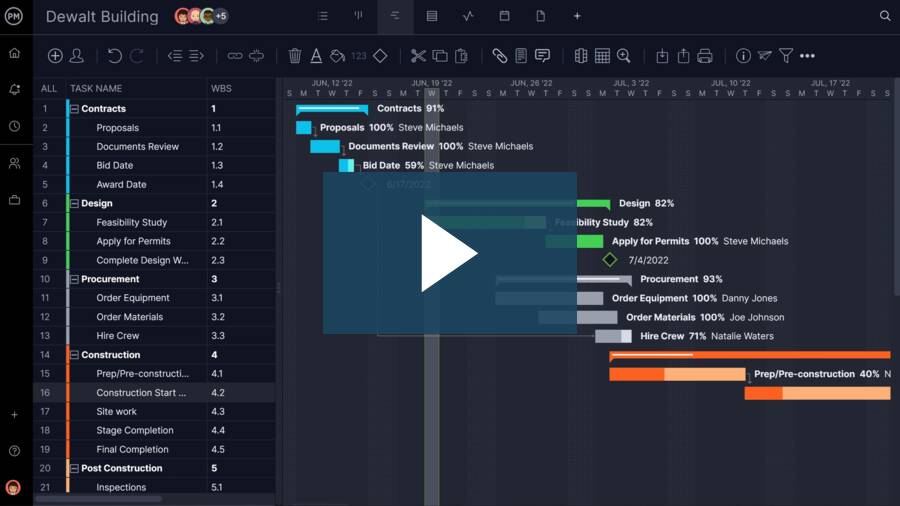
ProjectManager is an award-winning project management software packed with construction project planning, scheduling and tracking features, making it ideal for managing every phase of a construction project. Watch the video below to learn more and get started for free today!
Related Construction Project Management Content
We’ve created over 100 construction blogs, templates, ebooks and other types of content to help construction project managers better understand the many moving parts that must be managed to deliver successful construction projects. Here are some of them.
- Making a Construction Schedule
- How to Manage a Construction Project Step by Step
- The Ultimate Guide to Construction Project Management
- What Are Milestones in Project Management?
- 30 Project Milestone Examples Across Industries
- How to Create a Milestone Chart with Project Management Software
- Timeline With Milestones: How to Make One
