



Operational consistency rarely happens by accident; it requires structure, discipline and visibility into daily practices. A well-designed 5S Audit helps teams identify inefficiencies, enforce standards and sustain improvements over time. Using a 5S checklist brings clarity to evaluations, making it easier to align teams, support continuous improvement and maintain organized, high-performing work environments.
What Is a 5S Audit?
A 5S audit is a structured evaluation process within lean manufacturing that assesses how effectively a workplace follows the five principles of sort, set in order, shine, standardize and sustain. It functions as a control mechanism, characterized by routine inspections, visual checks and scoring systems, often driven by the need to maintain discipline and consistency. In practice, teams use audits to verify adherence to standard operating procedures, uncover gaps and trigger corrective actions that reinforce continuous improvement.
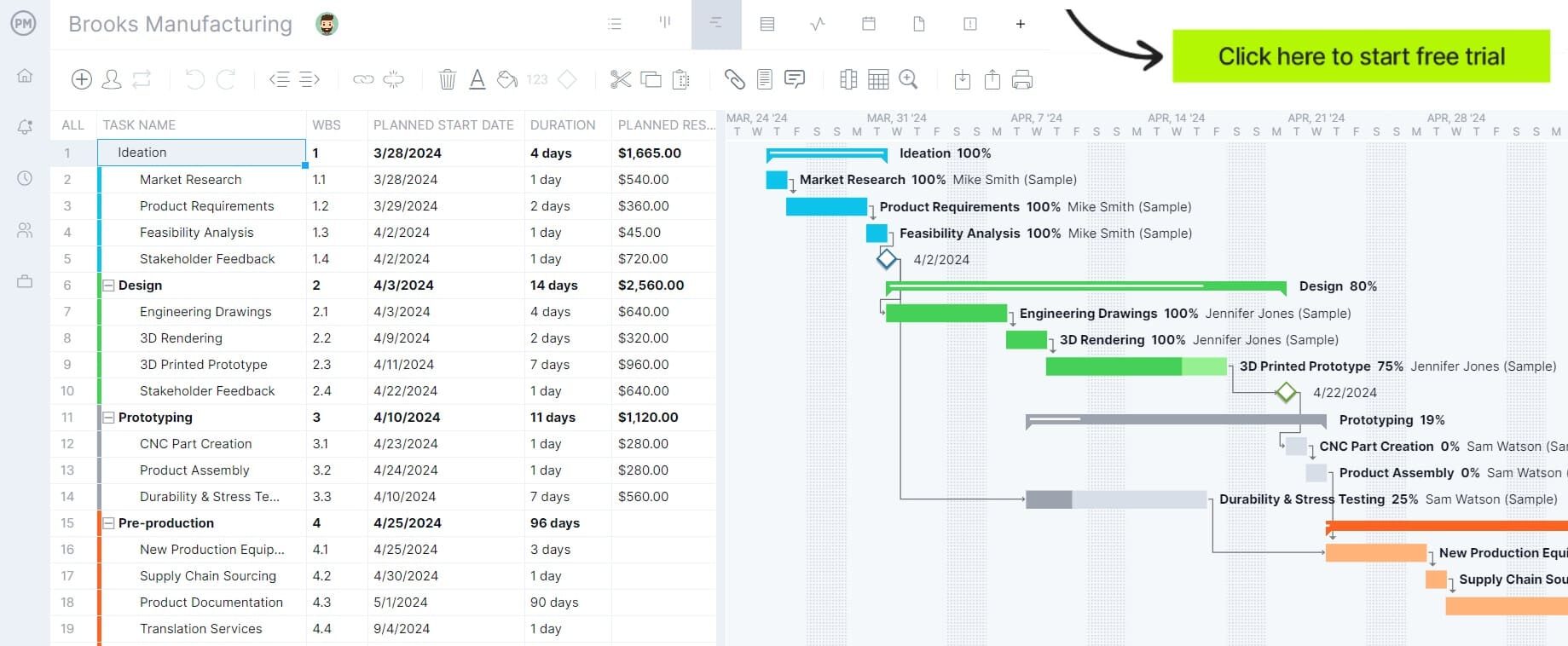
ProjectManager is an award-winning project management software that is equipped with tools that allow manufacturers to plan, schedule and monitor their projects from start to finish. Use Gantt charts to make production roadmaps, manage workflows with kanban boards, allocate resources with workload charts, track costs with timesheets and monitor your projects with real-time dashboards and reports. Get started for free today.
Originally developed in Japan, the five elements of a 5S Audit come from workplace organization practices refined within the Toyota Production System. Each term—Seiri, Seiton, Seiso, Seiketsu and Shitsuke—captures a specific discipline. Over time, these concepts became foundational to lean manufacturing, shaping how teams approach efficiency, order and continuous improvement.
Sort (Seiri)
Within a 5S Audit, Sort focuses on separating what is necessary from what is not in a workspace. It emphasizes removing excess materials, tools or information that do not directly support current operations. By eliminating clutter, teams reduce distractions, improve safety and create a more controlled environment for executing operating procedures effectively.
Set in Order (Seiton)
Set in Order centers on arranging tools, materials and equipment so they are easy to access, use and return. During a 5S Audit, this principle evaluates how well items are organized to support workflow efficiency. Clear placement, labeling and visual cues help reduce wasted motion and ensure tasks follow a consistent, logical sequence.
Shine (Seiso)
Shine represents the practice of cleaning and inspecting the workplace regularly to maintain optimal conditions. In a 5S Audit, it goes beyond appearance by identifying sources of dirt, wear or malfunction. Clean environments support preventive maintenance, allowing teams to detect issues early and maintain equipment reliability without disrupting operations.
Standardize (Seiketsu)
Standardize focuses on creating consistent methods to maintain the first three S practices across teams and shifts. A 5S Audit evaluates whether standard operating procedures, visual controls and routines are clearly defined and followed. Establishing consistency ensures improvements are repeatable and reduces variability in how workspaces are organized and maintained.
Sustain (Shitsuke)
Sustain reinforces discipline by ensuring that 5S practices become part of everyday work rather than one-time efforts. During a 5S Audit, this principle examines accountability, training and adherence to established routines. Strong sustainment supports continuous improvement by embedding habits that prevent regression and keep workplace standards consistently applied over time.
Purpose of a 5S Audit
At its core, a 5S Audit exists to verify that workplace organization practices are consistently applied across production environments. It helps teams identify deviations from standard operating procedures, enforce discipline and ensure that lean manufacturing principles translate into repeatable, measurable operational performance on the shop floor.

Benefits of a 5S Audit
Beyond maintaining order, a 5S Audit creates visibility into how work actually happens. It gives manufacturing teams a practical way to spot inefficiencies, reinforce accountability and support continuous improvement without relying on assumptions or inconsistent observations across departments or shifts.
- Improves workplace organization by removing unnecessary items and optimizing layouts for smoother workflows.
- Enhances safety conditions by identifying hazards, reducing clutter and enforcing clear operating procedures.
- Supports preventive maintenance by promoting regular cleaning and early detection of equipment issues.
- Strengthens standard operating procedures through consistent audit reporting and enforcement across teams.
- Reduces waste in motion, time and materials by aligning tasks with lean manufacturing principles.
- Drives accountability by assigning ownership of corrective actions and tracking follow-through over time.
- Creates a foundation for continuous improvement by providing structured data for ongoing process refinement.
What Is a 5S Checklist?
A 5S checklist is a document used to organize and capture all the criteria reviewed during a 5S audit. It outlines specific inspection points, helping teams standardize evaluations, guide audit reporting and ensure consistency across different areas, shifts or auditors within a lean framework.
What Should Be Included in a 5S Checklist?
Now it’s time to move from concepts into execution. A 5S checklist breaks down exactly what needs to be reviewed during a 5S audit, giving teams a practical manufacturing checklist to assess conditions, identify gaps and document findings through structured audit reporting.
Scoring System
To make audits actionable, teams need a clear scoring system that translates observations into measurable results. Most 5S audits use a scale, typically zero to five, to rate each item based on compliance. These scores highlight gaps, prioritize corrective actions and support consistent audit reporting across departments.
Sort (Seiri)
- Unnecessary tools, materials or documents are identified and removed from work areas.
- Obsolete inventory is clearly separated and tagged for disposal or corrective actions.
- Only items required for current production tasks are kept within immediate reach.
- Redundant equipment is evaluated and either reassigned, stored or eliminated properly.
- Workstations are free of excess items that do not support operating procedures.
- Storage areas are reviewed to ensure no accumulation of unused or outdated materials.
- Temporary items are clearly labeled with defined timelines for removal or reassessment.
- Personal items are limited and do not interfere with production workflows or safety.
- Clear criteria exist to distinguish necessary items from unnecessary workplace clutter.
- Audit reporting captures identified waste and assigns corrective actions for removal.
Set in Order (Seiton)
- Tools and equipment are stored in designated locations with clear labeling systems.
- Visual controls indicate proper placement and make missing items immediately noticeable.
- Frequently used items are positioned to minimize motion and improve workflow efficiency.
- Storage layouts align with process flow and reduce unnecessary movement across workstations.
- Shadow boards or markings clearly define where each tool should be returned.
- Pathways, aisles and access points remain unobstructed and clearly marked for safety.
- Inventory locations are organized to support quick retrieval and accurate stock management.
- Color coding or signage is used consistently across departments and operating procedures.
- Workstations are arranged to support ergonomic use and reduce operator fatigue risks.
- Manufacturing checklist verifies that placement standards are consistently followed across shifts.
Related: 23 Free Manufacturing Excel Templates
Shine (Seiso)
- Work areas are cleaned regularly according to defined preventive maintenance schedules.
- Equipment surfaces are free of dirt, oil or debris that could affect performance.
- Cleaning responsibilities are assigned and clearly documented within operating procedures.
- Inspection routines identify leaks, wear or abnormalities during routine cleaning activities.
- Cleaning tools are readily available, properly stored and maintained in good condition.
- Waste disposal processes are followed consistently to maintain a clean environment.
- Lighting conditions are adequate to support visibility during cleaning and inspection tasks.
- Floors, walls and work surfaces are maintained to prevent safety hazards or contamination.
- Audit reporting captures recurring cleanliness issues and assigns corrective actions accordingly.
- Continuous improvement efforts address root causes of dirt, buildup or equipment contamination.
5S Audit Template
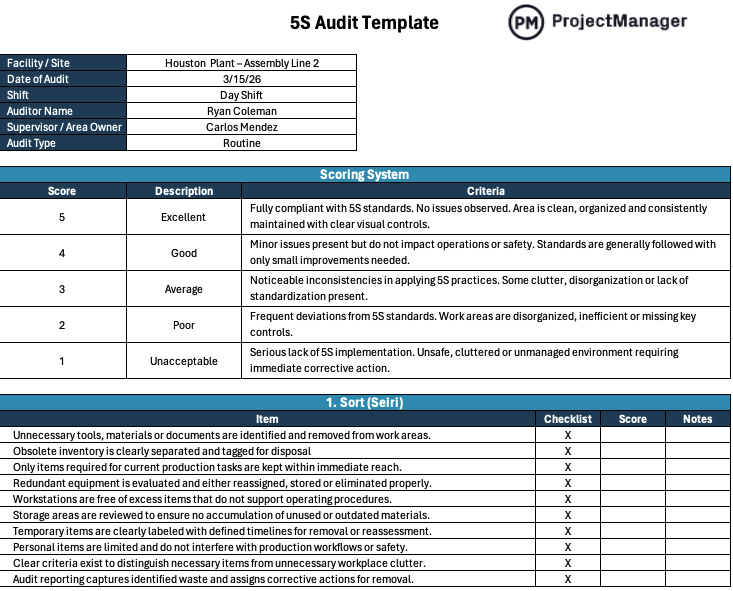
This 5S audit template provides a structured format to evaluate workplace organization using a clear scoring system, defined inspection criteria and space for audit reporting. It helps manufacturing teams assess compliance, document findings and assign corrective actions across all five 5S categories.
5S Audit Checklist Example
The best way to understand how a 5S audit should be conducted is to look at it in a real-world setting. Consider a manufacturing company that produces industrial components and is running a routine 5S audit on one of its assembly lines to evaluate workplace organization, reinforce lean manufacturing standards and identify areas requiring corrective actions and continuous improvement.
Overall, the audit revealed a generally well-managed workspace with strong adherence to standard operating procedures and visible lean framework practices. However, inconsistencies in labeling, minor cleanliness issues and gaps in documentation highlighted opportunities for corrective actions, reinforcing the need for more consistent audit reporting and continuous improvement across the assembly line.
5S Audit Information
| Field | Value |
| Facility / Site | Houston Plant – Assembly Line 2 |
| Date of Audit | 3/15/26 |
| Shift | Day Shift |
| Auditor Name | Ryan Coleman |
| Supervisor / Area Owner | Carlos Mendez |
| Audit Type | Routine |
5S Scoring System
| Score | Description | Criteria |
| 5 | Excellent | Fully compliant with 5S standards. No issues observed. Area is clean, organized and consistently maintained with clear visual controls. |
| 4 | Good | Minor issues present but do not impact operations or safety. Standards are generally followed with only small improvements needed. |
| 3 | Average | Noticeable inconsistencies in applying 5S practices. Some clutter, disorganization or lack of standardization present. |
| 2 | Poor | Frequent deviations from 5S standards. Work areas are disorganized, inefficient or missing key controls. |
| 1 | Unacceptable | Serious lack of 5S implementation. Unsafe, cluttered or unmanaged environment requiring immediate corrective action. |
1. Sort (Seiri)
| Item | Score | Notes |
| Unnecessary tools, materials or documents are identified and removed from work areas | 4 | Most unnecessary items removed, but some old fixtures still stored near workbench |
| Obsolete inventory is clearly separated and tagged for disposal | 3 | Obsolete parts identified but not consistently tagged across all storage areas |
| Workstations are free of excess items that do not support operating procedures | 5 | All workstations clean and contain only required tools for current tasks |
2. Set in Order (Seiton)
| Item | Score | Notes |
| Tools and equipment are stored in designated locations with clear labeling systems | 4 | Labeling present but faded in some areas, needs replacement |
| Frequently used items are positioned to minimize motion and improve workflow efficiency | 5 | High-use tools placed within reach, layout supports efficient workflow |
| Pathways, aisles and access points remain unobstructed and clearly marked for safety | 3 | One aisle partially blocked by temporary material storage |
3. Shine (Seiso)
| Item | Score | Notes |
| Work areas are cleaned regularly according to defined preventive maintenance schedules | 4 | Cleaning performed daily but checklist not always signed off |
| Equipment surfaces are free of dirt, oil or debris that could affect performance | 3 | Minor oil residue found on two machines in assembly area |
| Cleaning tools are readily available, properly stored and maintained in good condition | 5 | Cleaning stations fully stocked and well organized |
4. Standardize (Seiketsu)
| Item | Score | Notes |
| Standard operating procedures clearly define expectations for sorting, organizing and cleaning tasks | 5 | SOPs clearly documented and accessible at all workstations |
| Visual controls are consistently applied to reinforce correct practices across all work areas | 4 | Visual guides present but inconsistent between departments |
| Documentation reflects current processes and is updated after process changes or corrective actions | 3 | Some documents outdated after recent layout changes |
5. Sustain (Shitsuke)
| Item | Score | Notes |
| Regular audits are scheduled and conducted to reinforce adherence to 5S standards | 4 | Audits conducted monthly but not always on schedule |
| Employees receive ongoing training to maintain awareness of lean framework expectations | 3 | Training provided, but no recent refresher sessions completed |
| Leadership demonstrates commitment by participating in audits and reinforcing expectations regularly | 5 | Supervisors actively involved in audits and follow-up actions |
Free Lean Manufacturing Templates
We’ve created dozens of free manufacturing templates for Excel, Word and Google Sheets. Here are some of them.
Gemba Walk Template
This template structures shop floor observations across safety, work process, quality, flow, 5S and teamwork, helping teams capture issues, assign corrective actions and support continuous improvement through consistent follow-up.
Standard Operating Procedure Template
This template organizes standard operating procedures with sections for process overview, step-by-step tasks, resources, frequency and approvals, ensuring consistent execution, clear responsibilities and accurate documentation across operational workflows.
SIPOC Template
This template maps suppliers, inputs, process steps, outputs and customers, providing a high-level view of workflows while helping teams define scope, identify dependencies and improve process clarity within a lean framework.
How ProjectManager Helps Manufacturing Businesses
Manufacturing project management becomes far more manageable when teams can plan, monitor and adjust work within a single platform. ProjectManager combines production scheduling, resource planning and performance tracking so teams stay aligned and make quicker decisions on the shop floor.
Using interactive Gantt charts, manufacturing teams can create detailed schedules, link task dependencies, define milestones and update timelines as conditions evolve. Resource management tools help allocate labor, equipment and materials effectively, while tracking resource availability to prevent bottlenecks. Real-time timesheets, dashboards and reports offer immediate insight into progress, costs and workload, enabling teams to catch issues early and maintain control over operations.
With these tools and features, ProjectManager helps manufacturing businesses boost efficiency, minimize delays and deliver more consistent outcomes. Watch the video below to learn more!
ProjectManager is award-winning software for managing any project. Our collaborative platform connects your teams and gives you access to the manufacturing floor no matter where you are or what time it is. Get started with ProjectManager today for free.
