



What Is a Risk Mitigation Plan?
A risk mitigation plan is a risk management document used to reduce the likelihood or impact of identified risks. It is commonly used in projects, programs and operational initiatives to define preventive actions, assign responsibilities and prepare responses before issues occur. The plan outlines specific strategies for addressing threats that could affect project objectives, budgets, schedules, resources or deliverables. By documenting mitigation actions in advance, teams can respond more effectively when risks materialize.
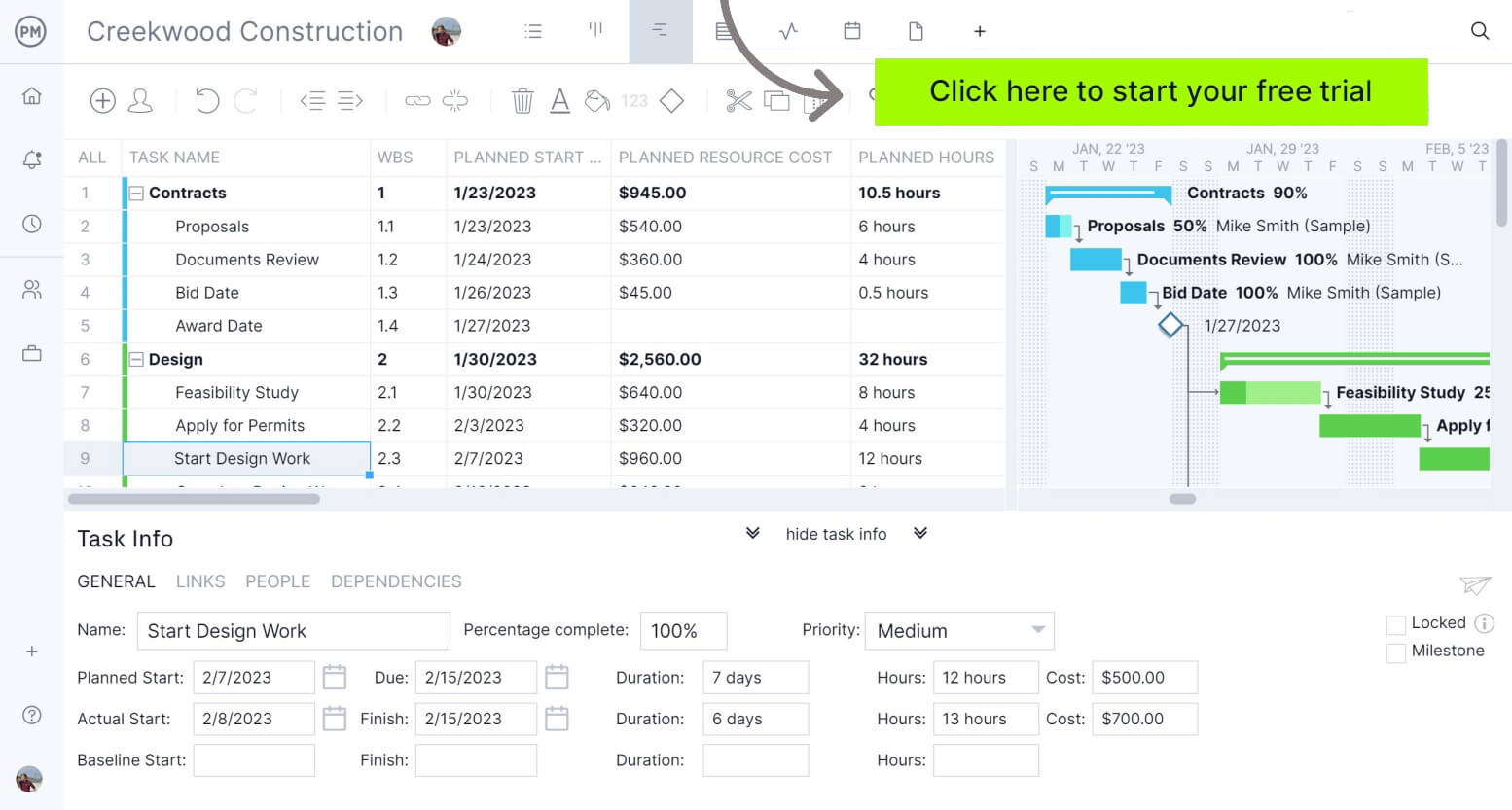
If you’re looking for a project management solution equipped with risk management features, try ProjectManager. ProjectManager is award-winning project management software that gives businesses across industries the tools they need to ensure projects are completed on time, within budget and within scope. It allows project managers to make detailed project schedules, estimate costs, allocate resources, set budgets, track progress and compare planned versus actual project outcomes using real-time dashboards and reports to identify delays or cost overruns quickly. Get started with ProjectManager for free today.
When to Use a Risk Mitigation Plan
Although the idea of a risk mitigation plan originated in project management, where risk management is one of the core knowledge areas described in the project management body of knowledge (PMBOK) by the project management institute (PMI), its application extends far beyond traditional projects.
Whether managing a construction project, launching a new product, implementing software, planning an event or expanding operations, uncertainty is unavoidable. Any organization that relies on projects can benefit from identifying potential threats early and establishing actions to reduce their impact before they disrupt objectives.
Construction
Construction companies use a risk mitigation plan to anticipate problems that could affect safety, schedules, budgets and project quality. Because construction projects involve multiple contractors, changing site conditions, regulatory requirements and material dependencies, identifying risks early helps teams prepare responses that reduce disruptions and keep work progressing as planned.
Some specific scenarios in this industry that require the use of a risk mitigation plan are:
- Unexpected subsurface conditions discovered during excavation can delay work and require contingency plans and budget reserves.
- Material shortages or supplier delays may impact critical construction activities and threaten contractual completion dates.
- Severe weather events can halt site operations, requiring schedule adjustments and alternative work sequencing strategies.
- Workplace safety hazards on active job sites often require preventive measures, training programs and emergency procedures.
- Permit approvals taking longer than expected can affect project milestones and require proactive stakeholder coordination.
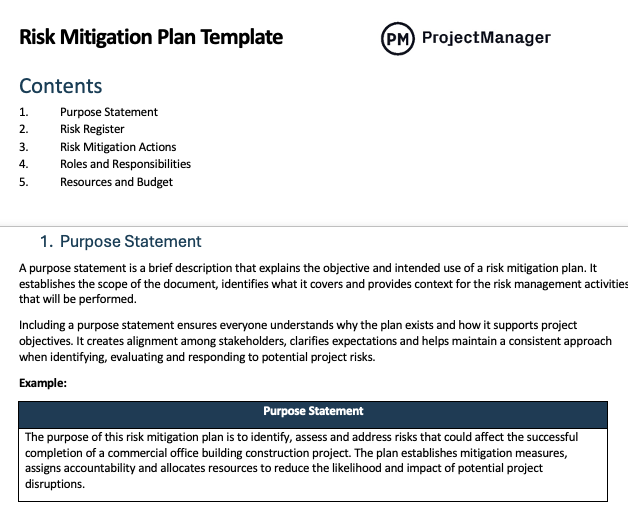
Get your free
Risk Mitigation Plan Template
Use this free Risk Mitigation Plan Template for Word to manage your projects better.
Manufacturing
Manufacturing companies use a risk mitigation plan to maintain production stability, control costs and meet customer demand. Manufacturing projects depend on equipment, labor, suppliers and logistics networks working together. When risks are identified in advance, manufacturers can reduce downtime, prevent quality issues and avoid costly interruptions to operations.
Some specific scenarios in this industry that require the use of a risk mitigation plan are:
- Critical machinery failures can stop production lines, making maintenance planning and backup equipment essential.
- Supplier disruptions may prevent raw materials from arriving on time, creating inventory and fulfillment challenges.
- Quality control issues can result in defective products, recalls and damage to customer relationships.
- Labor shortages or workforce disruptions may reduce production capacity and impact delivery commitments.
- Changes in regulations or compliance requirements can require process modifications and additional operational controls.
Information Technology (IT)
IT departments and technology companies use a risk mitigation plan to protect systems, data and project outcomes. Technology initiatives often involve complex integrations, cybersecurity threats and evolving requirements. Planning for potential risks allows teams to minimize service disruptions, protect sensitive information and improve the likelihood of successful project delivery.
Some specific scenarios in this industry that require the use of a risk mitigation plan are:
- Cybersecurity attacks targeting company systems may require incident response procedures and enhanced security controls.
- Software deployment failures can disrupt business operations and necessitate rollback plans and testing protocols.
- Cloud service outages may affect critical applications, requiring redundancy strategies and disaster recovery planning.
- Scope changes during software development projects can increase costs and delay planned release schedules.
- Data migration projects often carry risks of data loss, corruption or compatibility issues between systems.
What Should Be Included in a Risk Mitigation Plan?
A risk mitigation plan should document the information needed to identify, evaluate, prioritize and address potential risks. While the exact format may vary between organizations, most plans include a purpose statement, a risk register, a risk assessment and additional components that help teams define mitigation strategies, assign responsibilities and monitor risks throughout the project lifecycle.
Purpose Statement
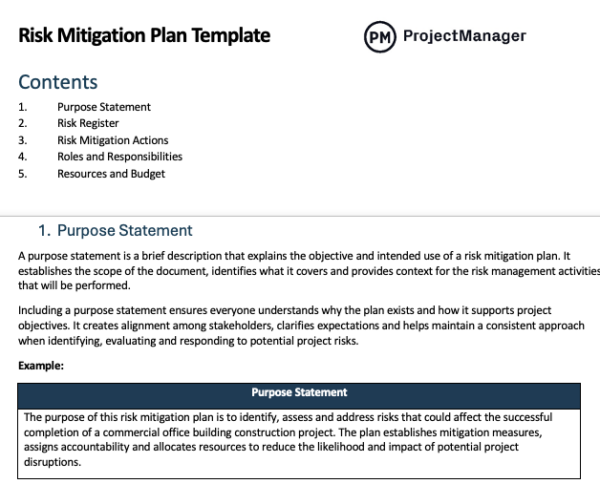
A purpose statement is a brief description that explains the objective and intended use of a risk mitigation plan. It establishes the scope of the document, identifies what it covers and provides context for the risk management activities that will be performed.
Including a purpose statement ensures everyone understands why the plan exists and how it supports project objectives. It creates alignment among stakeholders, clarifies expectations and helps maintain a consistent approach when identifying, evaluating and responding to potential project risks.
Risk Register
A risk register is a risk management document used to record identified risks and their key details. It typically includes risk descriptions, categories, potential impacts, likelihood ratings, mitigation actions, owners and current status information for ongoing monitoring.

Without a centralized record of identified risks, important information can be overlooked or become difficult to track. A risk register provides visibility into potential threats, supports accountability and serves as the foundation for planning and monitoring mitigation activities.
Risk Analysis
Risk analysis is the process of analyzing identified risks to determine their significance and potential effect on project objectives. Risks are typically evaluated based on factors such as impact, likelihood, urgency, detectability, proximity or other criteria established by the organization. The results help teams prioritize risks and focus resources on the threats that require the greatest attention.
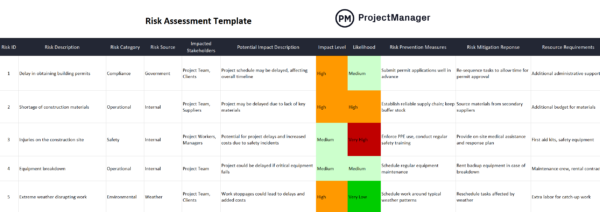
Not every risk deserves the same level of response. Conducting a risk assessment helps teams distinguish between minor concerns and critical threats, allowing mitigation efforts to be directed where they will provide the greatest protection to project objectives.
Risk Mitigation Actions
After the purpose of the risk mitigation plan has been established and risks have been identified, documented and assessed, the next step is to define risk mitigation actions. These are the specific measures or action plan the organization will take to address each risk. Depending on the situation, mitigation actions may be designed to eliminate the risk entirely, reduce its likelihood of occurring or minimize its potential impact. Clear actions transform risk analysis into practical risk management.
Roles and Responsibilities
With mitigation actions defined, attention shifts to assigning ownership. Roles and responsibilities should identify the individuals accountable for implementing, monitoring and reporting on each mitigation activity. Once assigned, these individuals become risk owners and are responsible for ensuring planned actions are executed effectively.
Resources and Budget
Having assigned risk owners, the next step is to determine the resources required to carry out mitigation activities. This includes identifying labor, equipment, materials, software or external services needed to execute and monitor the plan. Cost estimates can then be developed for those resources, allowing the organization to establish a budget that supports effective risk management throughout the project or operational initiative.
Implementation Timeline
Once resources and budgets have been established, the next step is to estimate how long mitigation actions would take to implement if a risk occurs. While it is usually impossible to assign exact due dates in advance, organizations should develop a tentative schedule that outlines expected durations. Understanding implementation time helps determine whether a mitigation strategy is realistic and capable of protecting project objectives when timely action is required.
Monitoring Guidelines
Even the most thorough mitigation strategy has little value if its effectiveness is never evaluated. Monitoring guidelines establish the procedures, review intervals and performance measures used to track mitigation activities after implementation. By following up on results, organizations can verify that risks were actually reduced, identify any remaining exposure and make adjustments when mitigation actions fail to achieve the desired outcome.
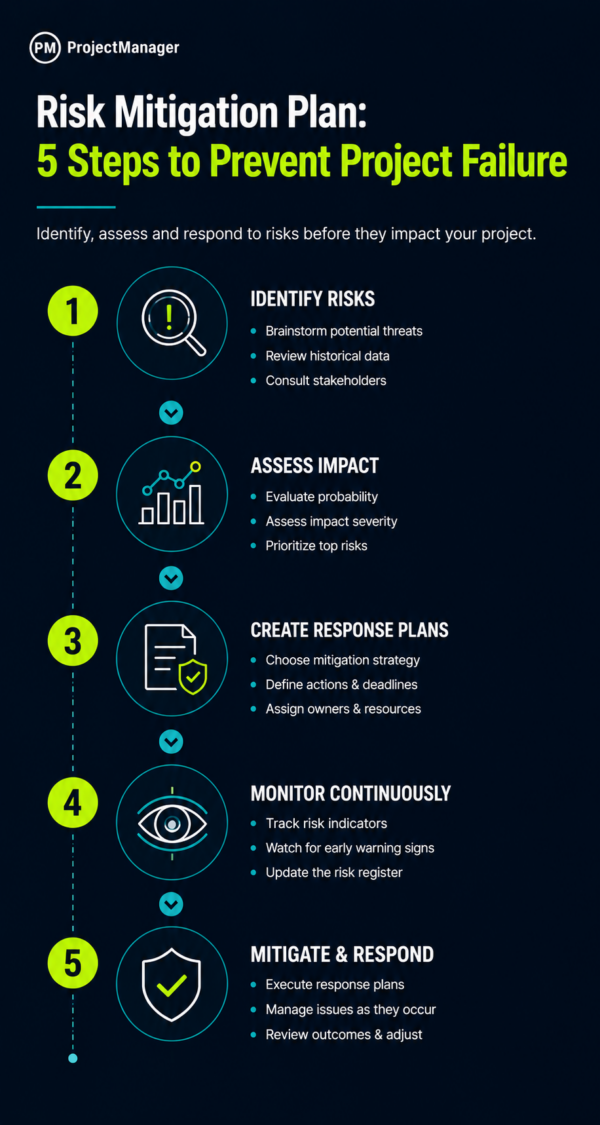
Free Risk Mitigation Plan Template
This risk mitigation plan template helps organizations identify potential risks, assess their impact and likelihood, define mitigation actions and assign accountability. It also includes resource planning and budget considerations to support implementation. By documenting mitigation strategies in one place, teams can reduce uncertainty and improve their ability to respond to project threats.
Risk Mitigation Plan Examples
Understanding the components of a risk mitigation plan is helpful, but seeing them applied in a practical context makes the process much easier to follow. Here are two risk mitigation plan examples to better understand how risk mitigation plans are used in real-life scenarios.
Construction Risk Mitigation Plan Example
The example below shows how a construction company might document and manage project risks, including risk identification, mitigation actions, ownership assignments and budget planning.
Purpose Statement
The purpose of this risk mitigation plan is to identify, assess and address risks that could affect the successful completion of a commercial office building construction project. The plan establishes mitigation measures, assigns accountability and allocates resources to reduce the likelihood and impact of potential project disruptions.
Risk Register
| Risk | Potential Impact | Likelihood | Priority |
| Severe weather delays | Schedule delays and increased labor costs | High | High |
| Material delivery delays | Work stoppages and missed milestones | Medium | High |
| Workplace safety incident | Injuries, regulatory penalties and project delays | Medium | High |
| Permit approval delays | Delayed construction start and schedule impacts | Low | Medium |
| Subcontractor labor shortage | Reduced productivity and schedule overruns | Medium | Medium |
Risk Mitigation Actions
| Risk | Risk Mitigation Action |
| Severe weather delays | Build weather contingency into the project schedule and prioritize indoor activities during adverse conditions. |
| Material delivery delays | Prequalify multiple suppliers, place long-lead orders early and maintain safety stock for critical materials. |
| Workplace safety incident | Conduct regular safety training, site inspections and mandatory toolbox talks. |
| Permit approval delays | Submit permit applications early and maintain regular communication with regulatory authorities. |
| Subcontractor labor shortage | Establish backup subcontractor agreements and monitor workforce availability throughout the project. |
Roles and Responsibilities
| Risk | Risk Owner | Responsibilities |
| Severe weather delays | Project Manager | Monitor forecasts, activate contingency plans and adjust project schedules. |
| Material delivery delays | Procurement Manager | Track supplier performance, manage purchase orders and coordinate alternative sourcing. |
| Workplace safety incident | Safety Manager | Enforce safety procedures, conduct inspections and oversee incident prevention activities. |
| Permit approval delays | Permitting Coordinator | Manage permit submissions, follow up with agencies and maintain approval documentation. |
| Subcontractor labor shortage | Construction Superintendent | Monitor labor availability, coordinate subcontractors and activate backup staffing plans. |
Resources and Budget
| Risk | Required Resources | Estimated Cost |
| Severe weather delays | Weather monitoring services, schedule contingency planning and temporary weather protection materials | $8,000 |
| Material delivery delays | Supplier qualification activities, safety stock inventory and expedited shipping allowances | $12,000 |
| Workplace safety incident | Safety training programs, personal protective equipment and site inspections | $15,000 |
| Permit approval delays | Permit management software, administrative support and agency coordination activities | $5,000 |
| Subcontractor labor shortage | Backup subcontractor agreements, recruiting support and workforce planning resources | $10,000 |
| Total Risk Mitigation Budget | All mitigation resources combined | $50,000 |
Manufacturing Risk Mitigation Plan Example
Purpose Statement
The purpose of this risk mitigation plan is to identify, assess and manage risks that could affect the successful operation of an automotive parts manufacturing facility. The plan establishes mitigation measures, assigns accountability and allocates resources to minimize production disruptions, quality issues and operational delays.
Risk Register
| Risk | Potential Impact | Likelihood | Priority |
| Equipment breakdown | Production downtime and missed customer orders | Medium | High |
| Raw material shortage | Interrupted production and delayed shipments | Medium | High |
| Product quality defects | Customer complaints, rework and warranty claims | Low | High |
| Workforce absenteeism | Reduced production capacity and scheduling challenges | Medium | Medium |
| Power outage | Production stoppage and equipment shutdown | Low | Medium |
Risk Mitigation Actions
| Risk | Risk Mitigation Action |
| Equipment breakdown | Implement preventive maintenance schedules and maintain critical spare parts inventory. |
| Raw material shortage | Establish multiple suppliers and maintain safety stock for essential materials. |
| Product quality defects | Increase quality inspections and implement statistical process control procedures. |
| Workforce absenteeism | Cross-train employees and develop backup staffing plans for key production roles. |
| Power outage | Install backup generators and establish emergency shutdown and restart procedures. |
Roles and Responsibilities
| Risk | Risk Owner | Responsibilities |
| Equipment breakdown | Maintenance Manager | Oversee maintenance programs, monitor equipment performance and coordinate repairs. |
| Raw material shortage | Supply Chain Manager | Manage supplier relationships, monitor inventory levels and secure alternative sources. |
| Product quality defects | Quality Assurance Manager | Monitor product quality, analyze defects and implement corrective actions. |
| Workforce absenteeism | Production Supervisor | Track staffing levels, coordinate workforce schedules and activate contingency staffing plans. |
| Power outage | Facilities Manager | Maintain backup power systems and oversee emergency response procedures. |
Resources and Budget
| Risk | Required Resources | Estimated Cost |
| Equipment breakdown | Preventive maintenance software, spare parts inventory and technician training | $20,000 |
| Raw material shortage | Safety stock inventory, supplier qualification activities and procurement support | $15,000 |
| Product quality defects | Inspection equipment, quality training and process monitoring tools | $12,000 |
| Workforce absenteeism | Cross-training programs and temporary staffing agreements | $8,000 |
| Power outage | Backup generator maintenance and emergency preparedness resources | $10,000 |
| Total Risk Mitigation Budget | All mitigation resources combined | $65,000 |
ProjectManager Is a Robust Project Management Software
ProjectManager is an online project management software that provides a robust feature set of project planning, scheduling and tracking tools, including Gantt charts, kanban boards, task lists and real-time dashboards and reports. With these tools, teams across industries can build detailed schedules, assign resources and monitor progress, costs and timelines.
ProjectManager also delivers AI-powered project insights to support better decision-making and connects with over 100 tools like Microsoft Project, Acumatica and Jira. With its open API and wide range of integrations, organizations can seamlessly link ProjectManager to their existing systems.
Watch the video below to learn more!
If you need a tool to help you manage projects, then sign up for our software now at ProjectManager. Our online software helps teams across industries plan, track and oversee projects as they unfold. Sign up for a free 30-day trial today!
