



Project plans rarely hold true once the execution phase starts. Requirements evolve, stakeholders change their minds, risks turn into issues and teams learn as they go. That’s where iterative project management earns its place. Instead of betting everything on a single pass, it encourages progress, feedback and adjustment of dynamic, evolving plans. Understanding how it works helps you build resilient projects.
However, before defining what iterative project management is, one must first define two closely related ideas: iteration and iterative process. They’re often used interchangeably in conversation, but they don’t mean exactly the same thing and clarifying that distinction is important for truly understanding iterative project management and being able to apply it in day-to-day project work.
What Is an Iteration In Project Management?
In practical terms, an iteration is a short, focused work cycle where a team plans, executes and reviews a specific portion of project work. It produces tangible deliverables, tests assumptions and exposes project planning gaps early. Rather than working towards a single final project delivery, teams use iterations to learn, adjust scope and refine priorities.
ProjectManager is an award-winning project portfolio management software that offers advanced planning, scheduling and tracking tools for software development and IT teams, allowing them to manage agile iterative workflows, allocate resources and track progress, costs and timelines in real time. Additionally, ProjectManager integrates with Jira, Azure Devops and features an open API that facilitates integration with other software development tools. Get started for free today.
What Is an Iterative Process In Project Management?
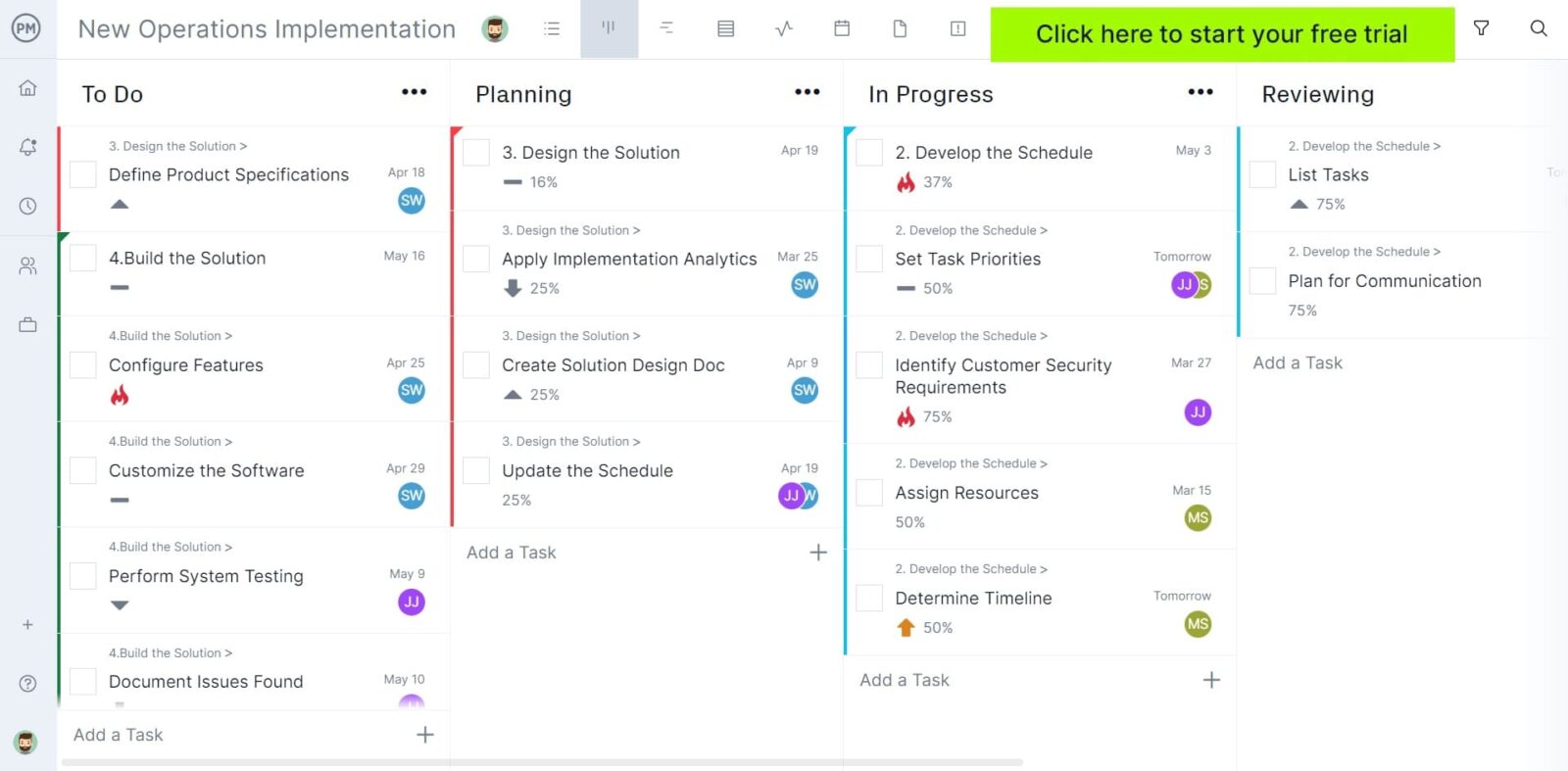
When those short cycles known as iterations in project management are intentionally repeated with built-in review and adjustment, they form an iterative process. In an iterative process work moves forward in increments, feedback reshapes upcoming tasks and lessons from one cycle directly influence the next. Over time, this structured repetition reduces risk, improves alignment and steadily strengthens overall project outcomes, which are built on constant feedback from project team members and external stakeholders.
What Is Iterative Project Management?
Iterative project management is an approach where project work is planned and delivered in repeated iteration cycles rather than a single linear sequence. Each iterative process produces usable output, incorporates feedback and reshapes upcoming tasks. Instead of locking everything upfront, teams intentionally adjust scope, priorities and solutions as real-world information emerges during execution.
Benefits of Iterative Project Management
We’ve already hinted at some advantages, but now it’s worth slowing down and looking at the most practical benefits teams experience when they implement iterative project management instead of committing to a traditional project plan.
- Increased customer satisfaction: Regular demonstrations and incremental deliveries allow customers and stakeholders to provide feedback early, which leads to outcomes that better match their evolving expectations.
- Earlier risk identification: Short work cycles expose technical, resource and requirement risks sooner, giving teams time to correct course before problems scale.
- Reduced rework: Because assumptions are tested frequently, misunderstandings are corrected in smaller increments rather than discovered at final delivery.
- Greater scope control: Teams can refine priorities between iterations, preventing uncontrolled scope growth and keeping focus on the highest-value work.
- Improved stakeholder alignment: Frequent check-ins keep stakeholders like sponsors, clients and team members aligned on progress, constraints and next steps.
- Better cost visibility: Incremental progress makes it easier to evaluate spending against delivered value instead of waiting for end-of-project financial reviews.
- Higher team accountability: Defined iteration goals create short-term commitments, encouraging ownership and measurable performance within each cycle.
- Faster delivery of usable features: Rather than waiting months for a complete solution, stakeholders begin receiving functional components earlier in the project lifecycle.
- Stronger adaptability to change: When priorities shift, adjustments can be made in upcoming iterations without destabilizing the entire project plan.
- Continuous process improvement: Retrospectives and reviews built into each cycle allow teams to refine workflows, communication and estimation accuracy over time.
Examples of Iterative Projects
Iterative processes aren’t limited to one industry. Iterative project management is used across industries that naturally benefit from structured, feedback-driven cycles.
Software Development
Inside software development teams, requirements shift, edge cases appear and technical constraints surface only after code is written and tested. Iterative project management allows developers to build in increments, validate functionality quickly and refactor before complexity compounds. Instead of attempting one massive release, teams stabilize architecture, improve performance and reduce defects through repeated, controlled engineering cycles.
Related: 18 Free Software Development Templates for Excel, Word & More
Here are some examples of iterative projects in software development.
- Developing a customer relationship management (CRM) system through sprint-based feature releases
- Building a mobile banking app with incremental security and usability enhancements
- Modernizing a legacy enterprise system through phased refactoring cycles
- Creating an e-commerce platform with staged checkout and payment integrations
- Implementing API integrations across multiple third-party systems
Digital Product Development
At the product level, uncertainty doesn’t just come from code—it comes from the market. Teams must validate assumptions about users, pricing and positioning while software is being built. Iterative project management supports MVP releases, structured user feedback and roadmap adjustments. Instead of locking strategy upfront, product teams refine value propositions and feature priorities based on real customer behavior.
Here are some examples of iterative projects in digital product development.
- Launching a subscription-based fitness app starting with a focused MVP
- Developing a fintech product with phased feature rollouts based on user adoption
- Creating a marketplace platform and refining pricing through A/B testing
- Building a learning management system while iterating on UX design from user feedback
- Introducing a new SaaS analytics product with staged onboarding improvements
Marketing
Campaign performance rarely matches marketing projections on the first attempt. Audience behavior, platform algorithms and competitive responses shift constantly. Iterative project management allows marketing teams to test messaging, adjust targeting and refine creative assets based on measurable data. Instead of committing the full budget upfront, teams optimize conversion rates, engagement and return on investment through structured experimentation cycles.
Related: 20 Marketing Templates for Planning, Strategy & More
Here are some examples of iterative projects in digital product development.
- Running a paid social media campaign with weekly creative testing and audience refinements
- Launching an email marketing funnel and optimizing subject lines through A/B testing
- Rolling out a content marketing strategy and adjusting topics based on engagement metrics
- Executing a product launch campaign with phased messaging adjustments
- Testing landing page variations to improve conversion performance
Research & Development (R&D)
Innovation rarely follows a straight line from concept to finished solution. Unknown variables, technical feasibility and performance constraints only become clear through testing. Iterative project management supports structured experimentation, prototype validation and controlled refinement. Rather than committing full resources upfront, R&D teams reduce uncertainty by building, testing and improving solutions in progressive development cycles.
Here are some examples of iterative projects in R&D.
- Designing a new medical device through successive prototype testing phases
- Developing a renewable energy technology with iterative laboratory trials
- Creating an automotive component and refining it through performance testing cycles
- Formulating a new pharmaceutical compound through staged clinical validation
- Building hardware prototypes for consumer electronics with incremental feature refinement
Iterative Project Management Methodologies
While iterative processes are dynamic and beneficial for organizations, they can become chaotic without a structured framework. Over time, several iterative project management methodologies have emerged to bring consistency and discipline to repeated cycles of planning, execution and review. Below is a practical overview of the most widely used approaches.
Agile Project Management
More than a structured project management methodology, agile project management is an iterative project management philosophy grounded in the Agile Manifesto, which emphasizes individuals and interactions, working solutions, customer collaboration and responsiveness to change. Rather than prescribing a strict framework, agile provides guiding principles for adaptive delivery, allowing teams to organize iterative work in ways that best fit their context.
Because agile is principle-driven rather than structurally rigid, iterations are implemented through frameworks such as scrum or flow-based systems like kanban. Teams collaborate closely with stakeholders, maintain prioritized backlogs and review progress frequently. Planning, feedback and adjustment happen continuously, but the specific ceremonies, roles and tracking tools depend on the chosen agile variation.
Scrum
Scrum is a structured agile framework that organizes work into fixed-length iterations called sprints, usually lasting two to four weeks. It defines specific roles, events and artifacts to guide iterative delivery. Scrum emphasizes transparency, inspection and adaptation, ensuring that progress and priorities are reviewed frequently and adjusted as needed.
In Scrum, constant team meetings called ceremonies are important for planning how work will be executed. Iterations are managed through sprint planning sessions where the product owner prioritizes backlog items and the team commits to deliverables. Daily stand-up meetings track short-term progress, while sprint reviews gather stakeholder feedback on completed work. Retrospectives evaluate team performance. Tools such as product backlogs, sprint backlogs and burndown charts help maintain visibility and accountability.
Kanban
Kanban is an iterative project management methodology focused on visualizing workflow and limiting work in progress to improve delivery efficiency. Unlike time-boxed approaches, it operates through continuous flow. Work items move across defined stages, allowing teams to identify bottlenecks and optimize throughput without fixed sprint cycles.
Iterations in kanban emerge through workflow management rather than scheduled sprints. Teams visualize tasks on kanban boards, typically divided into columns such as to do, in progress and done. Work-in-progress limits prevent overload, while regular review meetings assess cycle time and throughput. Continuous monitoring ensures adjustments happen naturally as work progresses.
Extreme Programming
Extreme programming (xp) is an agile, iterative project management methodology that emphasizes technical excellence, rapid feedback and continuous improvement. It focuses heavily on disciplined engineering practices such as pair programming, test-driven development and continuous integration. The goal is to improve software quality while remaining highly responsive to changing requirements.
Iterations in extreme programming are short and highly structured, often one to two weeks long. Developers work in pairs, write automated tests before coding and integrate changes frequently to avoid large-scale defects. Continuous customer involvement ensures requirements stay aligned with business needs. Tools typically include version control systems, automated testing frameworks and continuous integration servers.
Lean Development
Lean development is an iterative project management approach rooted in lean manufacturing principles, focused on maximizing value while minimizing waste. It encourages delivering small increments of work, validating assumptions quickly and eliminating activities that do not contribute directly to customer outcomes or measurable progress.
Iterations in lean development are driven by value delivery and flow efficiency rather than strict time boxes. Cross-functional teams prioritize high-impact tasks, limit work in progress and measure cycle time to identify bottlenecks. Feedback from users and stakeholders informs continuous adjustments. Visual boards, value stream mapping and flow metrics support ongoing optimization of the process.
Iterative Project Management Tools
Now that we have a better understanding of what iterative project management is and the different methodologies that teams use to coordinate their efforts, let’s take a closer look at the tools that help them manage iterative projects.
Kanban Board
A kanban board is a visual workflow management tool that displays work items as cards moving across columns representing stages of progress, such as to do, in progress and done. Each card typically includes a task description, owner, priority and status. Work-in-progress limits are often set per column to control capacity and maintain flow.
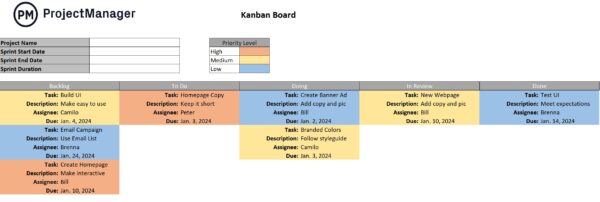
Using a kanban board, teams manage iterative work by continuously pulling tasks through the workflow rather than waiting for fixed cycles. As cards move across stages, bottlenecks become visible and adjustments happen in real time. Regular reviews of flow metrics such as cycle time help teams refine processes and improve delivery predictability.
Sprint Backlog
A sprint backlog is a prioritized list of tasks selected from the product backlog for completion during a specific sprint. It usually appears as a structured list or board containing user stories, task breakdowns, estimates and assigned team members. The sprint backlog defines the committed scope for that iteration.
Within an iterative process, the sprint backlog acts as the execution plan for a single time-boxed cycle. During sprint planning, the team selects and refines backlog items, then tracks progress daily. As work is completed, tasks move to done, and unfinished items are reassessed at the sprint review before the next iteration begins.
Product Backlog
A product backlog is a continuously evolving, prioritized list of features, enhancements, fixes and technical improvements required for a product. Items are typically written as user stories and include descriptions, acceptance criteria and estimated effort. It serves as the central repository of all potential work aligned with product goals.
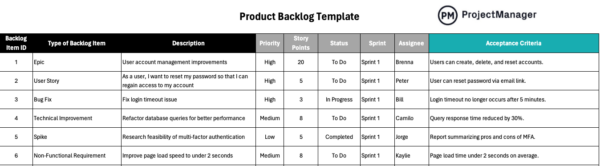
In iterative project management, the product backlog feeds upcoming iterations by ranking work according to value and urgency. Before each cycle begins, high-priority items are refined and selected for execution. Ongoing stakeholder feedback reshapes backlog priorities, ensuring future iterations focus on delivering the most meaningful improvements.
Burndown Chart
A burndown chart is a simple line graph that tracks remaining work against time within a sprint or iteration. The horizontal axis represents days in the cycle, while the vertical axis shows total work, often measured in story points or hours. An ideal trend line indicates planned progress, while the actual line shows real performance.
During an iteration, teams review the burndown chart daily to see whether work is progressing as expected. If the actual line flattens or rises, it signals delays, scope changes or estimation gaps. This visibility allows teams to adjust workload, remove blockers or recalibrate expectations before the iteration ends.
Retrospective Framework
A retrospective framework is a structured meeting format used at the end of an iteration to evaluate how the team worked. It typically includes prompts such as what went well, what did not and what should change. Notes are captured visibly, often on boards or shared documents, to organize insights and action items.
At the close of each iteration, the retrospective framework helps teams convert experience into improvement. Participants openly discuss collaboration, tools and obstacles, then agree on specific adjustments for the next cycle. Those action items feed directly into upcoming iterations, reinforcing continuous learning and strengthening the overall iterative process.
ProjectManager Can Help with IT & Software Development Projects
ProjectManager is an award-winning project portfolio management software equipped with powerful features for IT and software development teams, such as Gantt chart roadmaps to manage delivery plans and project portfolios, dashboards for monitoring resource utilization, project costs and progress in real time and kanban boards for agile sprints and iterative planning.
ProjectManager also offers robust resource management features such as workload charts to balance teams’ workloads and timesheets for detailed time tracking. On top of that, ProjectManager integrates with Jira and Azure DevOps and has an open API so that organizations can integrate its powerful project portfolio management features with their favorite tools. Watch the video below to learn more.
