



Before work begins on any construction site, teams and stakeholders need a shared reference to anchor expectations, measure progress and manage change. A baseline in construction plays that role by setting clear targets early, helping stakeholders stay aligned as schedules shift, costs fluctuate and project decisions accumulate over time.
What Is a Baseline In Construction?
A baseline in a construction project is an agreed-upon estimate of the schedule, budget or scope of work developed during planning by the project owner, project manager and key stakeholders such as designers, contractors or sponsors. Although formally approved, it remains a projection shaped by assumptions, inputs and known constraints. Actual performance is later measured against these estimated benchmarks, which together form the construction baseline.
- Construction schedule baseline: A construction schedule baseline is the approved estimated timeline for project activities and milestones. It reflects planned durations, sequencing and target dates, providing a benchmark to assess delays, accelerations or deviations as work advances.
- Construction cost baseline: A construction cost baseline represents the approved estimated budget for delivering the project. Built from forecasts, quantities and pricing assumptions, it establishes expected spending levels that are later compared to actual costs to identify overruns, underruns or financial risk.
- Construction scope baseline: A construction scope baseline defines the estimated boundaries of the work to be delivered. It outlines planned deliverables and requirements based on initial assumptions, serving as a reference point for evaluating changes when new information or conditions emerge.
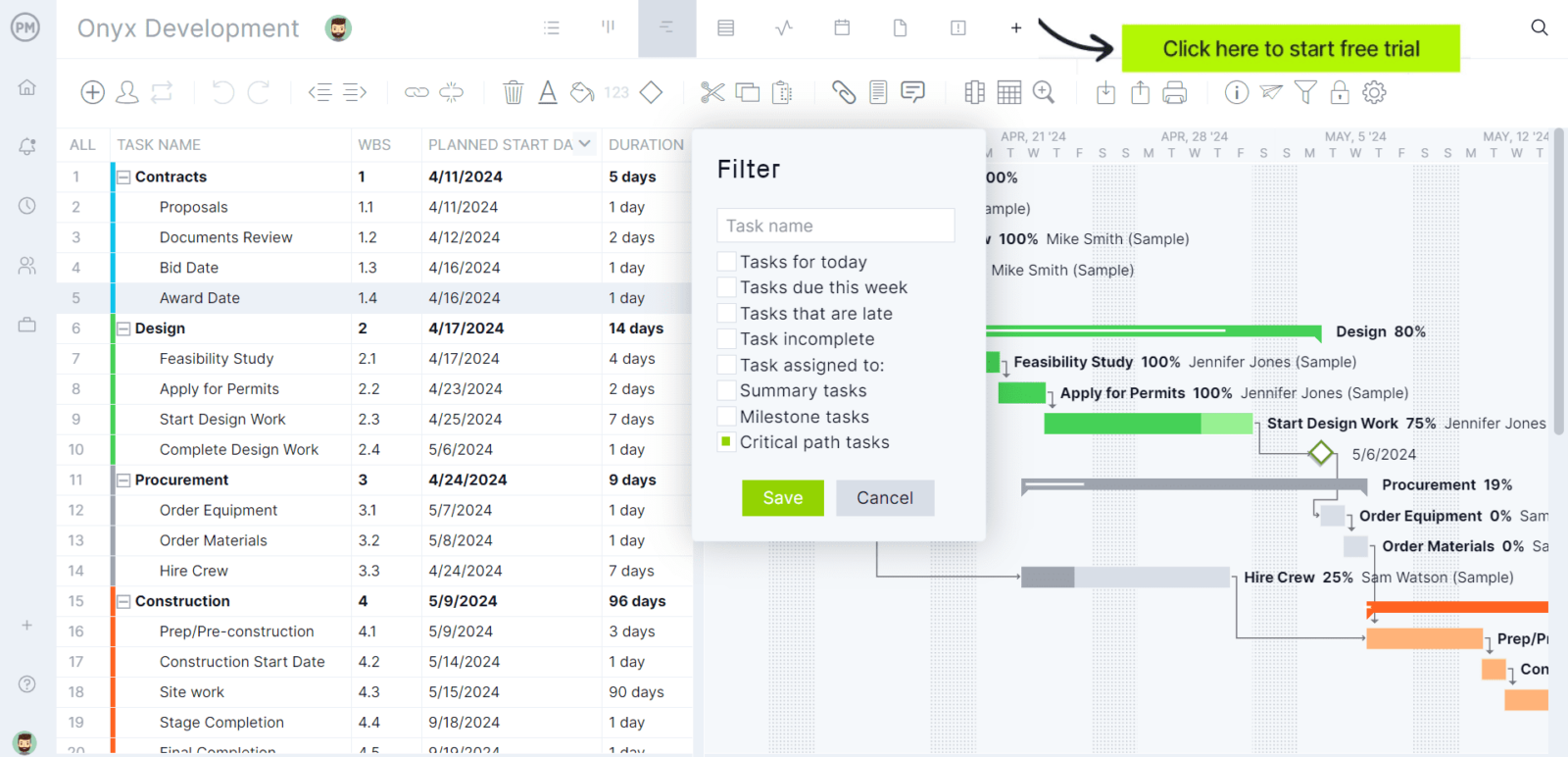
To create an accurate baseline for a construction project, you’ll need the right tools. ProjectManager is an award-winning construction project management software that’s ideal for establishing project baselines and tracking them as projects progress with tools like Gantt charts, workload charts, timesheets and real-time dashboards and reports. Additionally, ProjectManager also offers AI features that help to make sure nothing slips through the cracks. Get started for free today.
What Is the Purpose of a Baseline in Construction?
The primary purpose of a baseline in construction is comparison. Schedule, cost and scope baselines lock in estimated targets so actual performance can be measured against them as the project progresses. Without this comparison point, teams cannot quantify delays, overruns or scope changes. Baselines turn raw progress data into meaningful variance, enabling control, accountability and informed decision-making.
- Allows planned estimates to be directly compared against actual schedule, cost and scope performance.
- Makes deviations visible by quantifying variance rather than relying on subjective judgment.
- Provides the foundation for schedule variance and cost variance analysis.
- Enables objective tracking of project performance over time.
- Supports corrective actions based on measurable gaps between plan and reality.
- Clarifies whether changes reflect execution issues or approved scope adjustments.
- Creates a factual record of how the project performed versus its original estimates.
When to Make a Baseline for a Construction Project
Construction baselines should be established at the end of the planning phase, once design is sufficiently defined and estimates are credible but before execution begins. This typically follows conceptual and detailed design, takeoffs, scheduling and budget approval. Creating the baseline too early locks in unreliable assumptions, while creating it after construction starts removes its value. The baseline must reflect the approved plan that will be measured during procurement, mobilization and active construction across major project control areas from outset only.
Once established, the baseline is used continuously as actual progress, costs and delivered scope are recorded. Internally, the construction project management team compares real performance against the baseline to calculate variance, forecast outcomes and trigger corrective actions.
The same comparisons support clear reporting to project stakeholders such as project owners, and lenders. Instead of subjective updates, discussions are grounded in measurable differences between estimated plans and what is actually happening on site. This ensures transparency, accountability and alignment when approving changes, resolving disputes and explaining performance trends throughout the project lifecycle clearly.
Get your free
Construction Schedule Template
Use this free Construction Schedule Template to manage your projects better.
Get the template
Who Should Establish Baselines in a Construction Project?
The process of making a baseline for a construction project, is a collaborative effort involving those responsible for planning, execution and oversight. Project owners define objectives and constraints, project managers coordinate development, and designers and contractors contribute technical inputs. Financial controllers and planners validate assumptions. Together, these roles agree on estimated targets that will later be used to measure actual project performance throughout the construction lifecycle.
- Project owner: Approves baseline assumptions, funding limits and success criteria, ensuring schedule, cost and scope estimates align with overall business objectives.
- Construction project manager: Integrates schedule, cost and scope inputs into a single baseline and establishes the reference for performance comparison.
- Construction scheduler: A construction scheduler is responsible for developing the schedule baseline by defining activities, durations and dependencies based on the approved execution strategy.
- Cost estimator or quantity surveyor: Prepares the cost baseline using quantities, rates, contingencies and pricing assumptions derived from project scope.
- Design team: Establishes the scope baseline through approved drawings, specifications and documented deliverables at the time of baseline approval.
- Construction contractor: Contributes constructability input, productivity assumptions and sequencing insights that influence realistic schedule and cost estimates.
- Project controls or finance team: Reviews baseline data for consistency, risk exposure and reporting readiness before formal stakeholder approval.
How to Make a Baseline in Construction
The following steps explain how schedule, cost and scope baselines are created, which together form the construction baseline used for project monitoring and control.
1. Identify Project Goals and Objectives
Every construction baseline starts with clarity around what the project is meant to achieve. High-level goals and objectives guide all downstream planning decisions, shaping design priorities, specifications and performance expectations. When objectives are explicit early, such as targeting energy efficiency or accelerated delivery, they influence scope definition and prevent critical requirements from being overlooked as estimates are developed.
2. Create a Work Breakdown Structure
With general objectives established for the construction project, attention shifts to detailing the work itself. Using a work breakdown structure, the project team decomposes the overall scope into phases, deliverables and work packages. This structured breakdown creates visibility into everything required to complete the project. As the WBS matures, it becomes far easier to document a clear, measurable scope of work that will be used as the base for construction scheduling.

3. Write a Scope of Work Document
After the work has been broken down and organized, the next step is to formally document it. A scope of work translates the WBS into a written reference that defines what will be delivered, how success will be measured and where the boundaries of the project lie. This document consolidates assumptions, inclusions and exclusions, creating a clear scope baseline that guides sequencing, scheduling and cost estimation in the steps that follow.
4. Map Construction Sequences
After the scope of work is documented, project managers identify every single task that needs to be executed to deliver the project and determine the order in which they must occur. This is known as construction sequencing, a process that defines logical dependencies, constraints and handoffs between trades. Tools such as project network diagrams and Gantt charts are commonly used to visualize these relationships. Once tasks and sequences are mapped, the scope is sufficiently defined to establish a dependable scope baseline.
5. Create a Construction Schedule
With the scope defined and task sequences mapped, the project management team can develop the construction schedule that determines when work will actually take place. Each task is assigned an estimated duration, logical dependencies and planned start and finish dates based on available information such as subject-matter expert estimates or historical data from similar projects.
If that information isn’t available, there are construction scheduling techniques like the critical path method (CPM) or the program evaluation and review technique (PERT) which allow project managers to estimate the duration of tasks based on their dependencies and sequencing.
As this schedule is built, identifying the critical path is essential. The critical path is the longest chain of dependent activities that sets the minimum time needed to complete the project. Tasks on this path have no float, meaning they have no extra time available without affecting the final completion date.
Gantt charts are the standard tool to visually represent construction schedules as they can be used to identify task dependencies, project milestones and the critical path of projects. Once reviewed and approved, this estimated schedule becomes the schedule baseline, used to compare planned timelines against actual progress throughout construction.

6. Perform a Construction Takeoff
Once the scope of work is clearly defined, design and technical teams begin producing the documents needed to quantify the project. Architects develop drawings and specifications, engineers prepare structural, mechanical, electrical and plumbing plans, and designers may create CAD models or BIM files that detail building components.
These documents describe what will be built and how. Using them, estimators or quantity surveyors perform the construction takeoff process, systematically measuring and listing all required materials, labor, equipment, parts and assemblies. When completed, the takeoff provides a detailed picture of the resources needed to execute the work, forming the foundation for accurate cost estimates and a reliable cost baseline.
7. Make a Construction Budget
At this stage, the project team has a clear understanding of what resources the project will require. With quantities defined through the takeoff, costs for labor, materials, equipment, subcontracted work and overhead can be estimated with greater confidence.
These estimates are consolidated into a construction budget that reflects expected spending across phases and cost categories. Once reviewed and approved, this budget becomes the cost baseline, serving as the estimated financial reference used to compare actual expenditures and track cost performance throughout construction.
8. Establish a Construction Baseline for the Project
With the scope, schedule and budget defined, the construction project can formally establish its baseline. At this point, the scope baseline, schedule baseline and cost baseline are reviewed, approved and communicated to key stakeholders.
Together, they form the construction baseline that will be used throughout execution. From this moment forward, actual progress, costs and delivered work are measured against these estimated references to monitor performance, manage change and maintain control.
Construction Baseline Example
To illustrate how a construction baseline comes together, imagine a general contractor hired to build a mid-size hotel for a private project owner. The project includes guest rooms, common areas, a restaurant and a recreational pool area.
During planning, the team defines what will be built, when work is expected to occur and how much it should cost. These estimated elements are documented as scope, schedule and cost baselines. Below is a simplified example of a construction scope baseline for this project.
Construction Scope Baseline
| Project phase | Work package | Key tasks | Key deliverables |
| Design | Architectural planning | Define layout, room count, pool configuration | Approved architectural drawings |
| Site preparation | Earthworks and utilities | Clearing, grading, utility installation | Prepared site with services in place |
| Structural | Building structure | Foundations, framing, load-bearing elements | Completed structural shell |
| Interior construction | Guest rooms and common areas | Partitions, finishes, fixtures installation | Finished rooms and shared spaces |
| External works | Pool and outdoor areas | Pool construction, paving, landscaping | Completed pool and outdoor amenities |
Construction Schedule Baseline
| Work package | Estimated duration | Estimated start date | Estimated end date |
| Architectural planning | 8 weeks | 01/05/2026 | 03/01/2026 |
| Site preparation | 6 weeks | 03/08/2026 | 04/19/2026 |
| Building structure | 14 weeks | 04/26/2026 | 08/02/2026 |
| Guest rooms and common areas | 16 weeks | 08/09/2026 | 11/29/2026 |
| Pool and outdoor areas | 8 weeks | 10/04/2026 | 11/29/2026 |
Construction Cost Baseline
| Work package | Resource requirements | Estimated costs |
| Architectural planning | Architects, engineers, design software | $250,000 |
| Site preparation | Earthworks crew, excavation equipment, materials | $600,000 |
| Building structure | Concrete, steel, structural labor, cranes | $3,200,000 |
| Guest rooms and common areas | Interior trades, finishes, fixtures, equipment | $2,100,000 |
| Pool and outdoor areas | Pool contractors, materials, landscaping crew | $450,000 |
Free Construction Project Management Templates
We’ve created dozens of free construction project management templates for Excel, Word, Google Sheets and more. Here are some that can help establish and track a construction baseline.
Construction Schedule Template
This construction schedule template allows you to experience ProjectManager’s online Gantt chart tool. Create a thorough project task list, identify task dependencies, find the critical path of your project, allocate resources and much more.
Construction Scope of Work Template
This construction scope of work template helps define project tasks, deliverables, responsibilities and acceptance criteria in one structured document. It also links scope items to schedule progress and cost tracking, making it easier to establish and monitor the scope baseline throughout the construction project.
Construction Budget Template
This construction budget template allows teams to estimate, track and compare labor, material, equipment and fixed costs against actual spending. By organizing costs by task and WBS, it supports the creation of a clear cost baseline and ongoing cost performance monitoring.
ProjectManager Is Ideal for Making a Baseline for Construction Projects
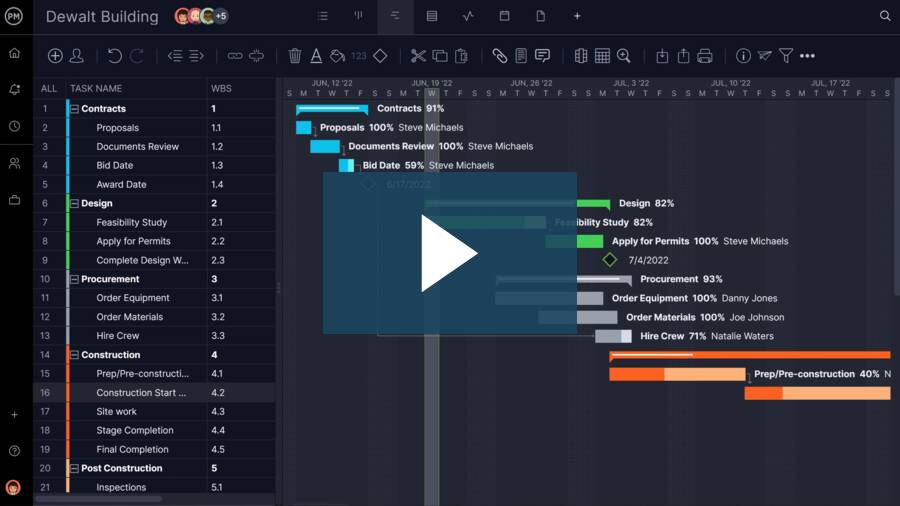
ProjectManager is an award-winning construction project management software equipped with powerful planning, scheduling and tracking features that allow to create detailed construction schedules, identify critical activities, allocate resources, establish baselines and compare estimated costs and task durations against actual project performance to quickly identify cost overruns, scope creep or delays. Watch the video below to learn more!
Related Construction Project Management Content
Our content library features over 100 construction blogs, templates, ebooks and other types of content to help construction project managers better understand the many moving parts that must be managed to deliver successful construction projects. Here are some of them.
