



What Is MYOB Acumatica?
MYOB Acumatica is a cloud-based enterprise resource planning (ERP) software platform used to manage accounting, finance, inventory, projects, customer relationships and business operations from a centralized system. It is commonly used in construction, manufacturing, distribution and service-based organizations to connect business data and control day-to-day processes across departments.
Previously known as MYOB Advanced, the platform combines Acumatica’s ERP technology with MYOB-specific localization for Australia and New Zealand business requirements. Teams use it to replace disconnected spreadsheets and software systems with shared workflows, real-time reporting and operational visibility across multiple functions.
What Is MYOB Acumatica Used For?
Growing organizations often reach a point where accounting systems, inventory tools and project data become difficult to manage separately. MYOB Acumatica is used to bring those processes into one environment so teams can track finances, manage inventory, monitor projects, process payroll, handle customer information and generate business reports. Companies typically use it to coordinate operational activities, improve data visibility and support decision-making across departments.
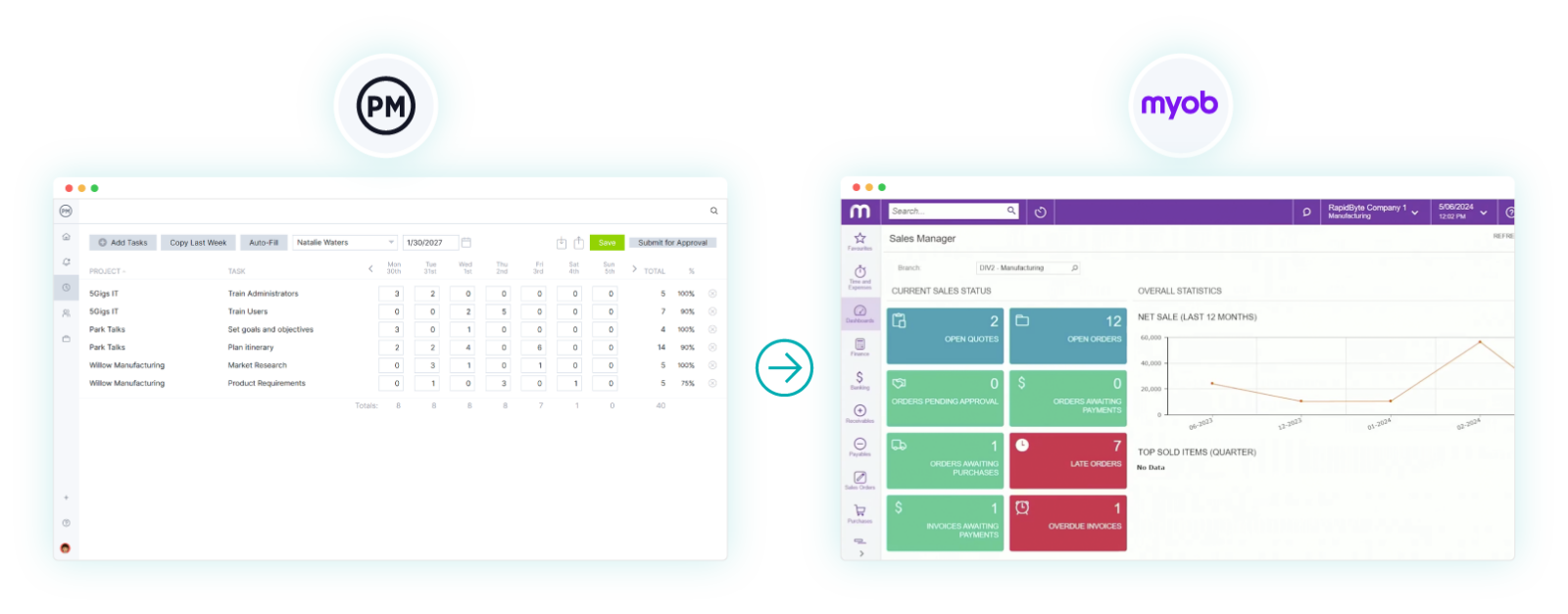
If you need a project management tool that integrates with MYOB Acumatica, try ProjectManager. ProjectManager is award-winning project management software that gives businesses across industries the tools they need to ensure projects are completed on time, within budget and within scope. It allows project managers to make detailed project schedules, estimate costs, allocate resources, set budgets, track progress and compare planned versus actual project outcomes using real-time dashboards and reports to identify delays or cost overruns quickly. Get started with ProjectManager for free today.
Who Uses MYOB Acumatica?
Now let’s take a closer look at how businesses across different industries use MYOB Acumatica to manage operations, track financial activity and coordinate day-to-day work.
Construction Companies
Construction businesses use MYOB Acumatica to connect project costs, procurement activities and financial data within a shared system. Teams often rely on it to monitor budgets, manage subcontractor expenses, track labor costs, process purchase orders and review project profitability. Having project management and accounting information in one place allows managers to compare planned costs against actual spending while keeping financial reporting current.
Manufacturing Companies
Production environments commonly use MYOB Acumatica to coordinate inventory levels, material requirements and manufacturing workflows. Daily operations may include tracking raw materials, managing bills of materials, scheduling production runs and monitoring product costs. Centralizing this information helps manufacturers reduce stock shortages, improve production planning and gain better visibility into operational performance.
Wholesale and Distribution Businesses
Distribution companies often manage thousands of products moving through warehouses, suppliers and customers simultaneously. MYOB Acumatica supports inventory tracking, purchasing activities, order processing and shipping workflows from a centralized platform. Teams use it to monitor stock availability, process customer orders faster and maintain more accurate records across the supply chain.
Professional Services Firms
Service-based organizations frequently use MYOB Acumatica to manage client work, employee time and financial operations. Managers may track billable hours, assign project resources, generate invoices and review revenue performance across active engagements. Bringing project and accounting data together makes it easier to understand utilization rates and monitor project profitability.
Retail and Multi-Location Businesses
Businesses operating across multiple stores or sales channels use MYOB Acumatica to coordinate inventory movement, purchasing decisions and financial reporting. Day-to-day work can involve tracking stock across locations, managing supplier orders and reviewing sales trends. Access to centralized business data helps teams make faster decisions and maintain consistent operations across different locations.
MYOB Acumatica Key Features
As organizations grow, managing financial records, inventory data, customer information and operational workflows through disconnected tools becomes increasingly difficult. MYOB Acumatica combines multiple business functions into one platform so teams can monitor activity, coordinate processes and access shared information without constantly switching between systems.
- Cloud-based ERP platform that provides access to business data from any location.
- Financial management tools for accounting, budgeting, reporting and cash flow monitoring.
- Inventory management capabilities to track stock levels and warehouse activities in real time.
- Project accounting features that connect project costs, budgets and financial performance.
- Customer relationship management tools for managing leads, contacts and customer interactions.
- Purchasing workflows that simplify vendor management and purchase order processing tasks.
- Payroll and workforce tools designed for employee and labor-related administration processes.
- Custom dashboards that display business metrics and operational data in centralized views.
- Multi-entity functionality for managing multiple companies from a shared system environment.
- Reporting and analytics tools that provide visibility into operational and financial trends.
MYOB Acumatica Pricing
MYOB pricing varies by product plan, billing frequency and promotional offer period. Based on MYOB’s pricing page, the listed plan names are Solo, Lite, Pro and Plus, with separate monthly and yearly pricing shown for each option.
| Pricing Plan Name | Who Is This Plan For? | Key Tools/Features Included | Pricing Amount |
| Solo | Sole traders that need an all-in-one mobile app for admin and payments | Banking tools, payments, automated tax and GST, mobile app, in-built AI features | $12/year for first 12 months, then $99/year |
| Lite | Sole traders and small businesses with up to two employees | Unlimited invoices, GST tracking, BAS lodgement, bank feeds, in-built AI features | $17.50/month, then $35/month; or $94.50/year, then $315/year |
| Pro | Small to medium businesses with multiple employees | Unlimited bank connections, payroll tools, expense tracking, reporting, in-built AI features | $21/month, then $70/month; or $315/year, then $630/year |
| Plus | Established businesses needing faster pay runs and inventory management | Inventory management, payroll processing, order management, time billing, priority support | $82.50/month, then $165/month; or $742.50/year, then $1485/year |
Note: Pricing information shown above is accurate as of the time this blog was published. MYOB may change pricing, promotional offers and plan features over time.
MYOB Acumatica Pros
MYOB Acumatica brings business information into a centralized platform where teams can access shared data, automate processes and gain broader visibility into day-to-day operations. Companies frequently adopt it to improve reporting, reduce duplicate work and maintain stronger coordination between departments.
- Centralizes financial, operational and customer data into a single connected business platform.
- Cloud-based architecture allows users to access information from multiple locations and devices.
- Custom dashboards provide real-time visibility into business metrics and operational performance data.
- Scales with growing organizations that need additional users, functions and business capabilities.
- Supports multiple business processes without relying heavily on disconnected software applications.
MYOB Acumatica Cons
Despite its broad functionality, MYOB Acumatica can present challenges for organizations during implementation and daily use. ERP systems typically require process adjustments, training and configuration work before teams can fully benefit from the platform. Businesses may also encounter limitations depending on budget, technical resources and the complexity of their operational requirements.
- Initial implementation may require significant setup effort, configuration time and internal planning resources.
- Users unfamiliar with ERP systems may experience a learning curve during early adoption stages.
- Advanced customization requirements can increase deployment complexity and ongoing administration responsibilities.
- Smaller businesses may find certain features unnecessary for simple operational requirements and workflows.
- Additional modules and customization needs can increase total software ownership and maintenance costs.
MYOB Acumatica User Reviews
Review platforms can provide additional insight into user experiences, feature feedback and overall satisfaction ratings. The sites below allow users to explore MYOB Acumatica reviews, ratings and customer comments.
- G2 MYOB Acumatica Reviews
- Capterra MYOB Acumatica Reviews
- Software Advice MYOB Acumatica Reviews
- SourceForge MYOB Acumatica Reviews
- GetApp MYOB Acumatica Reviews
ProjectManager Integrates with MYOB Acumatica
While MYOB Acumatica provides ERP functionality for finance, inventory, accounting and operational processes, many teams also need stronger planning and execution tools to manage project work. ProjectManager integrates with MYOB Acumatica and complements it by adding Gantt charts, task lists, kanban boards, workload management, timesheets and real-time dashboards that help teams plan schedules and monitor execution.
Together, the integration creates a connected ERP and project management solution that allows organizations across construction, manufacturing, professional services and other industries to align operational data with project planning, resource allocation and day-to-day work management.
ProjectManager Is a Robust Project Management Software
ProjectManager is an online project management software that provides a robust feature set of project planning, scheduling and tracking tools, including Gantt charts, kanban boards, task lists and real-time dashboards and reports. With these tools, teams across industries can build detailed schedules, assign resources and monitor progress, costs and timelines.
ProjectManager also delivers AI-powered project insights to support better decision-making and connects with over 100 tools like Microsoft Project, Acumatica and Jira. With its open API and wide range of integrations, organizations can seamlessly link ProjectManager to their existing systems.
Watch the video below to learn more!
MYOB Acumatica’s FAQs
Questions about branding, naming changes and product relationships can create confusion when researching MYOB Acumatica. The answers below clarify some of the most common topics users encounter when evaluating the platform.
What Is the Difference Between MYOB Acumatica and MYOB Advanced?
MYOB Acumatica is a cloud ERP platform used to manage financial, operational and business processes from a centralized system. It is commonly used by businesses that need accounting, inventory, project and customer management tools in one platform.
There is no major functional difference between MYOB Acumatica and MYOB Advanced because MYOB Advanced was the platform’s previous name. MYOB renamed the product to MYOB Acumatica to align it more closely with the underlying Acumatica technology platform and product ecosystem.
Are MYOB and Acumatica the Same?
MYOB and Acumatica are separate software companies that provide business management solutions. They are commonly used by organizations that need accounting, ERP and operational management software.
Acumatica develops the ERP technology platform, while MYOB delivers business software products and localized solutions. MYOB Acumatica combines Acumatica’s ERP platform with MYOB-specific functionality and regional features designed for Australia and New Zealand businesses.
Can MYOB Acumatica Integrate with Other Business Software?
MYOB Acumatica supports integrations with business software used to connect financial, operational and project-related workflows. It is commonly used by organizations that need business data to move between systems without relying on manual entry.
Examples of integrations include ProjectManager for project planning and execution, Microsoft Power BI for reporting and analytics, HubSpot for customer relationship management, Shopify for ecommerce operations, Microsoft 365 applications and payment platforms such as Stripe. Businesses may also connect payroll systems, banking tools and custom applications through APIs and third-party integration platforms.
If you need a tool to help you manage projects, then sign up for our software now at ProjectManager. Our online software helps teams across industries plan, track and oversee projects as they unfold. Sign up for a free 30-day trial today!
