



On busy construction sites, not every task can be priced neatly in advance. When uncertainty, urgency or incomplete information enters the picture, dayworks become a practical mechanism for keeping progress moving while maintaining transparency between contractors, clients and quantity surveyors.
What Are Dayworks?
Dayworks are a cost-recording method where construction work is documented and paid based on the actual labour hours, plant usage and materials consumed for a specific task as opposed to pricing work in advance by estimating the measured quantities or the estimated effort in terms of labour. Instead, site teams complete dayworks sheets that list resources used, which are later priced using agreed rates and submitted for valuation and payment.
When to Use Dayworks In Construction
Dayworks are used when traditional measurement is impractical or unreliable at the time work is instructed. This occurs when scope is undefined, conditions are unpredictable or instructions must be acted on immediately. In such circumstances, attempting to agree quantities upfront would either delay progress or result in inaccurate pricing, making dayworks the most reliable way to track and value costs as the work is carried out.
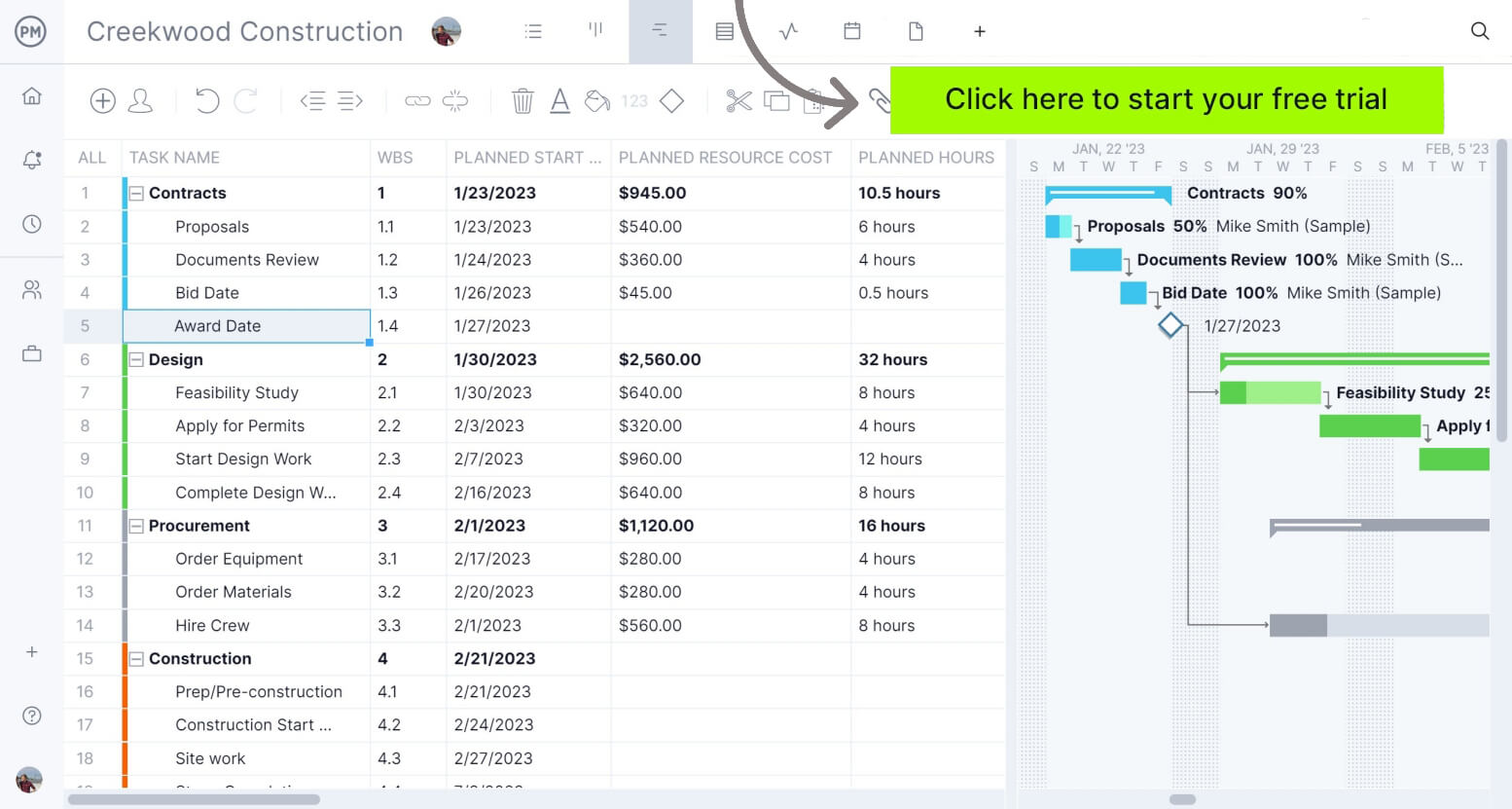
ProjectManager is a robust construction project management software with features that include Gantt charts, workload charts, timesheets, and real-time dashboards, ideal for estimating project costs, creating construction budgets and monitoring them as projects advance to quickly identify cost variances and overruns. Get started for free today.
What Is the Purpose of Dayworks In Construction?
The purpose of dayworks is to provide a fair and verifiable way to value work that cannot be priced accurately in advance. Their fundamental objective is commercial protection: allowing work to proceed without delay while ensuring costs are based on evidence rather than estimates. Dayworks create a controlled mechanism for capturing real expenditure, supporting transparent payment, cost justification and auditability within formal construction contracts.
How Are Dayworks Used In Construction Projects?
With the fundamentals established, it’s useful to move from theory into practice and examine how dayworks operate on real projects, highlighting the common situations where this costing method is applied.
Dayworks for Variations
When variations arise that cannot be accurately measured at the instruction stage, dayworks provide a practical pricing route. Labour, plant and materials are recorded as work progresses, avoiding speculative rates. This approach is valuable because it keeps work moving while ensuring variations are valued on actual resource use, giving both contractor and client confidence that costs reflect reality rather than assumptions made under time pressure during live construction environments on site.
Dayworks Sheet
On site, a dayworks sheet acts as the primary record of resources used for non-measured tasks. Supervisors document labour hours, plant usage and materials daily, often with signatures. Its value lies in contemporaneous evidence, reducing disputes later. By capturing information in real time, the dayworks sheet supports transparency, accountability and accurate cost agreement between parties across fast-moving construction project environments where instructions change frequently and site conditions evolve unexpectedly over time.
Dayworks Schedule
A dayworks schedule sets out agreed labour, plant and material rates before work begins, forming a commercial baseline. When dayworks are instructed, these predefined rates remove uncertainty. Their value is consistency, as both parties reference the same schedule. This prevents pricing disputes, speeds up valuation and ensures dayworks costs align with contractual expectations established at tender stage and supports disciplined cost control throughout project delivery and commercial administration processes overall.
Dayworks Valuation
During valuation, dayworks translate site records into payable amounts. Quantity surveyors assess verified sheets against agreed rates, ensuring only substantiated costs are certified. This use is valuable because it introduces structure and auditability into otherwise uncertain work. Dayworks valuation protects budgets, supports fair payment and provides a defensible basis for interim and final account assessments across complex construction projects with multiple variations and evolving scopes of work over time periods.
Dayworks in JCT and NEC Contracts
Under JCT and NEC contracts, dayworks provide a recognised mechanism for valuing work that falls outside measurable scope. JCT commonly relies on agreed daywork schedules, while NEC treats comparable work as defined cost or time charge. Their value lies in contractual clarity, giving both parties a pre-agreed framework for pricing unforeseen tasks. This reduces ambiguity, supports compliance with contract conditions and ensures costs are assessed consistently, transparently and in line with formal commercial procedures.
Advantages of Using Dayworks
Once dayworks are selected, their strengths become clear in uncertain conditions, offering flexibility, speed and commercial clarity when predefined quantities fail to reflect the realities of live construction sites accurately.
- Allows work to proceed immediately when scope cannot be defined, preventing delays caused by pricing uncertainty.
- Provides transparent cost recording based on actual labour, plant and materials used on site.
- Reduces speculative pricing by valuing work from verified records rather than assumptions.
- Supports fair commercial outcomes by aligning payment with real resource consumption.
- Creates a defensible audit trail for valuations, variations and final account negotiations.
Disadvantages and Risks of Dayworks
Despite their usefulness, dayworks introduce commercial exposure, administrative effort and behavioural risks that must be actively managed, especially where controls, authorisation or documentation practices are weak on busy construction projects.
- Costs can escalate quickly if dayworks are overused or poorly controlled.
- Heavy reliance on accurate site records increases administrative workload.
- Inadequate supervision may lead to inflated hours or inefficient working practices.
- Disputes can arise when records are incomplete, unsigned or retrospectively prepared.
- Frequent use may indicate scope definition or contract management weaknesses.
Dayworks Sheet Example
Midway through a city-centre refurbishment, the client requests an extra acoustic lining behind new partitions after ceilings are already open. The scope is too small and urgent for remeasurement, so the supervisor instructs the subcontractor to proceed on dayworks. Each operative, plant item and material is logged on a signed sheet to support valuation at the next interim payment cycle.
| Date | Dayworks Task / Instruction | Labour (Name & Role) | Hours | Plant / Equipment | Materials Used | Supervisor Sign-Off |
| 14/03/2026 | Install additional acoustic lining behind Partition Line A (Variation Instruction VI-17) | L. Reyes (Dryliner) | 6.0 | Mobile tower scaffold (1 unit) | Acoustic mineral wool (12 m2), Fixings (1 box) | A. Khan (Site Sup.) |
| 14/03/2026 | Install additional acoustic lining behind Partition Line A (VI-17) | M. Novak (Labourer) | 6.0 | Material hoist (shared) | Adhesive (2 tubes), Tape (1 roll) | A. Khan (Site Sup.) |
| 15/03/2026 | Make good and reinstate access panel around revised lining (VI-17) | L. Reyes (Dryliner) | 3.5 | Hand tools (included) | Plasterboard offcuts (1 sheet), Jointing compound (1 bag) | A. Khan (Site Sup.) |
Dayworks Schedule Example
Before starting a hospital fit-out, the main contractor agrees a dayworks schedule with key subcontractors to avoid pricing arguments during live changes. The schedule lists standard labour grades, common plant and typical consumables with hourly or unit rates. When a variation is instructed, the dayworks sheet is priced using these pre-agreed rates, keeping valuations consistent and reviewable by the QS.
| Category | Dayworks Item | Unit | Rate (EUR) | Notes |
| Labour | Dryliner (Skilled Operative) | Per hour | €42.00 | Standard hours only; overtime by agreement |
| Labour | General Labourer | Per hour | €28.00 | Includes basic handling and housekeeping |
| Plant | Mobile Tower Scaffold | Per day | €65.00 | Delivery/collection excluded unless stated |
| Materials | Acoustic Mineral Wool (45mm) | Per m2 | €6.80 | Measured net; wastage included in rate |
| Materials | Fixings and Consumables (Sundries) | Per task | €18.00 | Applies where itemisation is disproportionate |
Related Construction Project Management Templates
We’ve created dozens of construction project management templates for Excel, Word and Google Sheets. Here are some of them.
Bill of Quantities Template
Used widely in UK construction, a bill of quantities organises measured work, descriptions and rates, supporting tender pricing, cost control and valuation, while distinguishing measured items from separately assessed work.
Method Statement Template
A method statement explains how construction activities will be carried out safely and correctly, setting procedures, sequencing and controls, and is required on UK sites before work begins or changes.
Schedule of Values Template
A schedule of values breaks contract sums into payable components, supporting interim valuations and payment applications, and helping contractors and clients track progress, certified value and remaining contract balance accurately.
ProjectManager Is an Award-Winning Construction Project Management Software
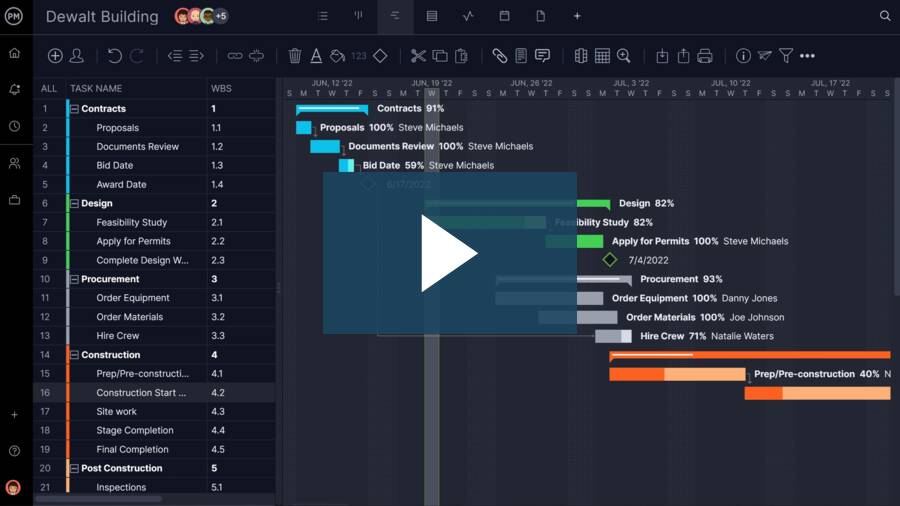
ProjectManager is an award-winning project management software packed with construction project planning, scheduling and tracking features, making it ideal for managing every phase of a construction project. Watch the video below to learn more and get started for free today!
Related Construction Project Management Content
We’ve created over 100 construction blogs, templates, ebooks and other types of content to help construction project managers better understand the many moving parts that must be managed to deliver successful construction projects. Here are some of them.
