



Last updated: November 5, 2026
The best Buildertrend alternatives for scheduling are ProjectManager, TeamGantt, Contractor Foreman, Buildern, Microsoft Planner and Project, Procore and Smartsheet. Builders look beyond Buildertrend when they need more from the Gantt chart than it offers, such as all four dependency types, crew workload across every job or lookahead schedules, to keep project timelines on track. ProjectManager is the best fit for builders running many homes at once who need all four dependency types, a critical path filter and crew hours across every job; TeamGantt suits builders who want lookaheads and subcontractor date confirmations at a flat price; Contractor Foreman and Buildern suit builders who want deep Gantt scheduling inside an all-in-one construction tool; Microsoft Planner and Project suits teams on Microsoft 365; Procore suits larger builders already on Procore; and Smartsheet suits teams that want a spreadsheet-style schedule.
Buildertrend’s schedule does more than many builders realize. It has a Gantt view, a critical path toggle, baselines and subcontractor confirmations. The question for a builder who lives in the schedule is how well it handles the hard cases: framing slips three days and drywall, electrical and inspections move on four homes at once, the same drywall sub is booked on two jobs next Tuesday, or the superintendent needs next week’s lookahead for every crew.
This guide is for builders whose main concern with Buildertrend is scheduling. It explains where Buildertrend’s scheduling falls short for some builders, what to look for in a construction scheduling tool and how seven alternatives compare on Gantt charts, dependencies, critical path, baselines and crew workload. If you’re comparing all-in-one platforms with client portals, selections and estimating, see the best Buildertrend alternatives for home builders instead. For a head-to-head comparison, see Buildertrend vs. ProjectManager.
ProjectManager is online project management software for construction scheduling. Link every task with all four dependency types and lag, filter for the critical path and see each crew’s hours across all your homes. Get started with ProjectManager today for free.

Where Buildertrend’s Scheduling Falls Short for Some Builders
Buildertrend’s scheduling falls short for some builders on dependency types, crew workload across jobs and lookahead planning, not on the basics. Its schedule includes calendar, list and Gantt views, and items linked on the Gantt move together: when a predecessor shifts, its successors shift by the same number of days. Buildertrend’s help center also describes a critical path toggle in the Gantt view, a baseline you set once the schedule is ready, shift reasons and history, workday exceptions for holidays, schedule templates and confirmation requests that let subs confirm or decline their dates. For many builders, that’s enough.
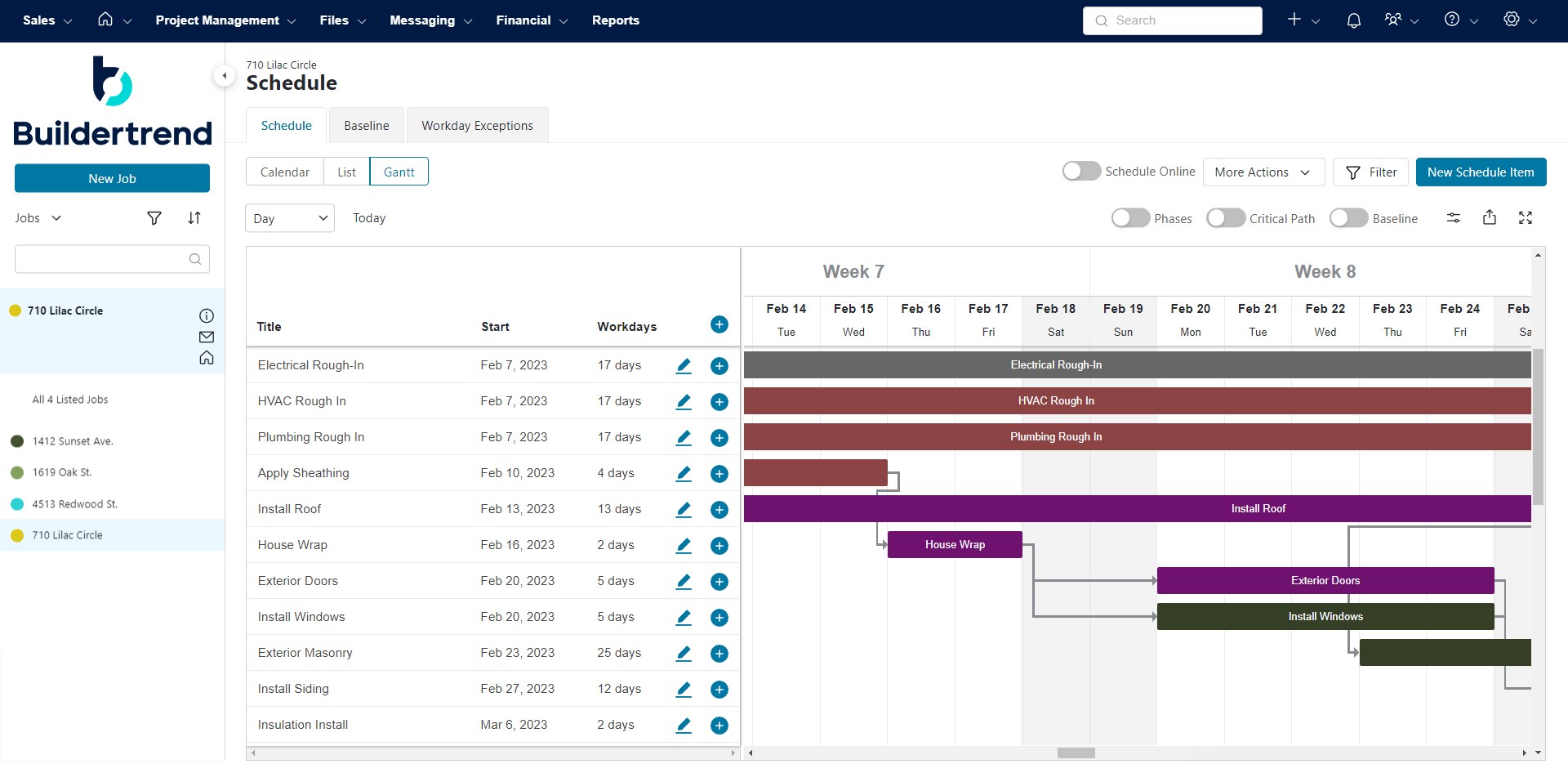
These are the limits builders run into most often:
- Two dependency types. Buildertrend links schedule items finish-to-start or start-to-start, with lag and lead. Its help center doesn’t describe finish-to-finish or start-to-finish links, which builders use for tasks that must finish together, such as final cleaning finishing with the punch list.
- Conflict warnings, but no workload view. Buildertrend shows a warning when you assign someone who’s already scheduled on another item, and you can view the calendar for all jobs at once. Its help center doesn’t describe a view of each person’s or sub’s hours across every job, which is what you need when a framing crew is booked on four homes next week.
- No dedicated lookahead. Buildertrend’s schedule can be filtered by date, assignee and status, but its help center doesn’t describe a lookahead schedule for planning the next two or three weeks of work.
- Notifications as dates cascade. A Capterra reviewer describes subs receiving several notifications with different dates as linked items shift during edits. Buildertrend only sends schedule notifications when the schedule is set to online, so setting it offline while you rework the dates avoids this.
If your schedules are mostly sequential and Buildertrend’s client portal, selections and financial tools are central to how you work, Buildertrend’s scheduling may be enough. If scheduling crews and subs across many homes is the hard part of your week, the tools below go further.
What to Look for in a Construction Scheduling Tool
A good construction scheduling tool should keep the logic of the job intact when dates move, show which tasks drive the finish date and show every crew’s workload across all your jobs. Check for these features.
A Gantt chart that handles real construction dependencies
The Gantt chart should support all four dependency types, finish-to-start, start-to-start, finish-to-finish and start-to-finish, with lag. Lag is how you model an inspection hold between rough-in and insulation, cure time after a slab pour or a lead time on windows. Negative lag, or lead, lets painting start before drywall is completely finished. Learn more about Gantt chart software.
Keeping construction timelines on track when dates slip
When a date moves, the tool should reschedule every linked task automatically. If framing slips three days, drywall, electrical trim-out and the final inspection should move with it on that home, and you should see the new finish date right away. Check whether rescheduling is automatic by default or depends on a setting.
Critical path and baselines
A critical path view shows which tasks set the completion date, so you know which delays actually push closing. Baselines save the original timeline so you can compare it with actual progress and document delays. Read more about the critical path method in construction.
Lookahead schedules
A lookahead pulls the next two to six weeks out of the master schedule so supers can plan crews, deliveries and inspections. Some tools have a dedicated lookahead feature; others rely on date filters and weekly views.
Crew and subcontractor workload across jobs
You should be able to see each crew’s and sub’s assignments across every home, not one schedule at a time. That’s how you catch a drywall sub booked on two jobs on the same day before it becomes a delay. Look for a workload or resource view across projects, and check whether it shows hours or only assignments.
Mobile field updates and sharing with subs
Superintendents should be able to update progress from a phone, and subs should be able to see their dates. Check what the mobile app can edit, whether subs need a paid seat and whether subs can confirm dates.
Import, export and pricing
Check whether the tool imports Excel, CSV or Microsoft Project files, since that’s how a Buildertrend schedule moves over. Then compare per-user pricing with flat company pricing, and count everyone who needs to edit the schedule.
Buildertrend Alternatives for Scheduling Compared
| Tool | Best for | Gantt chart | Dependency types and lag | Critical path | Baselines | Cross-job crew view | Mobile field updates | Starting price |
|---|---|---|---|---|---|---|---|---|
| ProjectManager | Builders running many homes who need crew workload across every timeline | Interactive Gantt with automatic rescheduling, plus sheet, board, list and calendar views | All four, with lag and lead | Yes, critical path filter | Yes, with variance reports | Workload page with hours across all projects (Business) | iOS and Android apps | $15/user/month (Team), $28/user/month (Business), billed annually |
| TeamGantt | Builders who want lookaheads and sub confirmations at a flat price | Drag-and-drop Gantt; portfolio timeline of every build (Builder Edition) | All four, with lag and lead | Yes, all paid plans | Unlimited (Business and Builder Edition) | Workloads across all active projects | iOS and Android apps; list view only | $59/month flat (Base); Builder Edition $199/month |
| Contractor Foreman | Budget-conscious builders who want Gantt scheduling in an all-in-one tool | Gantt, calendar and list views; tasks can link across projects | All four, with lag and lead | Yes (CPM) | Yes, per task | Crew schedule (Plus and above) | iPhone, iPad and Android apps | $49/month for the company (Basic, billed annually); Gantt scheduling from $166/month (Plus) |
| Buildern | Builders who want an all-in-one platform with multiple baselines | Gantt, list and calendar views with automatic shifting | All four, with lag and negative lag | Yes | Multiple named baselines | Assignee filter per project; no cross-job view documented | iOS and Android apps | $225/month (Starter, 2 seats, billed annually) |
| Microsoft Planner and Project | Builders on Microsoft 365 who want detailed CPM schedules | Timeline (Gantt) view in Planner premium plans; full Gantt in Project desktop | All four, with lead and lag | Yes (Planner and Project Plan 3) | One in Planner; up to 11 in Project desktop | People view within each plan | Limited; new features reach desktop and web first | Planner Plan 1 $10/user/month; Plan 3 $30/user/month, paid yearly |
| Procore | Larger builders already running jobs in Procore | Interactive Gantt in Procore Scheduling; milestones and version comparison | All four, with lag | Yes | Automatic version snapshots | Per project; cross-job crew planning in the separate Resource Planning product | iOS and Android apps; user guide lists Scheduling actions as web-only | Quote only, based on annual construction volume |
| Smartsheet | Teams that want a spreadsheet-style schedule | Gantt view on a sheet, with critical path highlighting | All four, with lag and lead | Yes, highlighted on the Gantt | One per sheet (Business and above) | Paid Resource Management add-on | iOS and Android apps; predecessor-driven dates can’t be edited on mobile | Pro $9/member/month, billed annually |
Prices are list prices as of November 2026 and change often. Check each vendor’s site before buying.
7 Best Buildertrend Alternatives for Scheduling
1. ProjectManager
ProjectManager is the best Buildertrend alternative for scheduling when you run many homes at once and need to see crews and subs across all of them. Each home’s schedule sits on a Gantt chart with all four dependency types, including finish-to-finish and start-to-finish links that Buildertrend’s help center doesn’t describe, and when framing slips three days, drywall, electrical trim-out and the final inspection move with it automatically. A critical path filter shows which tasks set the completion date, and a baseline with variance reports shows how far each home’s timeline has drifted.
Where ProjectManager goes further than Buildertrend is crew hours across jobs. The workload page shows each person’s assigned hours across all projects, so you can see that the drywall sub is booked on two homes next Tuesday and reassign the hours from the same screen. That page also works as a lookahead for next week’s crews, since ProjectManager has no dedicated lookahead feature. Subcontractors and equipment can be added as resources without buying them a license, and guests get free read-only access to the projects you share.
ProjectManager isn’t an all-in-one residential platform. It has no homeowner portal, selections, estimating or takeoff, and no dedicated change order workflow. Some builders keep Buildertrend or another all-in-one platform for those and run the schedule in ProjectManager alongside it. For a feature-by-feature comparison, see Buildertrend vs. ProjectManager.
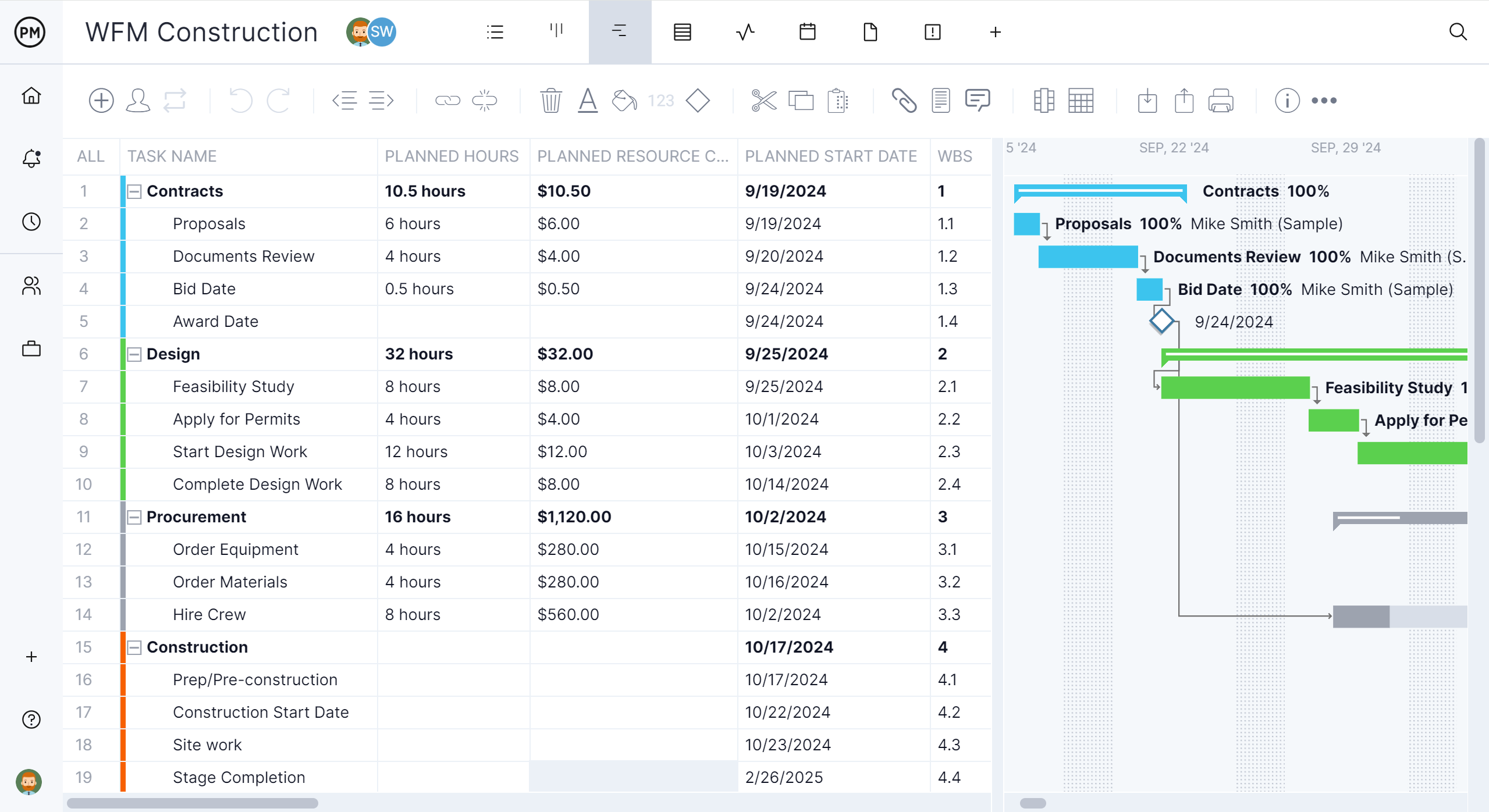
Best for: Home builders and light commercial contractors running many jobs at once who need all four dependency types, the critical path and crew hours across every project timeline.
Scheduling and Gantt chart features
- Gantt chart with finish-to-start, start-to-start, finish-to-finish and start-to-finish dependencies, plus lag and lead
- Automatic rescheduling of linked tasks when a date moves
- Critical path filter, baselines and variance reports
- Workload page with hours across all projects, with reassignment from the same view (Business plan and above)
- Subcontractors and equipment as resources with no license cost, and free read-only guests
- Portfolio roadmap and dashboard across projects (Business and above), plus timesheets and project dashboards
- Import of MPP, Microsoft Project XML, Excel and CSV files, and export to MPP, XML, Excel and CSV
- Browser access on any operating system, plus iOS and Android apps for progress updates and time
Pros
- All four dependency types, critical path and crew hours across every job in one tool
- Imports schedules from Excel, CSV and Microsoft Project files
- Published prices and a 30-day free trial
Cons
- No homeowner portal, selections, estimating, takeoff or dedicated change order workflow, so it doesn’t replace Buildertrend’s client-facing tools
- No dedicated lookahead view or subcontractor date confirmations; guests can view but not update, so a sub who updates progress needs a paid seat
- One baseline at a time, so setting a new baseline replaces the old one
- The workload page and portfolio views need the Business plan, and the Team plan is limited to 10 users and 20 projects, which matters if you set up one project per home
Pricing: Team $15/user/month, Business $28/user/month (billed annually), Enterprise by quote. 30-day free trial.
2. TeamGantt
TeamGantt is Gantt chart software with a construction plan, Builder Edition, aimed at custom home builders, remodelers, trade contractors and small commercial GCs. Its Gantt chart supports all four dependency types with lag and lead, highlights the critical path and stores as many baselines as you need on the Business and Builder Edition plans.
Builder Edition adds two things Buildertrend builders often ask for: 2- to 6-week lookaheads and subcontractor date confirmations by email or text, with no login for the sub. A portfolio view puts every active build on one timeline, and workloads show assignments across all active projects. The trade-offs are the mobile app, which shows projects as a list rather than a Gantt chart, and the project count, since Builder Edition’s starting price includes 10 active projects. For a broader list of scheduling tools, see the best construction scheduling software.
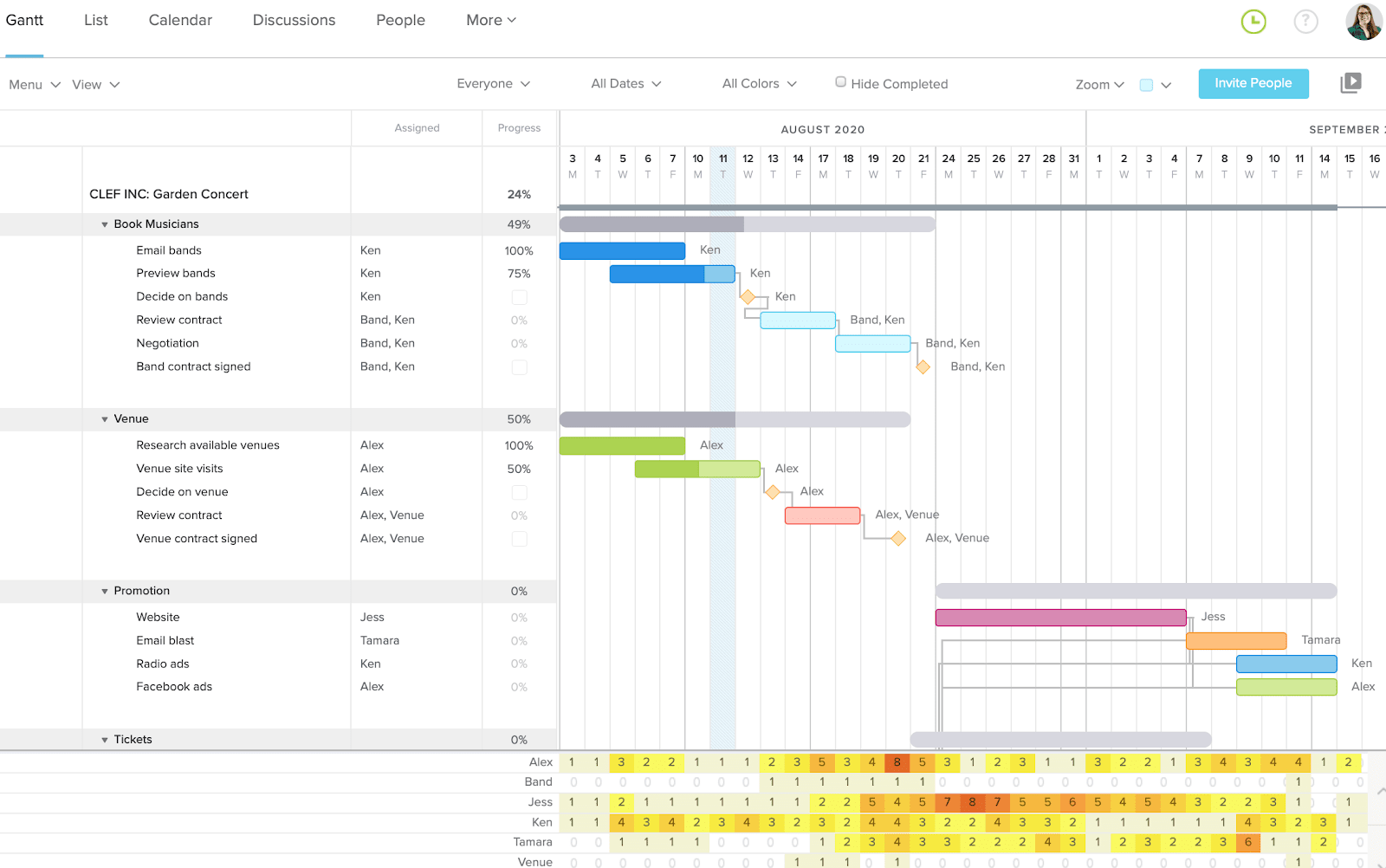
Best for: Builders and remodelers who want lookahead schedules and sub date confirmations on a simple Gantt chart, at a flat monthly price.
Scheduling and Gantt chart features
- All four dependency types with lag and lead; dependent tasks move with the predecessor when that setting is on
- Critical path highlighting on paid plans
- Unlimited baselines (Business and Builder Edition)
- Workloads across all active projects, with hours on Business and Builder Edition
- Lookaheads, sub date confirmations, portfolio view and a client portal (Builder Edition)
- Import of Microsoft Project files and export to CSV, PDF or Microsoft Project format
Pros
- Flat monthly price with unlimited users on Builder Edition
- Lookaheads and sub confirmations built for construction
- 14-day free trial
Cons
- The mobile app shows a list view only, with no Gantt chart
- Builder Edition’s starting price includes 10 active projects, which a builder with one project per home can outgrow
- The free trial requires a credit card, and imported Microsoft Project files don’t bring resources or assignments
Pricing: Free Personal plan (1 user, 1 project); Base $59/month; Business from $120/month; Builder Edition from $199/month with unlimited users and 10 active projects. Save 20% with yearly billing. 14-day free trial.
3. Contractor Foreman
Contractor Foreman is an all-in-one construction management tool, priced per company rather than per user, with scheduling that goes further than most tools in its price range. The Gantt scheduler supports all four dependency types with lead and lag, shows baselines and tracks the critical path, and tasks can be linked across projects so a delay on one home updates related tasks on another.
Two settings matter. Linked tasks only move when Auto Scheduling is turned on, and the Gantt scheduler and crew schedule start on the Plus plan. The crew schedule can send crews their next seven days of work by text or email, which serves as a simple lookahead, but Contractor Foreman’s help center doesn’t describe double-booking warnings. For its full feature set, see the best Buildertrend alternatives for home builders.
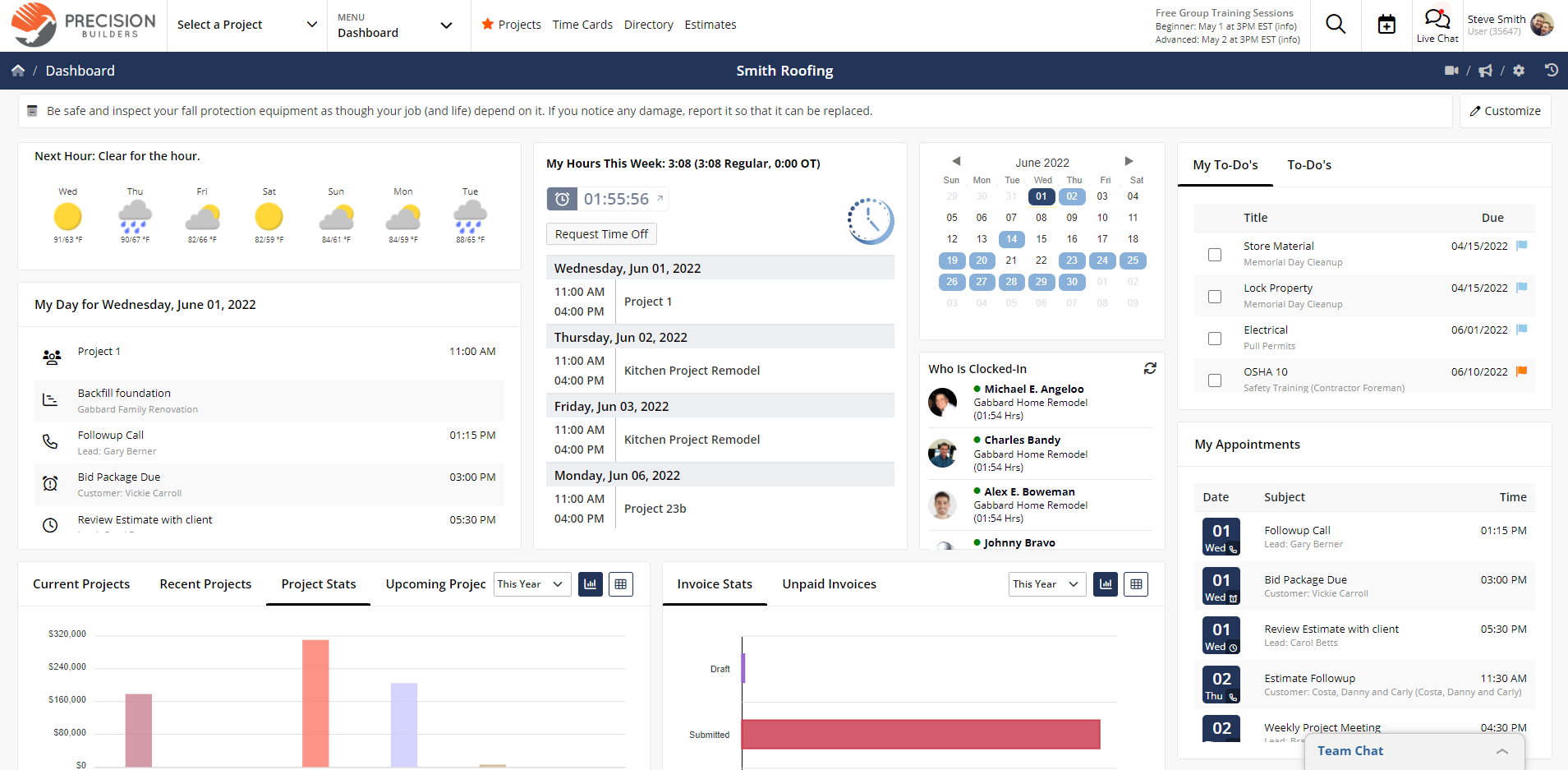
Best for: Budget-conscious builders who want Gantt scheduling with all four dependency types inside an all-in-one tool at a published company price.
Scheduling and Gantt chart features
- Gantt, calendar and list views (Plus and above)
- All four dependency types with lead and lag, and task links across projects
- Critical path and per-task baselines
- Crew schedule with text and email reminders and a seven-day schedule for crews (Plus and above)
- Schedule templates and Microsoft Project import and export
- iPhone, iPad and Android apps
Pros
- Scheduling depth close to dedicated scheduling tools
- Flat company pricing within each plan’s user limit
- 30-day free trial
Cons
- The Basic and Standard plans have no Gantt scheduling, so scheduling-focused builders start at Plus
- Dependencies don’t move dates unless Auto Scheduling is on, and Contractor Foreman acknowledges its baseline labels are confusing
- No documented double-booking warnings, and Gantt tasks can’t be edited from the crew schedule
Pricing: Basic $49/month (1 user), Standard $105/month (up to 3 users), Plus $166/month (up to 8 users), Pro $221/month (up to 15 users) and Unlimited $332/month, all billed annually. 30-day free trial.
4. Buildern
Buildern is construction management software for home builders, remodelers and commercial contractors, and its Gantt chart is one of the more complete among all-in-one platforms. It supports all four dependency types with lag and negative lag, shifts successor tasks automatically when a predecessor changes and has a critical path toggle on the Gantt toolbar. It also keeps multiple named baselines, so you can compare the current timeline with the original plan and with a re-baselined plan after a change.
Buildern’s limits for multi-home builders are on the crew side. Its calendar can be filtered by assignee, but its help center doesn’t describe a view of crews or subs across every project, double-booking warnings or a lookahead. Subs and vendors use a free portal with schedule-change notifications. Schedules import from Excel or CSV and export to PDF or Excel.
Best for: Builders who want an all-in-one construction platform with a full Gantt chart, multiple baselines and free subcontractor access.
Scheduling and Gantt chart features
- Gantt, list and calendar views
- All four dependency types with lag and negative lag, and automatic shifting of linked tasks
- Critical path toggle on the Gantt
- Multiple named baselines
- Schedule templates, Excel and CSV import, and PDF and Excel export
- Subcontractor and vendor portal with schedule-change notifications
Pros
- Multiple named baselines for comparing plan changes
- Unlimited subcontractors, vendors and field workers at no extra cost
- Published pricing
Cons
- No documented crew or sub view across projects, double-booking warnings or lookahead
- Microsoft Project import is listed on its scheduling page but not described in its help center
- Only a 7-day free trial, and office seats beyond those included cost $81 to $90/month each
Pricing: Starter $225/month (2 seats included) and Professional $360/month (4 seats included), billed annually, with extra seats at $81 and $90/month; Enterprise by quote. 7-day free trial.
5. Microsoft Planner and Project
Microsoft Planner and Project is the option for builders on Microsoft 365 who want detailed CPM schedules. Planner premium plans add a timeline (Gantt) view with all four dependency types, lead and lag, and Planner updates dates automatically when a predecessor moves. Planner and Project Plan 3 adds the critical path, baselines and the Project desktop client, which saves up to 11 baselines.
For a builder running many homes, the gaps are crew visibility and the field. Planner’s People view shows workload within one plan rather than across every home, Project desktop runs on Windows, and Microsoft says new Planner capabilities reach desktop and web first. Neither has construction features such as sub confirmations. For more on Microsoft’s tools, see the best Microsoft Project alternatives for construction.
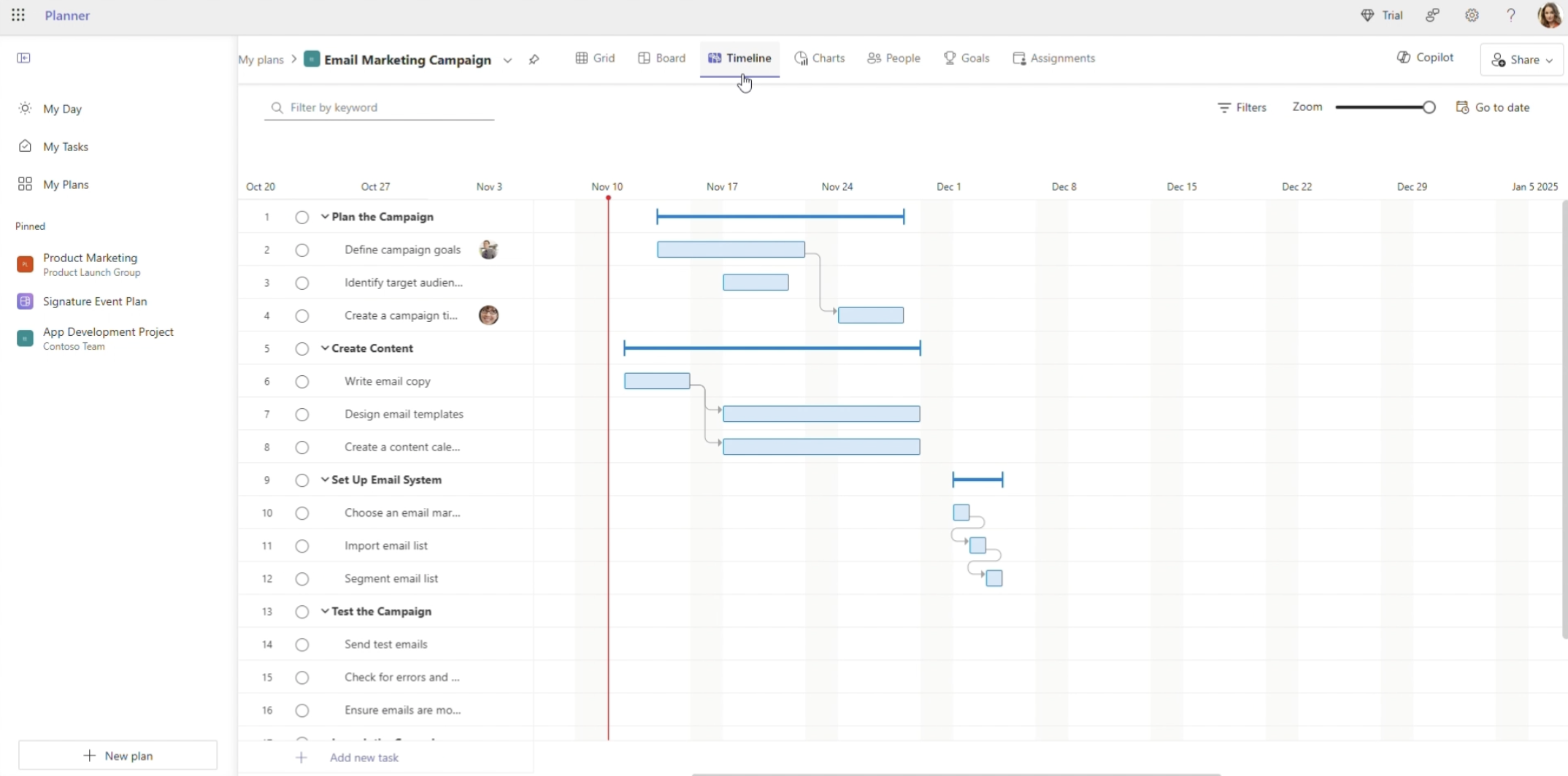
Best for: Builders on Microsoft 365 who want detailed CPM schedules in Planner or Project desktop with one vendor and sign-in.
Scheduling and Gantt chart features
- Timeline (Gantt) view in Planner premium plans
- All four dependency types with lead and lag, and automatic date updates
- Critical path and baselines (Planner and Project Plan 3)
- Project desktop client with up to 11 baselines (Plan 3)
- People view for workload within a plan
Pros
- Project desktop handles detailed CPM scheduling
- Works with Teams, Outlook and other Microsoft 365 apps
- One-month free trial
Cons
- Critical path and baselines need Planner and Project Plan 3, and Project desktop runs on Windows
- No workload view across plans, so crews on several homes are hard to see together
- Planner can’t import MPP files directly, and premium scheduling on mobile is limited
Pricing: Basic Planner included with Microsoft 365. Planner Plan 1 $10/user/month and Planner and Project Plan 3 $30/user/month, paid yearly.
6. Procore
Procore is a construction management platform, and Procore Scheduling, generally available since February 2026, puts a full Gantt chart inside it. It supports all four dependency types with lag, highlights the critical path and captures schedule versions automatically for baseline comparisons. It also imports Microsoft Project and Primavera P6 files, and Procore’s help docs tie its lookahead schedules to master schedules imported that way.
For residential and light commercial builders, Procore is usually more platform than a scheduling problem needs. Resource assignments in Procore Scheduling work within a project, and crew planning across jobs is a separate product, Procore Resource Planning. Procore’s user guide lists Scheduling actions as web-only, though its 2026 iOS release notes mention a mobile schedule with quick percent-complete edits. Pricing is based on annual construction volume. For more options, see the best Procore alternatives.
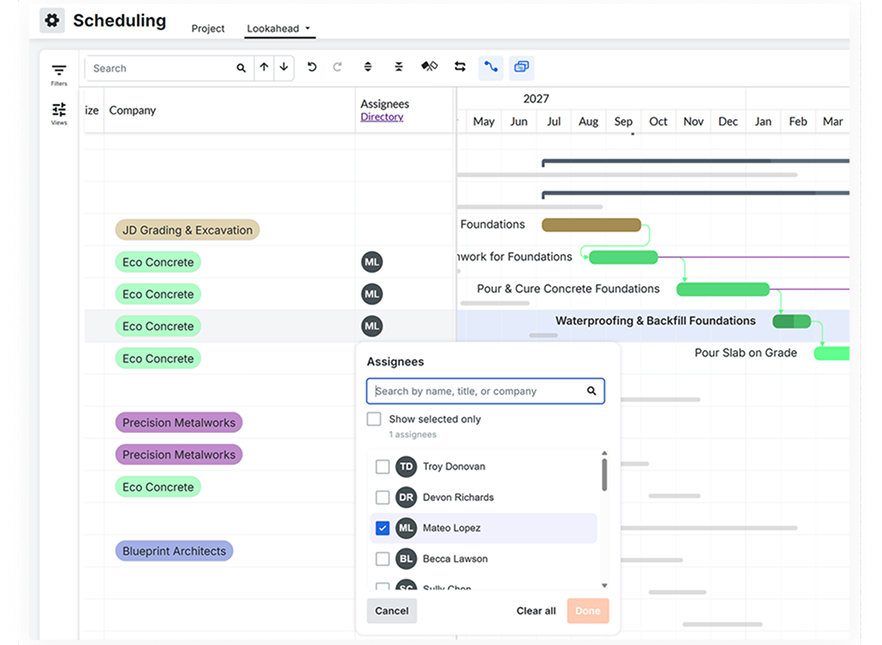
Best for: Larger builders and contractors already running jobs in Procore who want the schedule next to documents, RFIs and financials.
Scheduling and Gantt chart features
- Interactive Gantt chart with milestones
- All four dependency types with lag, with successors shifting as you move bars
- Critical path and automatic version snapshots with a compare view
- Lookahead schedules built from an imported master schedule
- Import of Microsoft Project and Primavera P6 files
Pros
- Puts the schedule next to the rest of the project record
- No charge for adding users
- Widely used by general contractors and larger builders
Cons
- Crew planning across jobs needs the separate Resource Planning product
- Procore’s user guide lists Scheduling actions as web-only
- Pricing is based on annual construction volume and can be high for smaller builders
Pricing: By quote, as an annual fee based on the products you choose and your annual construction volume. No charge for additional users.
7. Smartsheet
Smartsheet is a spreadsheet-style work management tool with a Gantt view. It supports all four dependency types with lag and lead, updates dependent dates immediately when a predecessor changes and highlights the critical path. It’s familiar to anyone who builds schedules in spreadsheets, and it imports Microsoft Project files.
For builders, the gaps are crews and the field. Resource planning across projects comes from Resource Management by Smartsheet, a paid add-on, each sheet holds one baseline, and dates driven by a predecessor can’t be edited from the mobile app. There are no construction features such as sub confirmations or lookaheads. For a closer look, see the best Smartsheet alternatives for construction.
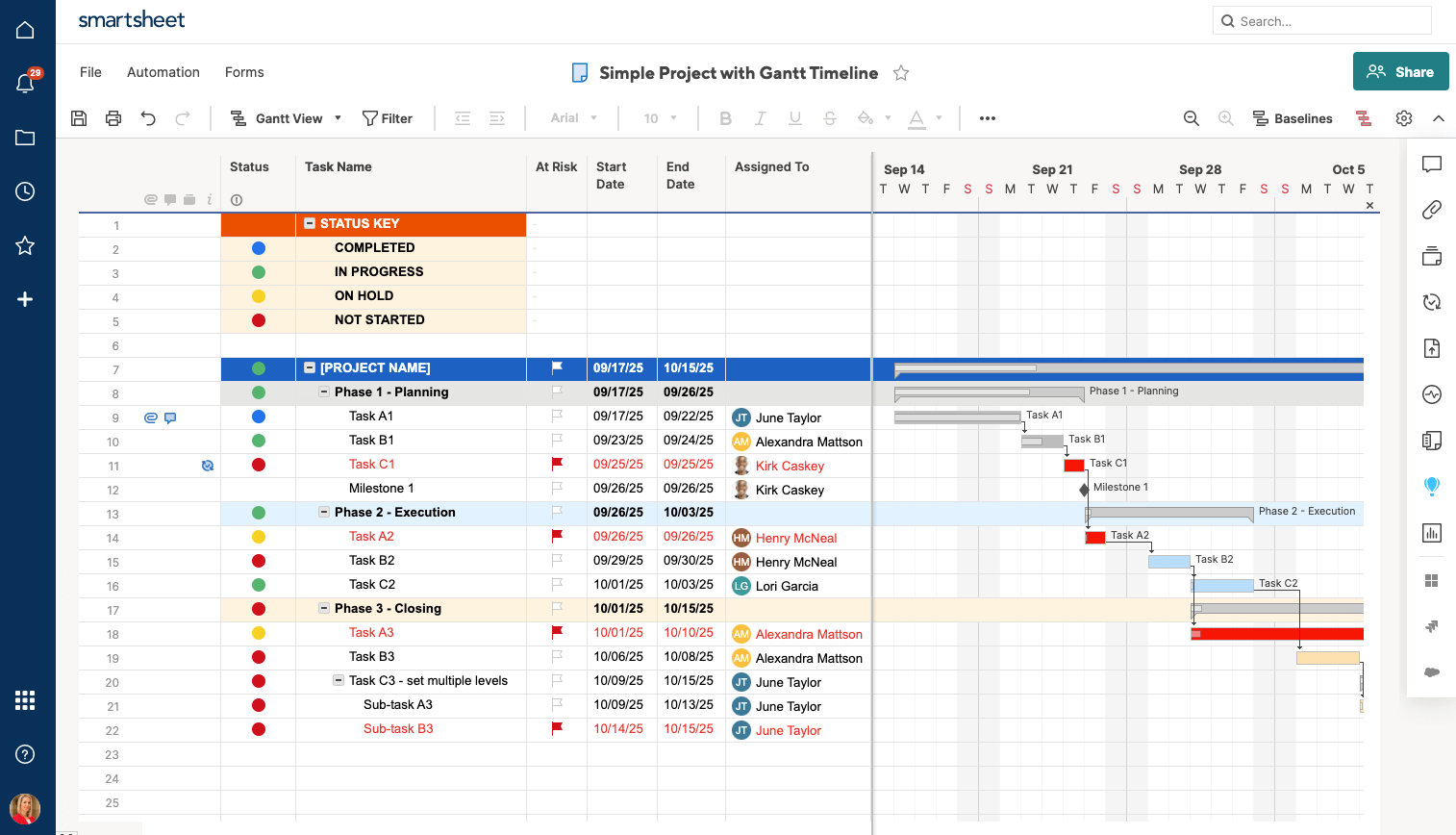
Best for: Builders who want a spreadsheet-style schedule with dependencies and critical path, and don’t need crew workload across jobs.
Scheduling and Gantt chart features
- Gantt view with all four dependency types, lag and lead
- Critical path highlighted on the Gantt
- One baseline per sheet (Business and above)
- Import of Microsoft Project, Excel and CSV files
- Resource Management add-on for workload across projects
Pros
- Familiar spreadsheet layout with little training
- Free contributors can view and comment on shared sheets
- 30-day free trial
Cons
- Crew workload across jobs needs a paid add-on
- Dates driven by predecessors can’t be edited on mobile
- No construction-specific scheduling features such as lookaheads or sub confirmations
Pricing: Pro $9/member/month billed annually ($12 monthly), Business $19/member/month billed annually ($24 monthly), Enterprise by quote. 30-day free trial.
How to Move Your Buildertrend Schedule Into ProjectManager
To move your Buildertrend schedule into ProjectManager, export each job’s schedule to Excel, set up one project per home with matching working days, import and map the file, then re-link dependencies and set a baseline. Buildertrend’s help center says grids that support it have an Export option that downloads an Excel file, and it doesn’t describe a Microsoft Project export, so plan to check the logic after importing.
- Export from Buildertrend. Open the job’s schedule in List view and export it to Excel. Do this for each home, and keep a PDF printout of each Gantt view so you can check the links later.
- Set working days first. In ProjectManager, click the + button and choose Project, then set your working days to match the job, such as a five-day or six-day work week. Working days are hard to change once the project exists. Add any global holidays now too, since they can’t be added to existing projects.
- Create one project per home. Name each project by lot or address so it’s easy to find on the portfolio and workload views. If you build the same plans repeatedly, save a finished schedule as a project template (Business and above) or copy an existing project and set a new start date.
- Import the file. Choose Import File when creating the project, or click the import icon on the Gantt ribbon of an existing project. Click select file, upload your Excel or CSV file and click next. If you’re importing into an existing project, choose Keep and append with the imported data or Replace with the imported data. Replace removes everything already in the project.
- Map the columns. Map each column, such as task name, assignee, start, finish and duration, to the matching Gantt column, then click import. Columns you leave unmapped are skipped.
- Re-link dependencies and add lag. Compare the schedule with your Buildertrend Gantt view and link any tasks that didn’t come through. This is the time to use finish-to-finish and start-to-finish links where they fit, and to add lag for inspection holds, concrete cure times and material lead times.
- Filter for the critical path. Turn on the critical path filter and check that it shows the tasks that drive the completion date. If it doesn’t, look for missing links or lag.
- Set a baseline. Once the schedule is right, set a baseline in Gantt settings so you can track variance from the start of the build.
- Add crews and subs, then check workload. Add crews and subcontractors as team members or as resources with no license cost, assign them to tasks and open the workload page to see their hours across every home (Business and above). That’s where a sub booked on two homes on the same day shows up.
Keep your original Buildertrend exports. If you keep Buildertrend for the homeowner portal, selections or financials, decide which tool owns the schedule dates so homeowners and subs don’t see two versions.
Want to see all your homes on one timeline? Start a free 30-day trial, import a schedule exported from Buildertrend and check crew workload across every home. Get started with ProjectManager today for free.
Buildertrend Scheduling Alternatives FAQ
Does Buildertrend have Gantt charts?
Yes. Buildertrend’s schedule has a Gantt view alongside its calendar and list views, where you link items by dragging between them and items move together when a predecessor shifts. Builders who want more from a Gantt chart usually look for all four dependency types (Buildertrend’s help center describes finish-to-start and start-to-start, with lag and lead), a view of crew workload across every job and lookahead schedules.
Does Buildertrend have critical path scheduling?
Yes. Buildertrend’s help center describes a Critical Path toggle in the Gantt view that outlines the critical path, with items off the path shown in grey because they have float. The path is calculated from the items you’ve linked, so it depends on links being in place, and Buildertrend links items finish-to-start or start-to-start.
What’s the best software for managing construction project timelines?
For builders running many homes, ProjectManager keeps project timelines on track with all four dependency types, automatic rescheduling, a critical path filter, baselines and crew hours across every project. TeamGantt’s Builder Edition adds lookaheads and sub date confirmations at a flat price, and Contractor Foreman and Buildern put deep Gantt scheduling inside all-in-one construction tools. For a longer list, see the best construction scheduling software.
Can I use a separate scheduling tool alongside Buildertrend?
Yes. Some builders keep Buildertrend for the homeowner portal, selections, estimates and change orders, and run the master schedule and crew workload in a dedicated scheduling tool such as ProjectManager. Decide which tool owns the dates, and plan how updates reach the homeowner, so clients and subs don’t work from two different timelines.
What is the best scheduling software for home builders?
It depends on how many homes you run and what else you need. Builders running many homes at once who mainly need scheduling and crew coordination can start with ProjectManager. Builders who want lookaheads and sub confirmations on a simple Gantt chart can look at TeamGantt, and those who want scheduling inside an all-in-one tool can look at Contractor Foreman or Buildern. For all-in-one options with client portals and selections, see the best Buildertrend alternatives for home builders.
Can I export my schedule from Buildertrend?
Yes, to Excel. Buildertrend’s help center says you can select Export on any grid that supports it to download an Excel file, and schedules can be printed or saved as PDFs. Its help center doesn’t describe an export to Microsoft Project, so expect to re-link dependencies in the new tool.
What happened to CoConstruct?
CoConstruct was acquired by Buildertrend in February 2021, and its customers are now being moved onto Buildertrend. CoConstruct’s site says the transition to Buildertrend is entering its final phase, so it isn’t a current option for new builders.
Is Fieldwire good for construction scheduling?
Fieldwire is built for field work from drawings, tasks and punch lists rather than CPM scheduling. Its Gantt view shows tasks on a timeline and links related tasks, but Fieldwire’s own scheduling guide says changing a task’s dates doesn’t automatically move related tasks. Many teams pair Fieldwire with a separate scheduling tool for the master schedule.
Related Content
- Best Buildertrend Alternatives for Home Builders (2026)
- 15 Best Construction Scheduling Software for 2026 (Free & Paid)
- Best Smartsheet Alternatives for Construction (2026)
- Best Microsoft Project Alternatives for Construction (2026)
- 11 Best Procore Alternatives of 2026 (Free + Paid)
- Critical Path Method (CPM) in Construction: A Quick Guide
