


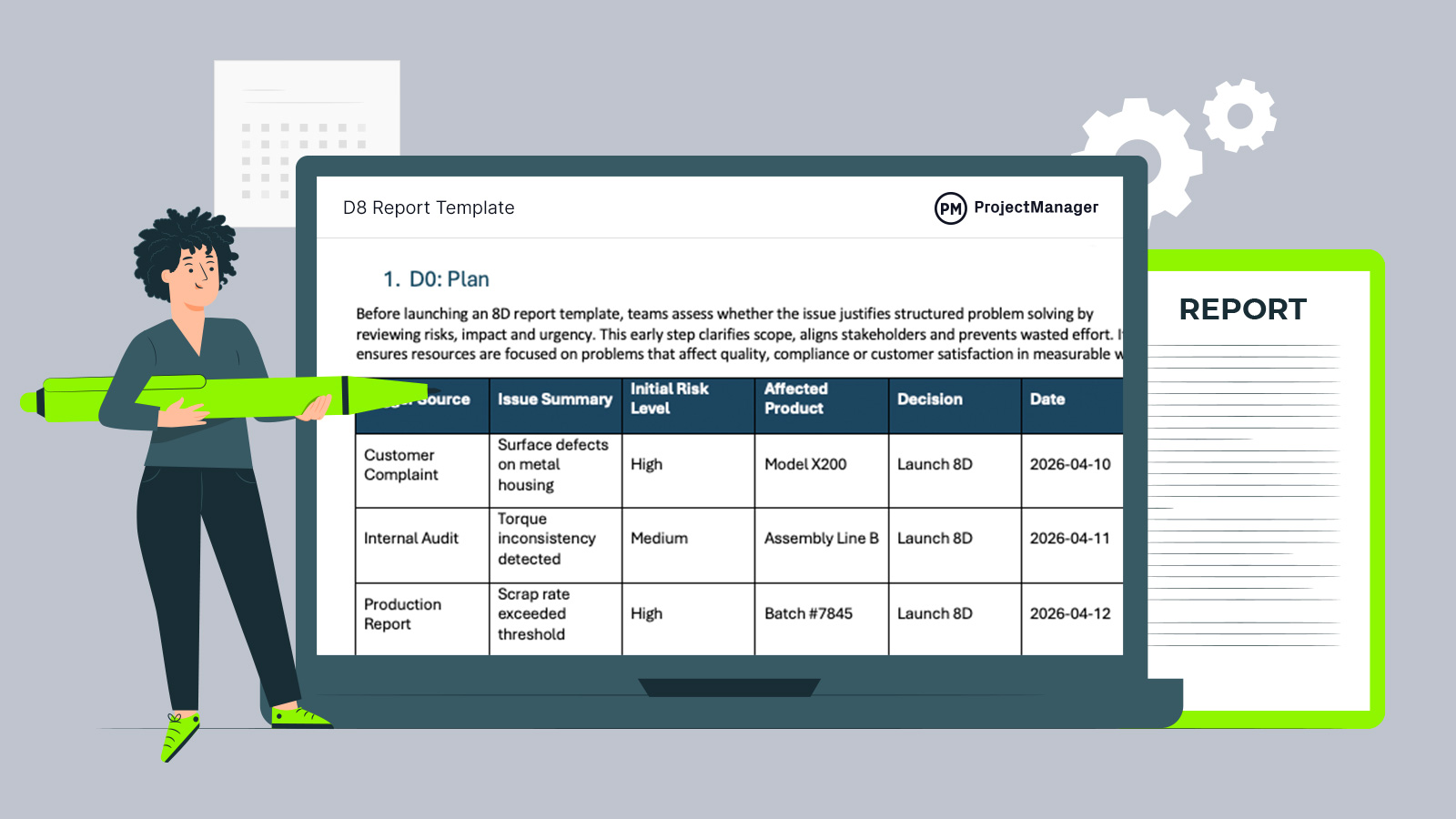
When recurring quality issues disrupt production or customer satisfaction, having a structured way to respond becomes critical. An 8D report template helps teams organize investigations, document corrective actions and ensure problems are resolved thoroughly instead of repeatedly resurfacing across operations.
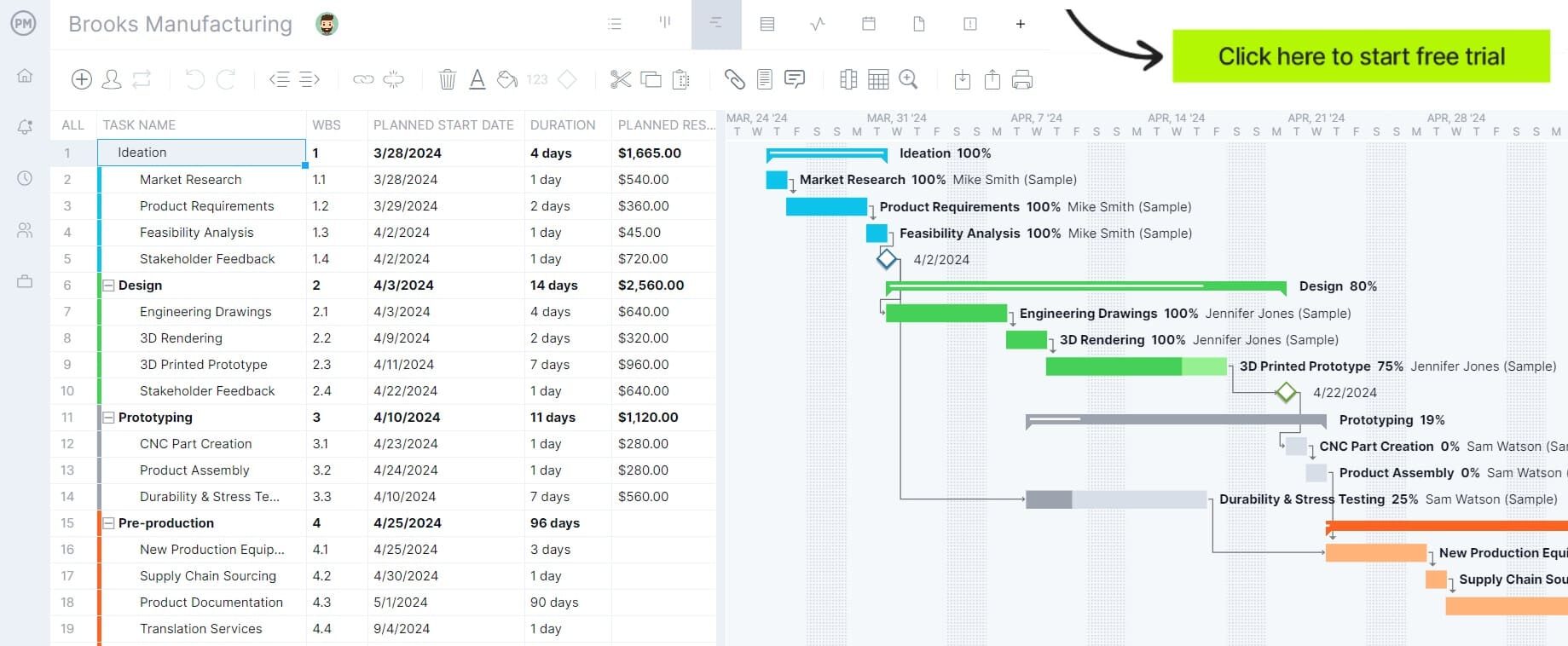
ProjectManager is an award-winning project management software that is equipped with tools that allow manufacturers to plan, schedule and monitor their projects from start to finish. Use Gantt charts to make production roadmaps, manage workflows with kanban boards, allocate resources with workload charts, track costs with timesheets and monitor your projects with real-time dashboards and reports. Get started for free today.
Why You Need a 8D Report Template
Without a consistent structure, problem-solving efforts often become reactive, inconsistent and difficult to track across teams. An 8D report template for Word provides a standardized format that guides teams through each stage of investigation, from defining issues to implementing corrective actions. This consistency improves collaboration, ensures accountability and makes it easier to document decisions, share findings and meet quality or compliance requirements in manufacturing environments.
When To Use a 8D Report Template
Manufacturing teams rely on an 8D report template when issues exceed routine troubleshooting and require structured investigation. It is typically used when defects impact quality, safety or customer satisfaction, especially when problems are recurring, complex or involve multiple departments that must coordinate to identify root causes and implement lasting solutions.
- Customer complaints reveal repeated defects in delivered products that require formal investigation and documented corrective actions.
- Internal quality audits identify systemic process failures that cannot be resolved through standard operating procedures or quick fixes.
- Production lines experience recurring defects that increase scrap rates and require cross-functional analysis to determine root causes.
- Supplier-related issues introduce nonconforming materials that affect product quality and require structured resolution and communication.
- Safety incidents or compliance failures occur, requiring thorough documentation, root cause analysis and preventive action planning.
Who Should Use this Free 8D Report Template?
In most manufacturing organizations, the quality manager or quality engineer is responsible for creating, maintaining and enforcing the use of an 8D report template. They ensure the process is followed correctly, documentation is complete and corrective actions meet internal standards and external compliance requirements.
- Production supervisors provide frontline insight into process issues and help validate whether corrective actions are practical on the shop floor.
- Process engineers analyze workflows, identify failure points and support root cause investigations using technical expertise and data.
- Quality assurance analysts collect inspection data, verify defect trends and ensure documentation aligns with quality standards and audit expectations.
- Maintenance technicians investigate equipment-related failures and contribute to identifying mechanical or calibration-related root causes.
- Operations managers oversee implementation of corrective actions and ensure changes are adopted consistently across production lines.
How to Use ProjectManager’s 8D Report Template for Word
Follow the steps below to complete each section of this 8D report template and guide your team through a structured problem-solving process, from initial issue assessment to permanent resolution and prevention.
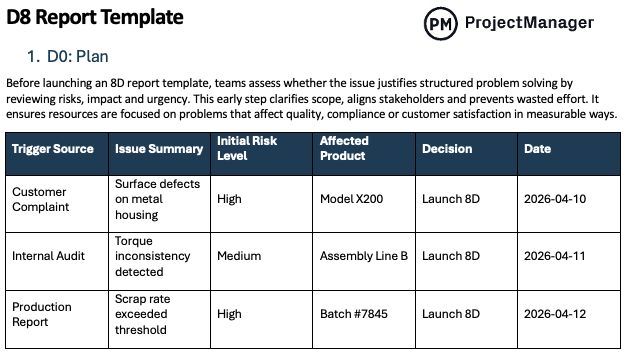
D0: Plan
Start by determining whether the issue requires a formal 8D report template by reviewing its impact, urgency and associated risks. Use this step to define scope, confirm stakeholder alignment and justify resource allocation. Only proceed when the problem affects quality, compliance or customer satisfaction in a measurable and significant way.
D1: Form the Team
Select a cross-functional team with the authority and expertise needed to resolve the issue. Include representatives from quality, operations and engineering to ensure well-rounded input. Clearly assign roles and designate a team leader to maintain accountability, streamline communication and keep corrective actions moving according to defined timelines.
D2: Define the Problem
Document the problem by clearly stating what is happening, where it occurs, when it started and how often it appears. Support your description with measurable data such as defect rates or incident frequency. A precise problem statement ensures the team focuses on the actual issue rather than symptoms or assumptions.
D3: Interim Containment Actions
Implement immediate actions to control the problem and protect customers or downstream operations. These measures may include isolating affected products, adding inspections or adjusting workflows. Focus on stabilizing the situation quickly while allowing time for proper root cause analysis and development of permanent solutions.
D4: Identify Root Cause
Analyze the problem using structured methods such as the 5 Whys or fishbone diagrams to identify the true root cause. Determine not only why the issue occurred but also why it was not detected earlier. Base conclusions on evidence to ensure corrective actions address the underlying failure.
D5: Choose Corrective Actions
Evaluate potential solutions and select corrective actions that directly eliminate the identified root cause. Consider feasibility, effectiveness and potential risks before deciding. The chosen action should resolve the issue at its source, ensuring the problem does not reappear once changes are implemented.
D6: Implement and Validate
Execute the selected corrective actions by assigning responsibilities, setting timelines and allocating necessary resources. After implementation, validate the results using measurable data to confirm effectiveness. Ensure the solution performs consistently under real operating conditions before considering the issue resolved.
D7: Prevent Recurrence
Update procedures, training materials and control systems to prevent the issue from occurring again. Apply lessons learned to similar processes or products where applicable. Strengthening these controls ensures improvements are sustained and reduces the likelihood of the same problem appearing in the future.
D8: Closure and Recognition
Finalize the 8D report template by documenting results, confirming all actions were completed and obtaining formal approval. Review outcomes to ensure the issue is fully resolved. Acknowledge team contributions to reinforce accountability and support a culture of continuous improvement across the organization.
How ProjectManager Helps Manufacturing Businesses
Keeping production on schedule while managing resources, costs and changing priorities requires more than spreadsheets or disconnected tools. Manufacturing project management becomes easier when teams can plan, track and adjust work in one centralized system. ProjectManager brings together production scheduling, resource planning and performance tracking so production teams can stay aligned and make faster decisions on the shop floor.
With interactive Gantt charts, manufacturing teams can build detailed production schedules, map task dependencies, identify milestones and adjust timelines as conditions change. Resource management tools allow managers to assign labor, equipment and materials efficiently, while monitoring resource availability and avoiding bottlenecks. Real-time dashboards and reports provide instant visibility into progress, costs and workload, helping teams identify issues early and maintain control over production performance.
Teams can also collaborate more effectively using kanban boards and task lists that track work at every stage of the manufacturing process. Thanks to these and other tools and features, ProjectManager helps manufacturing businesses improve efficiency, reduce delays and deliver consistent results. Watch the video below to learn more!
Free Related Manufacturing Templates
We’ve created dozens of free manufacturing templates for Excel, Word and Google Sheets. Here are some of them.
Asset Register Template
Track equipment details, ownership, location and financial data in one centralized sheet. This template helps manage assets, monitor depreciation and maintain accurate records for operational control and reporting.
Material Requisition Form
Request and track materials with item details, quantities, delivery dates and supplier information. This form streamlines procurement, ensures timely delivery and improves coordination between project and inventory teams.
Maintenance Schedule Template
Plan and monitor equipment maintenance with schedules, conditions and assigned responsibilities. This template helps prevent breakdowns, track service history and ensure maintenance tasks are completed on time.
ProjectManager is award-winning software for managing any project. Our collaborative platform connects your teams and gives you access to the manufacturing floor no matter where you are or what time it is. Get started with ProjectManager today for free.