



If you can’t track time properly, you’re losing money. It’s that simple. Yet for most project management professionals, tracking billable hours and reconciling financial data remains one of the most time-consuming, error-prone parts of the job, not because they lack discipline, but because the tools they rely on weren’t built to talk to each other.
To better understand how teams are navigating this challenge, ProjectManager surveyed 142 project management professionals about how they reconcile project and financial data, with a specific focus on time tracking and billable hours. What we found paints a clear picture of an industry in transition.
Noteworthy Survey Findings from the Financial Management Survey
Today’s project managers can no longer solely focus on bringing projects in on time and on budget. As organizations demand greater accountability, project managers are increasingly expected to be financially fluent, not just operationally sharp. Projects shouldn’t just finish on schedule; they should produce measurable value for the company and its stakeholders.
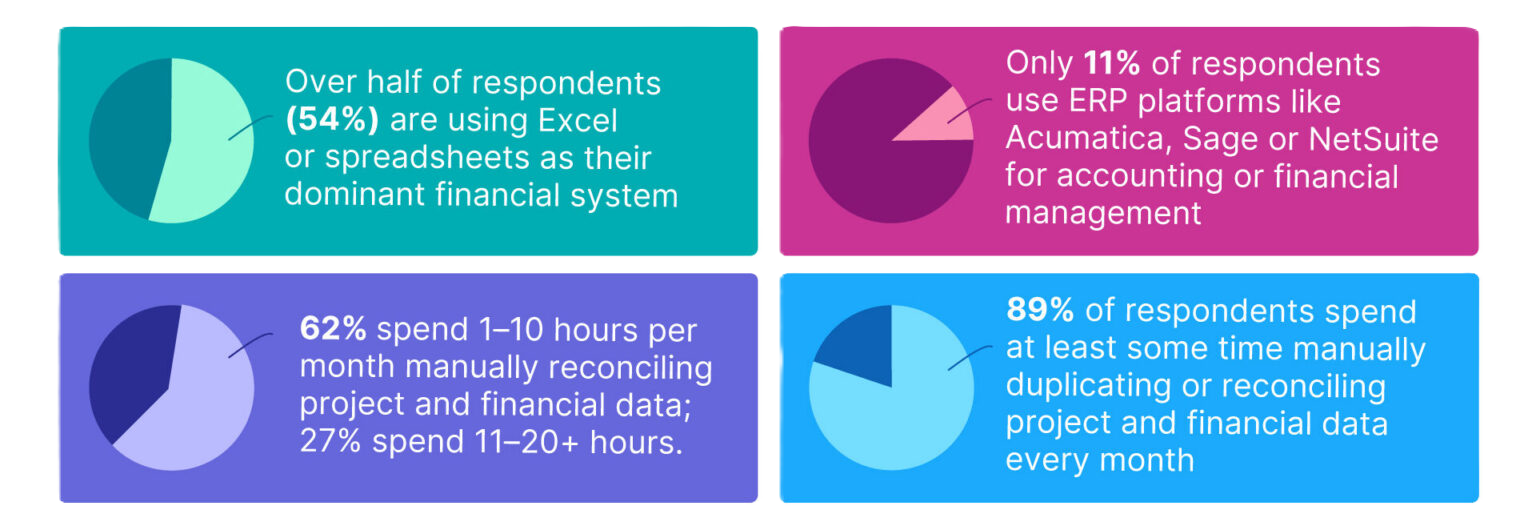
However, most teams aren’t set up to do that efficiently. Over half of respondents (54%) are still relying on Excel or spreadsheets as their dominant financial system and 89% spend at least some time every month manually duplicating or reconciling project and financial data. More than a quarter of those respondents spend over 10 hours a month on that work alone.
The result is delayed reporting, financial blind spots and an operational cost that compounds quietly in the background, one manual entry at a time.
Biggest Issues in Project Financial Management Processes
Manual data reconciliation continues to be a widespread challenge. Nearly nine in 10 respondents (89%) reported spending time each month duplicating or reconciling project and financial information across systems. More than one-quarter (27%) spend over 10 hours per month on these activities, highlighting the operational cost of disconnected project management and accounting tools.
When asked to name the single biggest problem with their current process, delayed reporting and lack of visibility topped the list, cited by 35 respondents. Financial errors and reconciliation issues and high operational costs from manual effort tied for second, each flagged by 29 respondents. Audit and compliance risk concerned 14 respondents, while 12 said they avoid syncing systems altogether because the process is too complex.
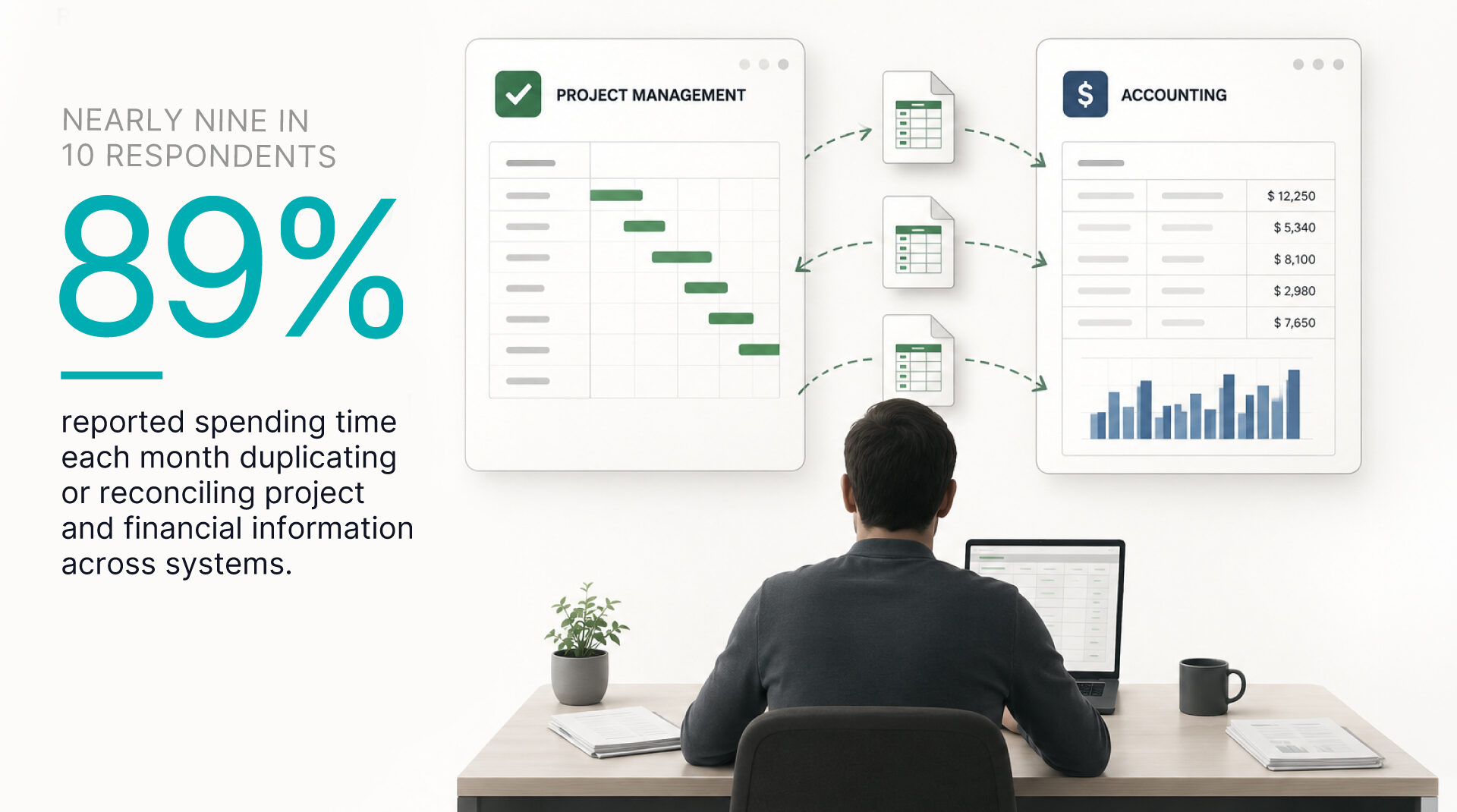
Together, these findings reinforce a clear pattern: disconnected tools don’t just create extra work, they create blind spots. When project and financial data live in separate systems, teams can’t see what’s happening in real time, mistakes slip through the cracks and the cost of keeping everything aligned falls on the people doing the work manually.
“It’s not only about having a financial plan, but having systems in place where things are tracked, added to and approved,” says Jennifer Bridges, PMP.
Top Priorities in Project Financial Management
We asked respondents which data connections would be most valuable in a project management integration. The most desired integrations are project-job data and budget vs. actual visibility.
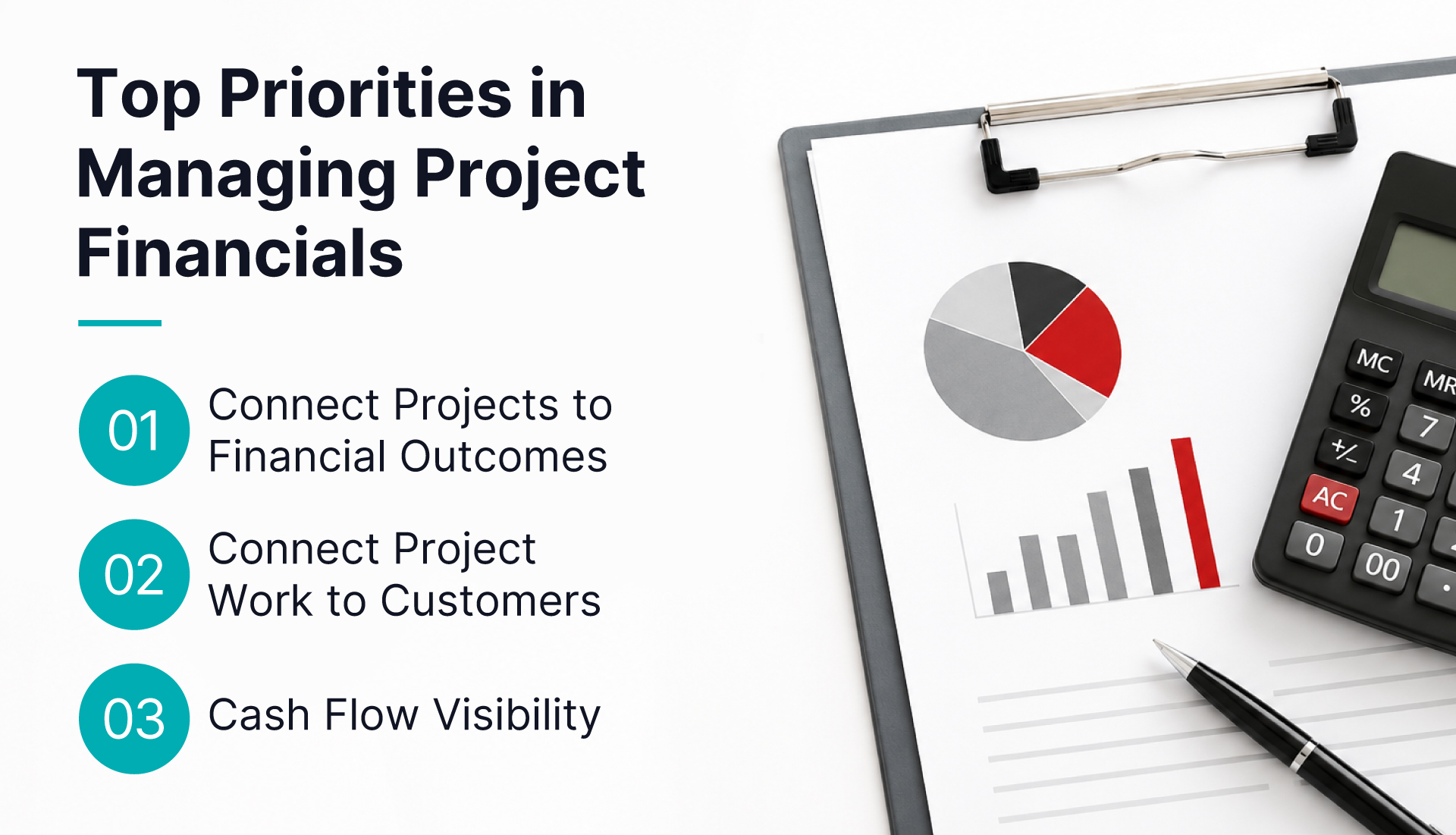
Priority 1: Connect Projects to Financial Outcomes
Most respondents gave a strong signal that people don’t simply want accounting data inside their project management software. Instead, they want to determine which projects are profitable, how much has been spent against budget, which projects are falling behind financially and the financial impact of each project.
Respondents aren’t simply looking to move information between systems; they want to understand how project performance affects financial performance.
For many organizations, project information lives in one system while budgets, costs and revenue reside in another. This separation makes it difficult to answer critical business questions such as:
- Is this project on budget?
- How much has been spent compared to what was planned?
- Which projects are generating the highest margins?
- Where are cost overruns occurring?
- How will project delays impact profitability?
Without integrated data, answering these questions often requires manual reporting, spreadsheet exports and time-consuming reconciliation efforts.
Priority 2: Connect Project Work to Customers
The fact that customers/clients (74 responses) ranked among the most valuable data connections suggests organizations want to bridge the gap between project delivery and customer management.
Traditionally, project management systems focus on work, while accounting systems focus on transactions. When customer data is disconnected, teams struggle to answer basic questions such as:
Which projects belong to which customers?
- What work is currently underway for a specific client?
- How much revenue has a customer generated across projects?
- Which customers are the most profitable?
- Are there unpaid invoices associated with active projects?
By integrating customer records with project data, organizations can gain a more complete view of client relationships. Project managers can better understand customer commitments, finance teams can connect billing activity to project progress and leadership can evaluate customer profitability at a portfolio level.
The result isn’t simply operational efficiency. It creates one source of truth that helps organizations make more informed decisions about resource allocation, customer retention and future business opportunities.
Priority 3: Cash Flow Visibility
One of the more revealing findings is that respondents rated payments & invoice status (74 responses) and expenses (63 responses) higher than invoices (50 responses).
This highlights an important distinction between accounting processes and business visibility.
Many organizations already have systems for creating invoices, but they often lack visibility into the financial health of projects after invoices are sent.
Respondents appear to be asking questions such as:
- Has the customer paid yet?
- How much outstanding revenue is tied to this project?
- Are project expenses growing faster than expected?
- Will this project remain profitable?
- Are we likely to exceed the budget before completion?
In other words, they want insight into financial outcomes rather than tools for completing accounting tasks. This data shows that organizations increasingly view project management and financial management as interconnected disciplines. Rather than simply synchronizing records between systems, they want real-time visibility into project financial performance, cash flow and profitability.
What Comes Next for Project Financial Reconciliation?
Teams cannot simply continue to rely on outdated and unreliable methods of tracking project financials. There’s too much at stake, and too much money on the line. So where do we go from here?
If teams continue to do nothing and work using Excel and manual imports, only more money is lost. On the other hand, they can pay for an expensive ERP set up and endure a lengthy roll out.
However, there’s another option. Sign up a free trial of ProjectManager, a powerful tool with a native QuickBooks Online integration. This integration automatically syncs approved hours and actual task costs, helping your team spend less time entering data and more time managing profitable projects. It’s a way to keep prices low with reliable data.

As Justin Smith, Director at Construc, said “We could start tracking our projects and making more accurate quotes. It was fantastic.”
Whether you already use ProjectManager, or you’re looking for a project management platform that connects the work your team does with the accounting system your business runs on, this integration helps bring project and financial data together. Explore our homepage or read more information on our QuickBooks Online integration.
