



You identify them, record them, monitor them and plan for them: risks are an inherent part of every project. Some project risks are bound to become problem areas—like executing a project over the holidays and having to plan the project timeline around them. But there are many risks within any given project that, without risk assessment and risk mitigation strategies, can come as unwelcome surprises to you and your project management team.
That’s where a risk management plan comes in—to help mitigate risks before they become problems. But first, what is project risk management?
What Is a Risk Management Plan?
A risk management plan defines how the project’s risk management process will be executed. That includes the budget, tools and approaches that will be used to perform risk identification, assessment, mitigation and monitoring activities.
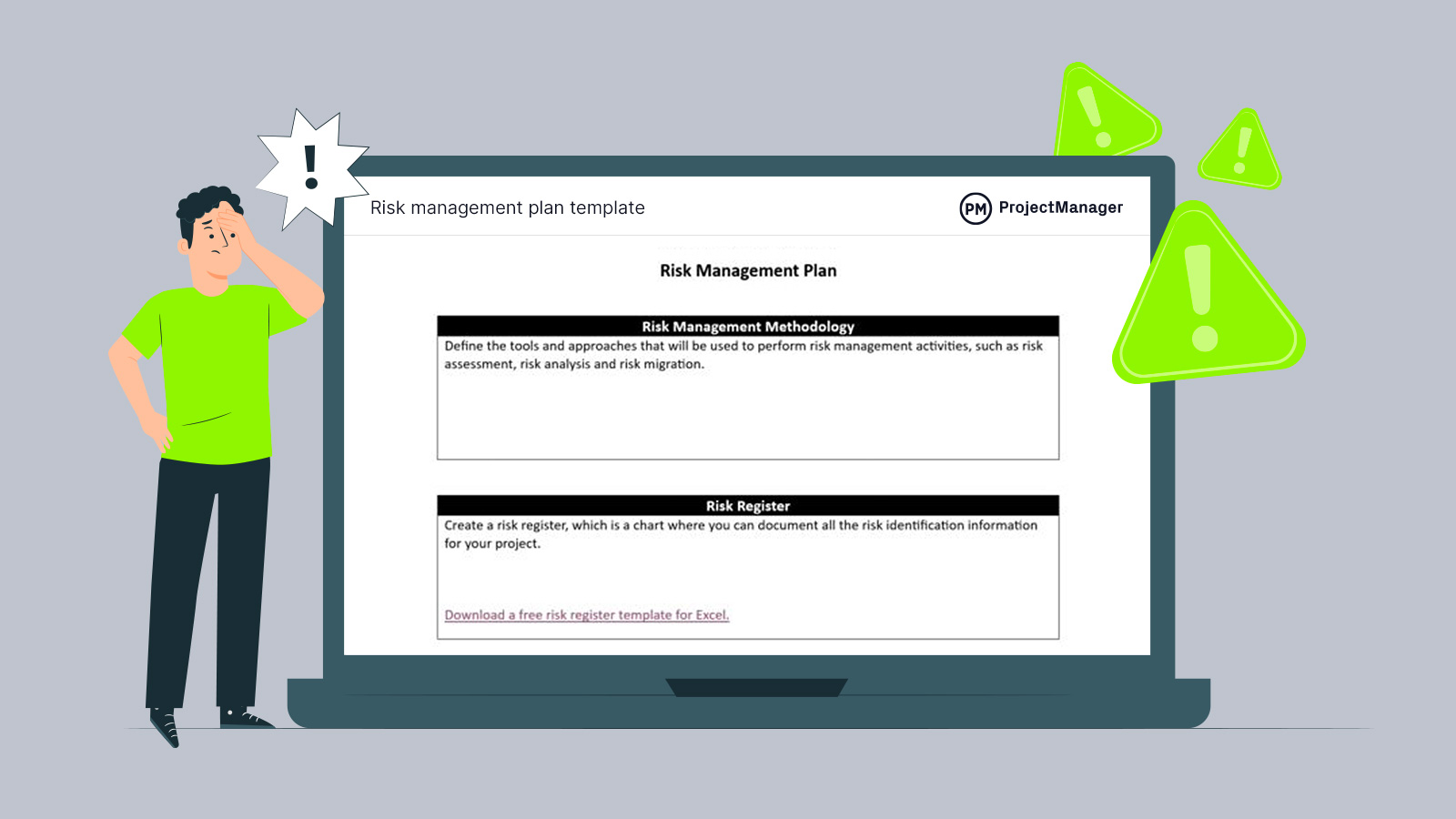
Get your free
Risk Management Plan Template
Use this free Risk Management Plan Template to manage your projects better.
Get the template
A risk management plan describes all the activities that will be taken throughout the process of managing project risks. Project risk management activities can be grouped into the following categories:
- Risk Planning: Before risks can be managed, the overall approach must be defined. The risk management plan establishes the methodologies, roles, responsibilities, budget allocation and timing for all risk management activities throughout the project life cycle.
- Risk Identification: The first step to managing project risks is to identify them. The risk management plan explains the tools and data sources, such as information from past projects or subject matter experts’ opinions to estimate all the potential risks that can impact the project.
- Risk Assessment: Once the project risks are identified, they need to be prioritized by looking at their likelihood and level of impact. In most cases, the risk management plan includes a risk assessment matrix to do so.
- Risk Mitigation: Now it’s time to create a contingency plan with risk mitigation actions to manage your project risks. You also need to define which team members will be risk owners, responsible for monitoring and controlling risks.
- Risk Control: Once risk mitigation responses are in place, they must be actively controlled. The risk management plan describes how risk responses will be executed, evaluated for effectiveness and adjusted as project conditions or risk exposure change.
- Risk Monitoring: Risks must be monitored throughout the project life cycle so that they can be controlled. The risk management plan describes the procedures, tools and techniques to monitor the occurrence and mitigation of project risks.
- Risk Ownership: To ensure accountability, risks must be assigned to specific team members. The risk management plan defines risk owners and outlines their responsibilities for tracking, monitoring and implementing approved risk response actions.
- Risk Reporting: Risk information must be shared clearly and consistently with stakeholders. The risk management plan describes how risks will be reported, escalated and communicated to support timely awareness and informed decision-making.
Even one risk can jeopardize the entire project plan. There isn’t usually just one risk per project, either; there are many risk categories that require assessment and discussion with stakeholders. That’s why risk management needs to be both a proactive and reactive process that is constant throughout the project life cycle.
Manage Risks and Projects Online with ProjectManager
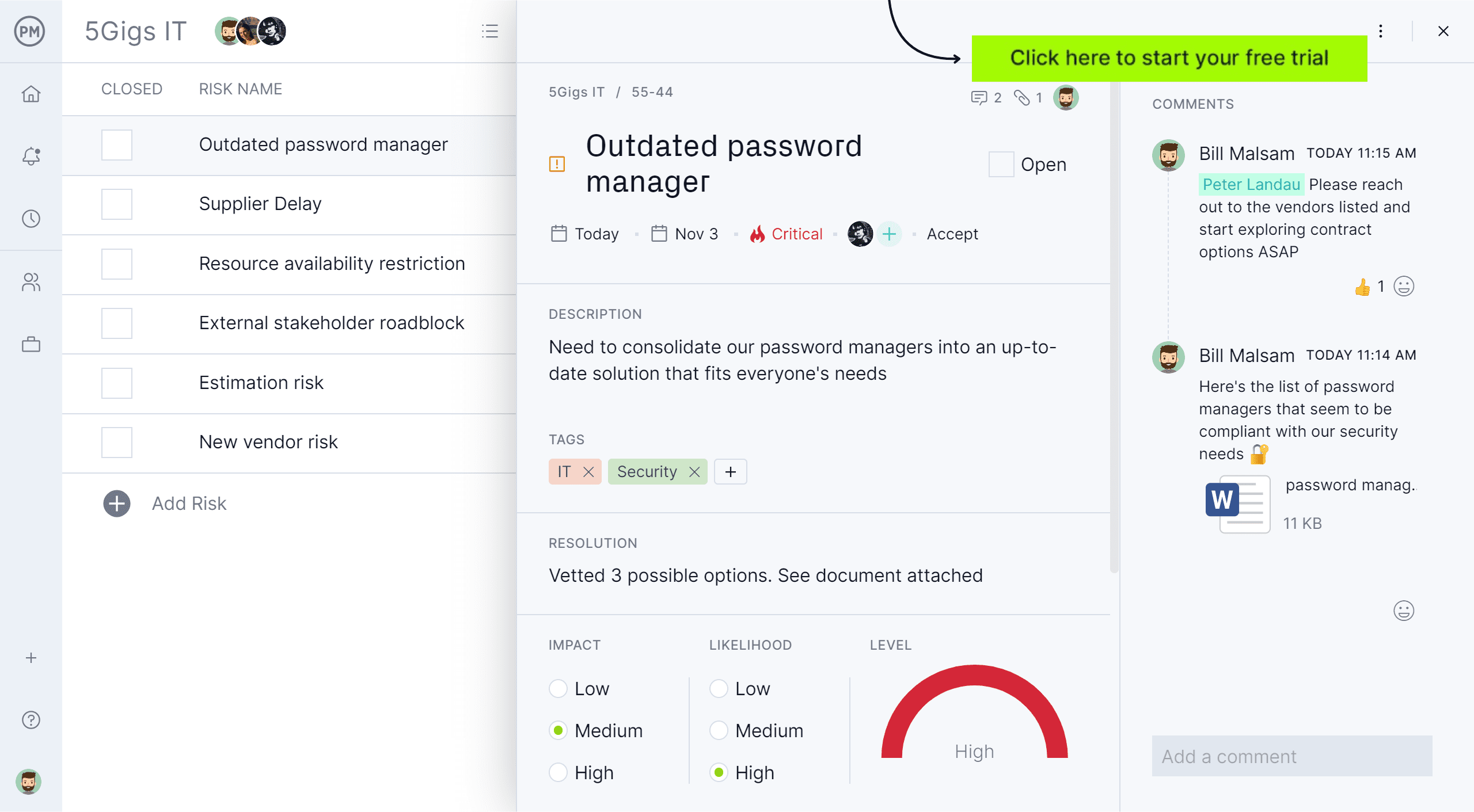
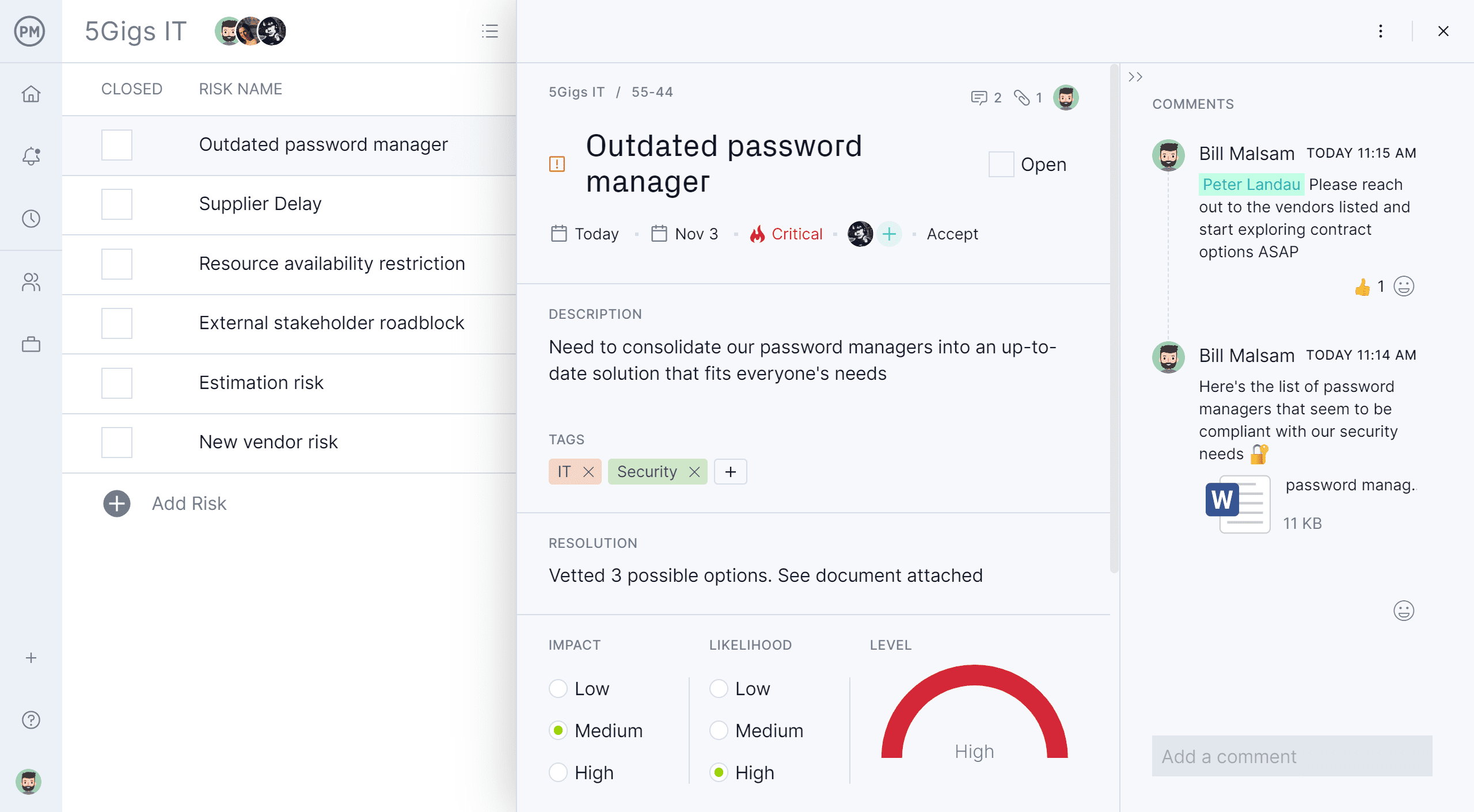
For example, it’s easy to create a risk register using online project management software. Use the risk list view on ProjectManager to capture all project risks, add their priority level and assign a team member to identify and resolve them. Then manage those risks alongside detailed project plans with in-depth data.
- Manage projects in five different views: Gantt, sheet, list, kanban and calendar
- Track and report on tasks and risks with dashboards
- Give stakeholders first-hand access to data and progress with free guest licenses. Try it free
What Is the Purpose of a Risk Management Plan?
The purpose of a risk management plan in project management is to define how risks will be systematically identified, analyzed, prioritized, responded to and monitored throughout the project lifecycle.
It establishes a consistent approach to managing uncertainty, protects project objectives related to scope, schedule, cost and quality, and supports informed decision-making by clarifying risk ownership, thresholds and response strategies. While its primary role is project-focused, it can also support broader organizational risk awareness when projects operate in complex or regulated environments.
When to Use a Risk Management Plan
A risk management plan originated in project management, where it formalizes how risks are identified, analyzed, prioritized and addressed to protect project objectives. Over time, its structured, repeatable approach proved valuable beyond projects.
Today, organizations use risk management plans whenever uncertainty must be managed deliberately, including operations, construction, IT, finance and compliance.
- Project risk management plan: Defines how project-specific risks are identified, assessed and managed to protect scope, schedule, cost and quality objectives throughout the project lifecycle.
- Business risk management plan: Addresses operational and strategic risks affecting ongoing business activities, focusing on continuity, process stability, compliance and performance rather than time-bound deliverables.
- Enterprise risk management plan: Provides an organization-wide framework to identify, assess and govern risks aligned with strategic objectives, risk appetite and executive-level decision-making.
- Financial risk management plan: Focuses on identifying and mitigating risks related to budgets, cash flow, funding, pricing and financial exposure that could impact organizational or project viability.
- IT risk management plan: Manages risks related to information systems, cybersecurity, data integrity and system availability, emphasizing controls, incident response and technology resilience.
In these contexts, the plan provides a consistent framework for anticipating threats, evaluating exposure, defining response strategies and monitoring risk over time, even when no project timeline exists.
Free Risk Management Plan Template
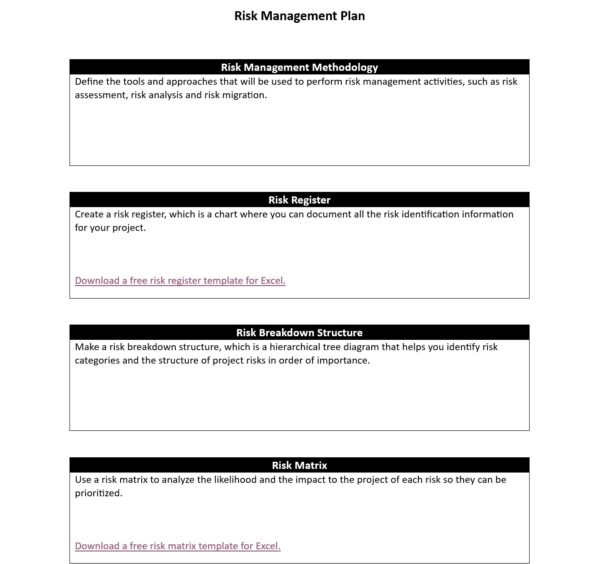
This free risk management plan template will help prepare your team for any risks inherent in the project. This Word document includes sections for your risk management methodology, risk register, risk breakdown structure and more. It’s so thorough, you’re sure to be ready for whatever comes your way. Download the template today.
What Should Be Included in a Risk Management Plan?
Making a risk management plan is essential for identifying, analyzing and responding to risks that could affect a project’s success. For a risk management plan to be effective, it should include certain key components. A risk management plan usually includes the following sections.
Risk Management Methodology
A risk management methodology defines the structured approach a project uses to identify, analyze, respond to and monitor risks. It establishes the tools, techniques and data sources used to evaluate uncertainty, assess probability and impact, and determine appropriate responses.
In a risk management plan, the risk management methodology section explains how risk activities will be performed on the project. It documents the tools, techniques and documentation to be used for risk identification, analysis and prioritization so stakeholders understand how risks are managed. This section ensures risk management is repeatable, aligned with organizational standards and applied consistently throughout the project life cycle execution.
Risk Identification Techniques
Risk identification techniques are systematic methods used to recognize potential problems, uncertainties, or threats that could impact a project’s objectives. By proactively identifying risks, project teams can assess their likelihood and impact, prioritize responses and develop mitigation strategies. These techniques help ensure that risks are managed before they escalate, supporting smoother project execution and informed decision-making.
- Brainstorming: Collaborative sessions where team members generate a list of potential risks, encouraging diverse perspectives and creative thinking.
- Delphi Technique: Experts anonymously provide risk input in multiple rounds, refining ideas until consensus is reached, reducing bias from dominant voices.
- SWOT Analysis: Evaluates internal strengths and weaknesses and external opportunities and threats to identify areas of potential risk.
- Checklists: Uses predefined lists of common risks based on previous projects or industry standards to ensure nothing is overlooked.
- Root Cause Analysis: Investigates underlying causes of potential problems, identifying risks by understanding what could trigger failures or obstacles.
Risk Scoring and Prioritization Tools
Risk scoring assigns numerical or qualitative values to identified risks based on their probability of occurrence and potential impact. Risk prioritization then ranks these risks to determine which require the most immediate attention and resources. In a PMI-aligned risk management plan, scoring and prioritization are critical for focusing mitigation and response strategies on high-priority risks.
By systematically evaluating each risk, project teams can allocate resources efficiently, monitor critical threats and integrate response actions into project schedules, budgets and decision-making, ensuring alignment with PMBOK principles for proactive and structured risk management.
ProjectManager makes it seamless to understand risks and how they can impact your project. Our built-in risk management features enable you to identify risks, set a priority, assign an owner and more. Use it to take action to keep your projects on track. Get started by taking a free 30-day trial, no credit card required.

Organizational Risk Tolerance or Risk Appetite
Organizational risk tolerance, or risk appetite, defines the level and type of risk an organization is willing to accept in pursuit of its objectives. In a risk management plan, understanding this threshold guides decision-making, prioritizes risk responses and ensures that mitigation strategies align with the organization’s strategic goals, helping project teams manage uncertainties without exceeding acceptable risk levels.
- Risk acceptance criteria: Define when a risk can be accepted without further mitigation, ensuring decisions stay within organizational tolerance, align with project objectives and are formally documented.
- Risk exposure thresholds: Set the maximum impact or likelihood a risk can reach before action is required, helping teams prioritize responses, allocate resources effectively and stay aligned with risk appetite.
Risk Reporting Guidelines and Documentation
Risk reporting is the systematic process of communicating identified risks, their status, potential impact and mitigation measures to project stakeholders. Within a risk management plan, risk reporting ensures transparency, enables informed decision-making, supports proactive risk response and tracks the effectiveness of mitigation strategies throughout the project lifecycle, keeping stakeholders aligned and facilitating timely escalation of critical issues.
Popular risk reporting documents include:
- Risk Register: A centralized document listing all identified risks, their probability, impact, mitigation strategies and ownership, updated throughout the project to track risk status.
- Issue Log: Tracks current problems affecting the project, linking them to identified risks, documenting resolutions and ensuring accountability and timely corrective action.
- RAID Log: Captures Risks, Assumptions, Issues and Dependencies, providing a holistic view of project uncertainties and facilitating structured reporting and management.
- Risk Heat Map: Visual representation of risks by probability and impact, helping stakeholders quickly identify high-priority risks requiring attention.
- Risk Status Report: Periodic report summarizing active risks, progress on mitigation actions, changes in risk exposure and emerging threats to keep stakeholders informed.
Related: 12 Free Risk Management Templates for Excel & Word
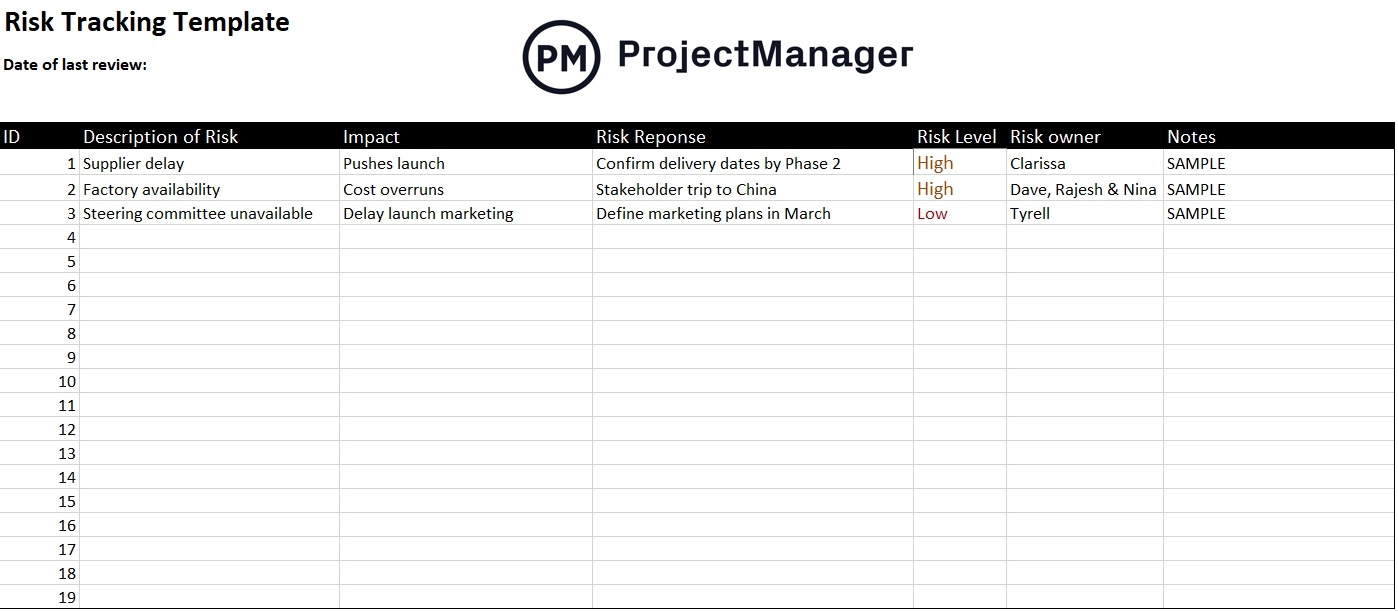
Risk Register
A risk register is a chart to document the risk identification information. It serves as a centralized repository that captures and tracks all identified risks throughout the project life cycle. This provides a comprehensive overview, systematic tracking, prioritization of critical risks, stakeholder engagement and more.
Risk Response Plan
A risk response plan is a project management document that explains the risk mitigation strategies that will be employed. Its purpose is to proactively manage uncertainties, reduce potential impacts on project goals, and ensure preparedness. By assigning responsibilities, defining timelines, and outlining procedures, the plan provides a clear, structured approach to maintaining control and keeping the project on track.
This plan enables project teams to anticipate and address potential issues before they escalate, reducing delays, cost overruns, and quality problems. It ensures that risks are managed systematically rather than reactively, improves decision-making, aligns stakeholder expectations, and provides a documented framework for accountability. Ultimately, it helps protect project objectives and supports smoother, more predictable project execution.
- Risk mitigation strategies: Proactive actions designed to reduce the likelihood or impact of identified risks. In a risk management plan, these strategies help minimize disruptions, protect project objectives, guide resource allocation, support contingency planning and provide structured responses to uncertainty before risks escalate.
- Risk management roles and responsibilities: Define who identifies, owns, monitors and responds to risks throughout the project. Clearly assigned responsibilities—from the project manager and risk owners to stakeholders and support teams—ensure accountability, consistent risk oversight and effective execution of risk response actions.
Risk Management Budget
Have a section to identify the funds required to perform risk management activities. This financial plan will allocate resources specifically for identifying, assessing and managing risks within a project. The budget ensures there’s enough funding available to implement risk management strategies and mitigate negative impacts on project objectives.
Risk Breakdown Structure
This is a chart that identifies risk categories and the hierarchical structure of project risks. It provides a structured risk identification, which makes it easier to analyze and manage risks. The risk breakdown structure also provides clear definitions and descriptions of risks at various levels, which helps the team to understand the nature and source of each risk. Risks can be prioritized more effectively, too.
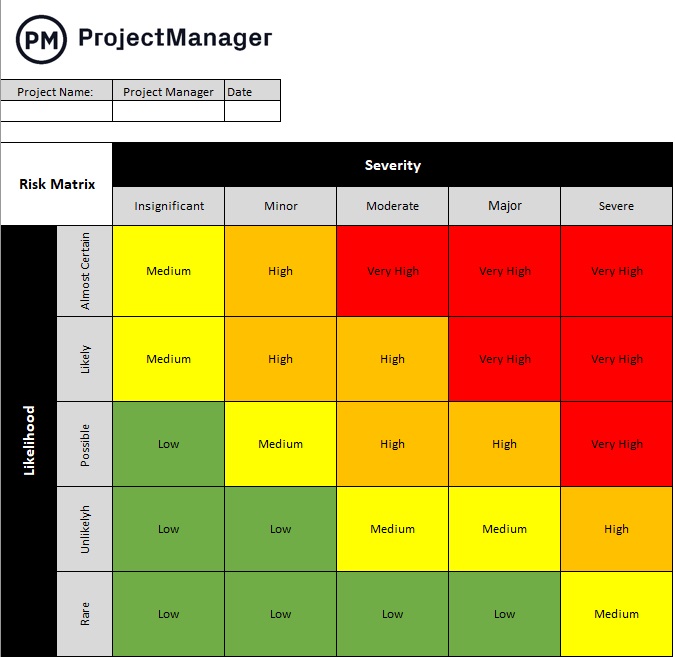
Risk Assessment Matrix
A risk assessment matrix allows teams to analyze the likelihood and the impact of project risks so they can prioritize them.
Using a risk assessment matrix provides a visual representation of the relationship between the likelihood of risks occurring and their potential impact. It helps teams to focus on critical risks by categorizing them into different levels. The risk assessment matrix also facilitates communication to ensure everyone is aligned on risk prioritization.
How to Write a Risk Management Plan
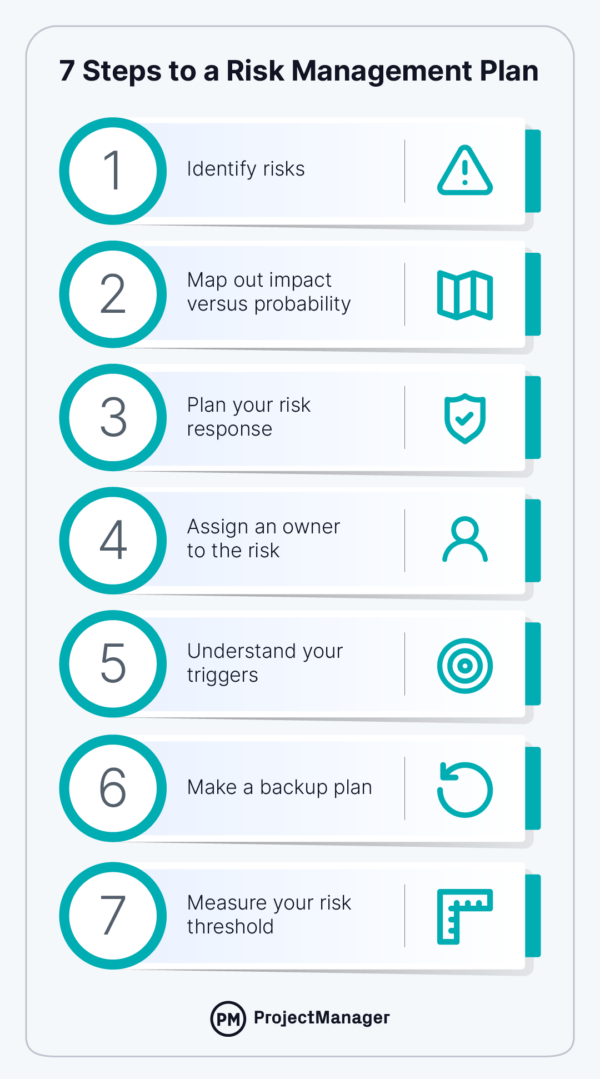
For every web design and development project, construction project or product design, there will be risks. That’s the nature of project management. But that’s also why it’s always best to get ahead of them as much as possible by developing a risk management plan. We’ve outlined the steps to make a risk management plan below.
1. Risk Planning
You can’t create a risk management plan without understanding the overall risk planning approach. In other words, what methodologies, roles, responsibilities, budget allocation and timing will be used throughout the project life cycle? This information will set the foundation for the plan itself.
2. Risk Identification
Risk identification occurs at the beginning of the project planning phase, as well as throughout the project life cycle. While many risks are considered “known risks,” others might require additional research.
Create a risk breakdown structure to identify project risks and classify them into risk categories. You can do this by interviewing all project stakeholders and industry experts. Many project risks can be divided into risk categories, like technical or organizational, and listed out by specific sub-categories like technology, interfaces, performance, logistics, budget, etc. Additionally, create a risk register to share with everyone interviewed for a centralized location of all known risks revealed during the identification phase.
3. Risk Assessment
In this next phase, review the qualitative and quantitative impact of the risk—like the likelihood of the risk occurring versus the impact it would have on the project—and map that out into a risk assessment matrix
First, you’ll do this by assigning the risk likelihood a score from low probability to high probability. Then, map out the risk impact from low to medium to high and assign each a score. This provides an idea of how likely the risk is to impact project success as well as how urgent the response will need to be.
To make it efficient for all risk management team members and project stakeholders to understand the risk assessment matrix, assign an overall risk score by multiplying the impact level score by the risk probability score.
4. Risk Mitigation: Create a Risk Response Plan
A risk response is the action plan taken to mitigate project risks when they occur. The risk response plan includes risk mitigation strategies to mitigate the impact of project risks. Doing this usually comes with a price—at the expense of your time or your budget. So you’ll want to allocate resources, time and money for your risk management needs before creating the risk management plan.
5. Control & Monitor the Risk
As soon as the risk mitigation response has been established, it’s time to actively control any risks. In other words, how will the responses be executed, evaluated for effectiveness and altered as project conditions or risk exposure change?
6. Assign Risk Owners
Next, assign a risk owner to each project risk. Those risk owners become accountable for monitoring the risks assigned to them and supervising the execution of the risk response if needed.
Related: Risk Tracking Template
When creating the risk register and risk assessment matrix, list out the risk owners; that way, no one is confused as to who will need to implement the risk response strategies once the project risks occur, and each risk owner can take immediate action.
Be sure to record the exact risk response for each project risk with a risk register and have the risk response plan approved by all stakeholders before implementation. That way, there’s a record of the issue and the resolution to review once the project is finalized.
7. Understand Your Triggers
This can happen with or without a risk already having impacted the project, especially during project milestones as a means of reviewing project progress. If they have, consider reclassifying those existing risks.
Even if those triggers haven’t been met, it’s best to come up with a backup plan as the project progresses—maybe the conditions for a certain risk won’t exist after a certain point has been reached in the project.
8. Make a Backup Plan
Consider your risk register and risk assessment matrix a living document. Project risks can change in classification at any point, and because of that, come up with a contingency plan as part of the process.
Contingency planning includes discovering new risks during project milestones and reevaluating existing risks to see if any conditions for those risks have been met. Any reclassification of a risk means adjusting your contingency plan.
9. Measure Your Risk Threshold
Measuring your risk threshold is all about discovering which risk is too high and consulting with project stakeholders to consider whether or not it’s worth it to continue the project, worth it whether in time, money or scope.
Here’s how the risk threshold is typically determined: consider your risks that have a score of “very high”, or more than a few “high” scores, and consult with your leadership team and project stakeholders to determine if the project itself may be at risk of failure. Project risks that require additional consultation are risks that have passed the risk threshold.
To keep a close eye on risks as they arise in the project, use project management software. ProjectManager has real-time dashboards embedded in our tool, unlike other software that requires teams to manually build them. We automatically calculate the health of projects, checking if teams are on time or running behind. Get a high-level view of how much you’re spending, progress and more. The quicker the risk is identified, the faster you can resolve it.

10. Keep Stakeholders Informed
Stakeholders should always be aware of how risks are progressing and being handled throughout the project. The plan should note how risks are reported, escalated and communicated as needed.
Risk Management Plan Example
This risk management plan defines the approach used to identify, analyze, prioritize and manage risks for a multi-story residential parking garage construction project. The plan establishes consistent methods and thresholds to support proactive decision-making throughout the project lifecycle.
Risk Management Methodology
The risk management methodology defines how risks will be identified, assessed, prioritized and monitored throughout the project. It establishes a structured, repeatable process to ensure risks are managed consistently and aligned with project objectives related to safety, schedule, cost and quality.
| Methodology Step | Description | Tools and Techniques | Responsible Party |
| Risk identification | Systematically identify potential project risks | Workshops, checklists, site reviews | Project manager |
| Qualitative analysis | Assess likelihood and impact of identified risks | Probability–impact matrix | Project team |
| Risk prioritization | Rank risks based on exposure | Risk scoring model | Project manager |
| Risk monitoring | Track risks and response effectiveness | Risk register updates, reviews | Project manager |
Risk Identification Techniques
Risk identification techniques are used to proactively uncover potential threats that may impact project objectives. These techniques draw on historical data, expert judgment and field-level observations to ensure comprehensive coverage.
| Technique | Description | Application | Participants |
| Risk workshops | Facilitated sessions to identify risks collaboratively | Planning and early execution | Project team, subcontractors |
| Historical data review | Analyze risks from similar past projects | Preconstruction phase | Project manager |
| Site inspections | Identify risks related to site conditions | Throughout construction | Site supervisor |
| Expert judgment | Input from engineers and specialists | Design and execution phases | Design consultants |
Risk Scoring and Prioritization
Risk scoring and prioritization evaluate identified risks based on their probability of occurrence and potential impact on project objectives. The resulting risk exposure score is used to rank risks and determine response priority.
| Risk ID | Risk Description | Probability | Impact | Risk Score | Priority Level |
| R-01 | Unexpected subsurface conditions | High | High | 9 | Critical |
| R-02 | Concrete supply delays | Medium | High | 6 | High |
| R-03 | Weather-related work stoppages | Medium | Medium | 4 | Moderate |
Organizational Risk Tolerance
Organizational risk tolerance defines the level of risk exposure the organization is willing to accept in pursuit of project objectives. These thresholds guide decision-making, escalation and the selection of risk response strategies.
| Risk Category | Risk Acceptance Criteria | Risk Exposure Threshold | Required Action | Escalation Authority |
| Safety | No tolerance for high-severity safety risks | Score ≥ 6 | Immediate mitigation required | Project sponsor |
| Schedule | Minor delays acceptable if recoverable | Score ≥ 5 | Mitigation and resequencing | Project manager |
| Cost | Cost increases limited to contingency | Score ≥ 5 | Management approval required | Finance lead |
| Quality | Rework acceptable within standards | Score ≥ 4 | Corrective action plan | Project manager |
Risk Register
The risk register serves as the central repository for all identified project risks. It documents risk descriptions, ownership, priority levels and current status, enabling ongoing monitoring and informed decision-making throughout the project lifecycle.
| Risk ID | Risk Description | Category | Risk Score | Risk Owner | Status |
| R-01 | Unexpected subsurface conditions | Technical | 9 | Project manager | Open |
| R-02 | Concrete supply delays | Supply chain | 6 | Procurement lead | Open |
| R-03 | Severe weather impacts on schedule | Environmental | 4 | Site supervisor | Monitoring |
| R-04 | Safety incidents during elevated work | Safety | 8 | Safety officer | Open |
Risk Response Plan
The risk response plan defines specific actions to address prioritized risks. Response strategies are selected based on organizational risk tolerance and are assigned to accountable roles responsible for implementation and monitoring.
| Risk ID | Risk Description | Risk Mitigation Strategy | Response Type | Roles and Responsibilities |
| R-01 | Unexpected subsurface conditions | Conduct early geotechnical surveys and include contingency plans | Mitigate | Project manager coordinates studies and approvals |
| R-02 | Concrete supply delays | Prequalify alternate suppliers and place early orders | Mitigate | Procurement lead manages supplier agreements |
| R-03 | Severe weather impacts | Build schedule buffers and resequence non-critical work | Accept | Site supervisor adjusts daily work plans |
| R-04 | Safety incidents during elevated work | Implement enhanced safety training and inspections | Avoid | Safety officer enforces compliance and reporting |
Risk Management Budget
The risk management budget allocates funds specifically for risk mitigation and contingency activities. This budget supports proactive risk responses and reduces the likelihood of unplanned cost impacts during execution.
| Budget Item | Purpose | Estimated Cost (USD) | Approval Authority |
| Geotechnical investigations | Reduce subsurface condition uncertainty | 25,000 | Project sponsor |
| Safety training and audits | Prevent high-severity safety incidents | 15,000 | Safety manager |
| Schedule contingency | Address weather-related delays | 20,000 | Project manager |
| Total | — | 60,000 | — |
How ProjectManager Can Help Your Risk Management Plan
A risk management plan is only as good as the risk management features you have to implement and track them. ProjectManager is online project management software that lets you view risks directly in the project menu. You can tag risks as open or closed and even make a risk matrix directly in the software. You get visibility into risks and can track them in real time, sharing and viewing the risk history.
Tracking & Monitoring Risks in Real Time
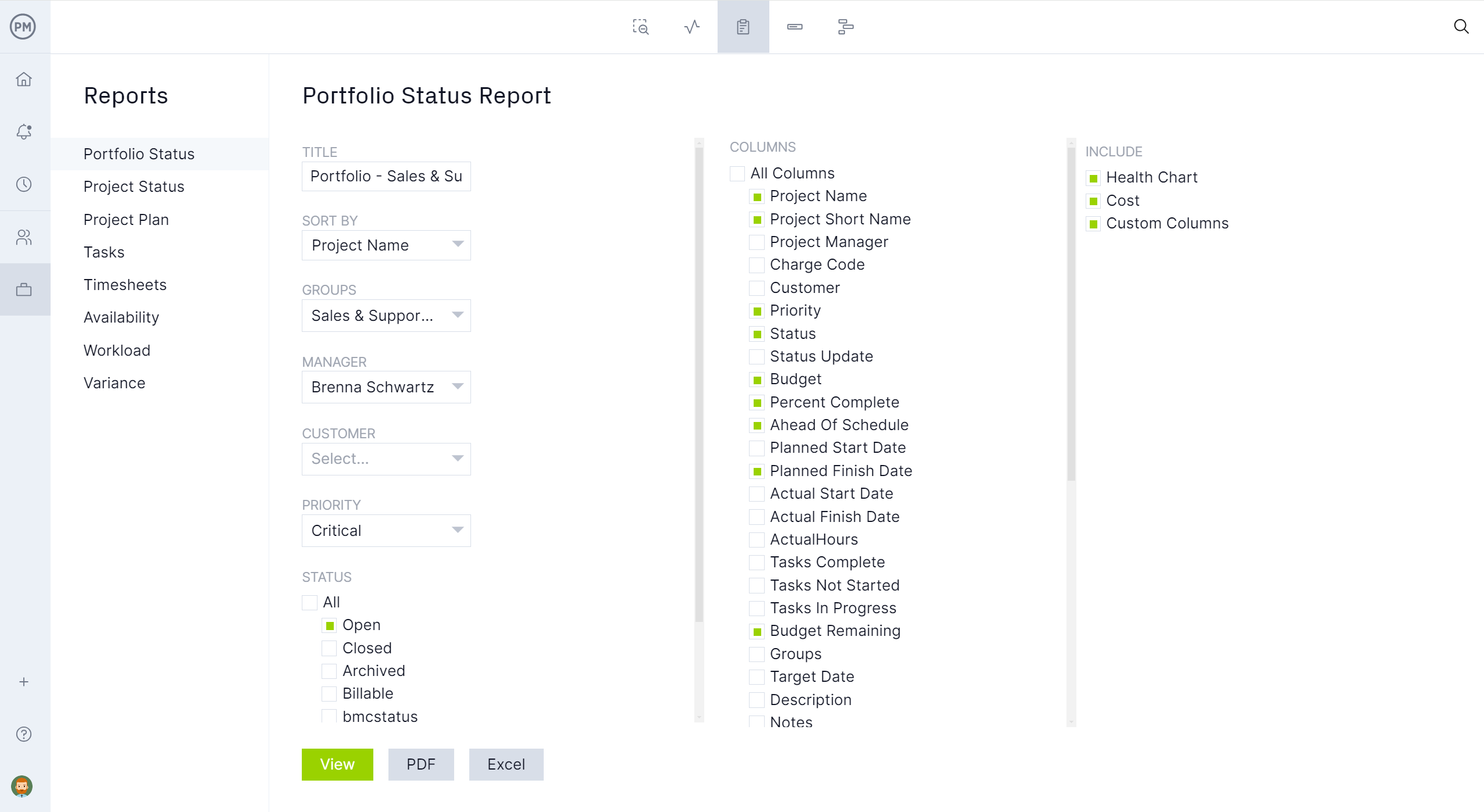
Managing risk is only the start. You must also monitor risk and track it from the point at which you first identified it. Real-time dashboards provide a high-level view of slippage, workload, cost and more. Customizable reports can be shared with stakeholders and filtered to show only what they need to see. Risk tracking has never been easier.
Best Practices for Maintaining Your Risk Management Plan
Risk management plans only fail in a few ways: incrementally because of insufficient budget, via modeling errors or by ignoring your risks outright.
Your risk management plan is constantly evolving throughout the project life cycle, from beginning to end. So the best practices are to focus on the monitoring phase of the risk management plan. Continue to evaluate and reevaluate your risks and their scores, and address risks at every project milestone.
Project dashboards and other risk-tracking features can be a lifesaver for maintaining your risk management plan. Watch the video below to see just how important project management dashboards, live data and project reports can be for keeping projects on track and budget.
In addition to routine risk monitoring, at each milestone, conduct another round of interviews with the same checklist you used at the beginning of the project, and re-interview project stakeholders, risk management team members, customers (if applicable) and industry experts.
Record their answers, adjust the risk register and risk assessment matrix if necessary, and report all relevant updates of your risk management plan to key project stakeholders. This process and level of transparency help identify any new risks to be assessed and show if any previous risks have expired.
Related Content
- Cómo hacer un plan de gestión de riesgos
- 12 Free Risk Management Templates for Excel & Word
- How to Make a Risk Assessment Report (Templates Included)
- A Quick Guide to Contractor Risk & Contractor Risk Management
Risks are bound to happen, no matter the project. However, if you have the right tools to better navigate the risk management planning process, you can better mitigate errors. ProjectManager is online project management software that updates in real time, giving you all the latest information on your risks, issues and changes. Start a free 30-day trial and start managing your risks better.
